Madagascar and India drift apart

Separation developed around 88 million years ago. Volcanic rock ages provide key evidence; the breakup did not happen in one day. After the split, around 72–66 million years ago, India’s Rajasaurus and Madagascar’s Majungasaurus were close dinosaur relatives, not the same species or direct ancestors. As India moved north, lemur ancestors are inferred to have arrived much later from Africa, roughly 60–50 million years ago. The date is uncertain and the proposed rafting route is unknown.
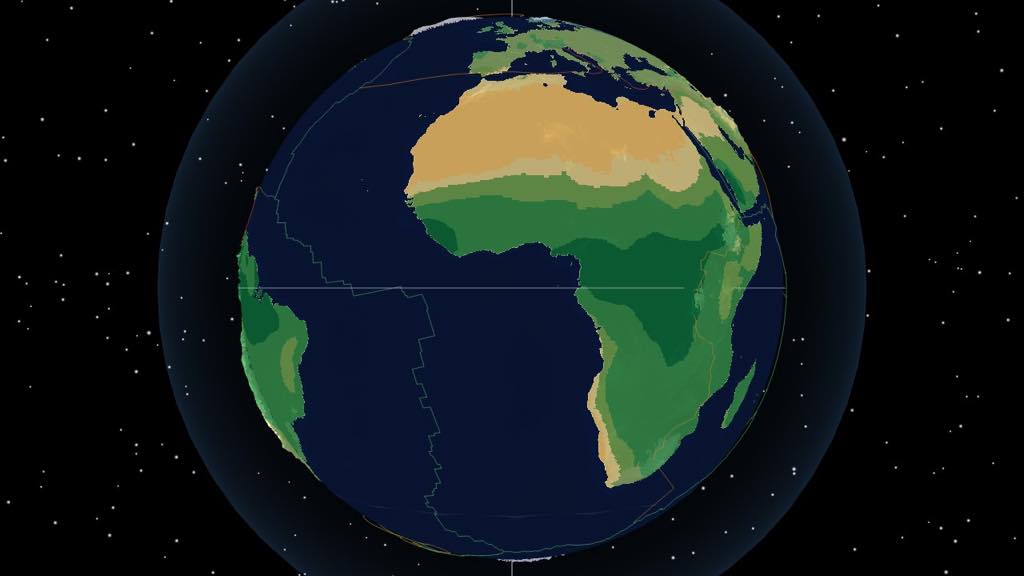
Loading Earth...
CO₂280ppm
Temp14.3°C
Sea0m
O₂21%

Annual surface temperature from CESM (T): a model estimate, not a direct observation of the past.

0 Ma: pre-industrial climate/CO₂; modern sea-level and O₂ references.

Data references
Sources & methods
🧑
Quaternary
Ice Ages and Humanity
▼

Glacial-interglacial cycles with 120m+ sea level swings. Homo sapiens spread from Africa across the globe, and most megafauna went extinct.

Key Life
🧑Homo sapiens🦣Mammoth🧔Neanderthals
Innovations
  • ›Language and culture
  • ›Agricultural revolution (~10,000 years ago)
  • ›Birth of civilization
Simplified Köppen
Af Rainforest
Am Monsoon
Aw Savanna
BW Desert
BS Steppe
Cf Temperate wet
Cs/Cw Temperate dry
Df Cold wet
Dw Cold dry
ET Tundra
EF Ice
CESM (Li et al. 2022)

Annual model means · 0 Ma: pre-industrial

🦴 Fossils—
Vertebrates
Invertebrates

Mapped sample / window records · not abundance
0–2.5 Ma

Loading

Map sources & limits

API records whose numeric ages miss the queried window are excluded from the map and counts, with exclusions retained in provenance.

Plate boundaries are a separate model comparison. Their reference frame differs from PALEOMAP terrain and coordinates; coastlines may not align.

· 0 Ma

Data & licenses ↗
Full exploration range1,800 Ma → Present
540 Ma → Present
Precambrian
Paleozoic
Mesozoic
Cenozoic
Cambrian
Ordovician
Devonian
Carbonif.
Permian
Triassic
Jurassic
Cretaceous
Paleogene
┆ Data transition · 540 Ma

Present