Organism · Molluscs
Actaeonella oviformis
Source time context (not species duration) · ≈ 143–66 Ma
Inferred life reconstruction
Actaeonella oviformis
Overview
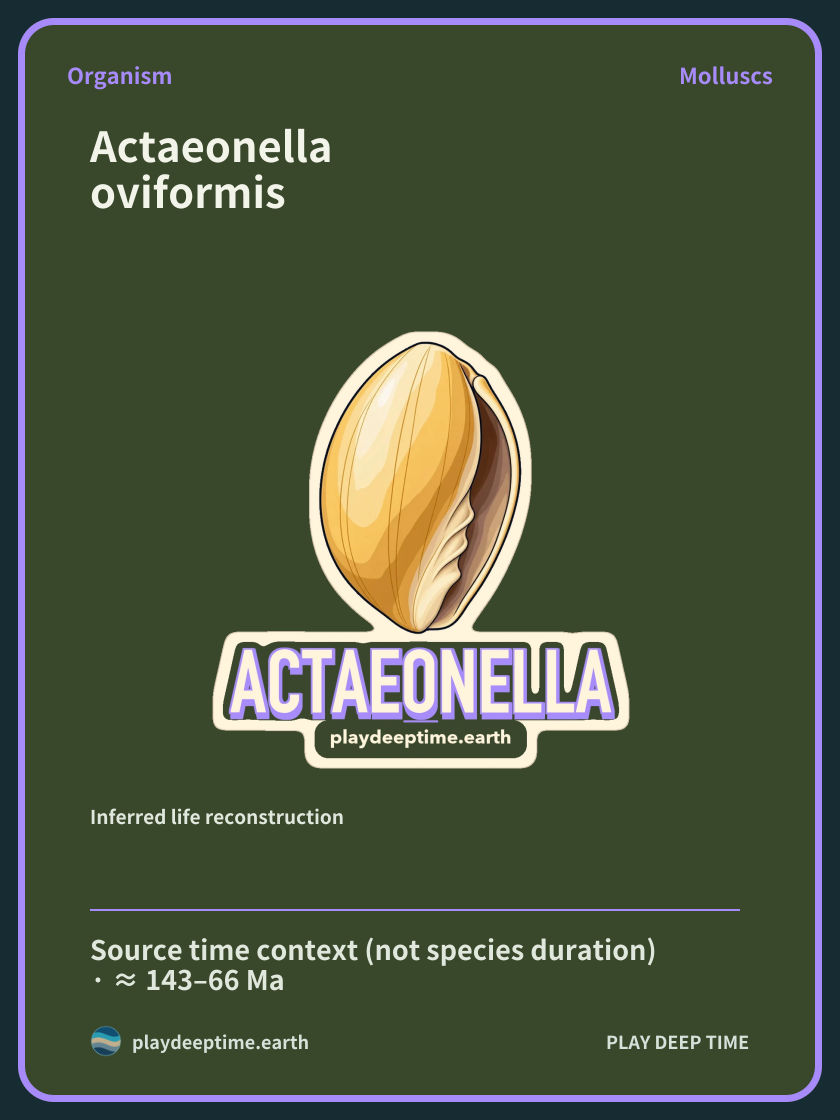
Actaeonella oviformis was a Cretaceous gastropod known from an elongated, smooth shell. A narrow aperture and gentle folds on its inner margin are described. The outer outline and features of the small opening can be examined in turn.[1][2]
Loading illustration…
Key facts
The type specimen’s shell apex was broken. Its original describer left that region unknown, while a later researcher interpreted it as missing the tip of a low, rounded apex. The description of the same fossil became more specific over time.[1][2]
Time and place
It is a fossil gastropod studied from Cretaceous layers. The Cretaceous spans approximately 140–66 million years ago. A nineteenth-century description and twentieth-century reassessment together inform understanding of the overall shell shape.[1][2][3]
The time range describes source context, not the complete duration of this species.
Size, form and skeleton
The elongated, egg-shaped outline has nearly parallel sides in the middle and a smooth surface. The aperture is narrow, widening slightly toward the front. Two gentle folds are described along its inner margin.[1]
The type specimen of Actaeonella oviformis has a preserved shell height of 42.5 mm and a diameter of 21.6 mm. Even this fragment shows convex sides, growth lines, and three folds along the internal shell pillar.[4]
Loading illustration…
Habitat and reproduction
The hard shell conveys the outline that once surrounded the body. Its narrow opening and folds along the inner margin are important comparative regions. Beyond the whole shell, small differences at the aperture can be examined.[1]
Fossil discovery
Gabb’s 1869 description explained the type shell’s form and broken apex. Anderson’s 1958 reassessment interpreted the nearly complete shell as missing the tip of a low, rounded apex. Reexamining an old specimen progressively clarified its outline.[1][2]
References
- Gabb (1869) — Description of the shell of Actaeonella
- Anderson (1958) — Reinterpreting the apex of Actaeonella
- International Commission on Stratigraphy (2024) — Geological time chart
- Sohl & Kollmann (1985), Cretaceous Actaeonellid Gastropods from the Western Hemisphere, USGS Professional Paper 1304
- Bailey-Matthews National Shell Museum — The shell of Cerithium eburneum
Research questions
How can missing portions of a broken fossil be considered? Researchers interpreted the apex by comparing the surviving shell outline with earlier descriptions. Distinguishing what remains from what was inferred reveals the reasoning involved in fossil research.[1][2]
Observation
Follow the smooth, elongated outline from the shell apex to the aperture. Finding the front of the narrow opening and folds along its inner margin reveals both the large outline and small structures.[1][2]
Related organisms
 Cerithium eburneumMolluscsPresent
Different bodies among gastropods
Compare the bodies of Actaeonella oviformis and Cerithium eburneum. Actaeonella oviformis: a Cretaceous gastropod known from an elongated, smooth shell. Cerithium eburneum: a marine gastropod with conspicuous knob-like projections on its shell surface.