Organism · Arthropods
Adelophthalmus granosus
Source time context (not species duration) · ≈ 359–299 Ma
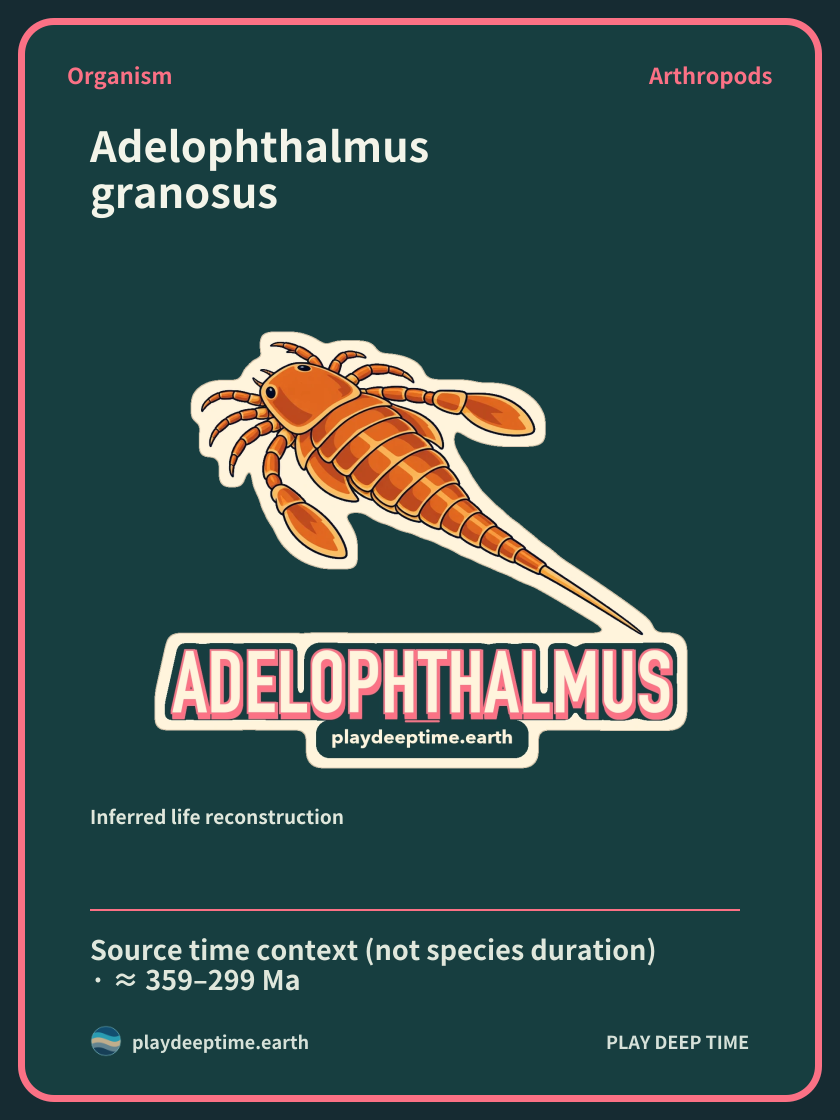
Inferred life reconstruction
Adelophthalmus granosus
Overview
Adelophthalmus granosus is a Late Carboniferous eurypterid known from several segments of the rear body. The type specimen preserves the rear of the anterior carapace and segments continuing behind it. Repeating body segments reveal the construction of an ancient arthropod.[1]
Loading illustration…
Key facts
The first through ninth opisthosomal segments can be identified in type specimen MB.A.890. Researchers compared these preserved regions with the form of related groups. A limited area of preservation connects to the construction of a larger body.[1]
Time and place
It is known from research redescribing Late Carboniferous adelophthalmids. The Carboniferous as a whole was roughly 360–300 million years ago. The study compared forms while distinguishing type specimens of different species.[1][2]
The time range describes source context, not the complete duration of this species.
Size, form and skeleton
The reference material includes the rear of the prosomal carapace followed by a segmented opisthosoma. The author’s composite form considers these species-specific parts alongside general adelophthalmid construction. Genus-level comparisons also include paddle-shaped appendages and a long telson.[1]
In 2005, researchers reconstructed Adelophthalmus granosus at about 15cm in total length based on body proportions and surface ornament. This is the size of a reconstruction combining the preserved fossil with the group’s general body construction.[3]
Loading illustration…
Habitat and reproduction
How did appendage shapes differ within the same body? The genus-level description distinguishes spiny appendages from a paddle-shaped sixth appendage. Examination of body segments continues alongside comparisons of appendage construction.[1]
Fossil discovery
The redescription rechecked the body segments actually preserved in MB.A.890. MB.A.889, a comparative specimen of another species, was treated separately. This study organized species-specific evidence by examining old fossils anew.[1]
References
Research questions
When only part of a body remains, how can the rest be studied? The author separately compared the proportions and ornament preserved in the species with the construction of the same group. This encourages consideration of which questions the preserved regions and comparative material each answer.[1]
Observation
Follow the segments continuing behind the anterior carapace in sequence. Examining the repeating body regions, broad appendages, and long telson separately reveals both the major construction and partial features.[1]
Related organisms
 Megarachne servineiArthropodsSource time context (not species duration) · ≈ 359–299 Ma
Different bodies among eurypterids
Explore the bodies and living backgrounds of Adelophthalmus granosus and Megarachne servinei together. Adelophthalmus granosus: Adelophthalmus granosus is a Late Carboniferous eurypterid known from several segments of the rear body. The type specimen preserves the rear of the anterior carapace and segments continuing behind it. Megarachne servinei: Megarachne servinei is an arthropod once known as a giant spider and later reidentified as a eurypterid. Different readings of rounded structures and appendages in the same fossil produced entirely different accounts of its body.