Organism · Seed plants
Aethophyllum stipulare
Fossil record age bounds · ≈ 252–227 Ma
Inferred life reconstruction
Aethophyllum stipulare
Overview
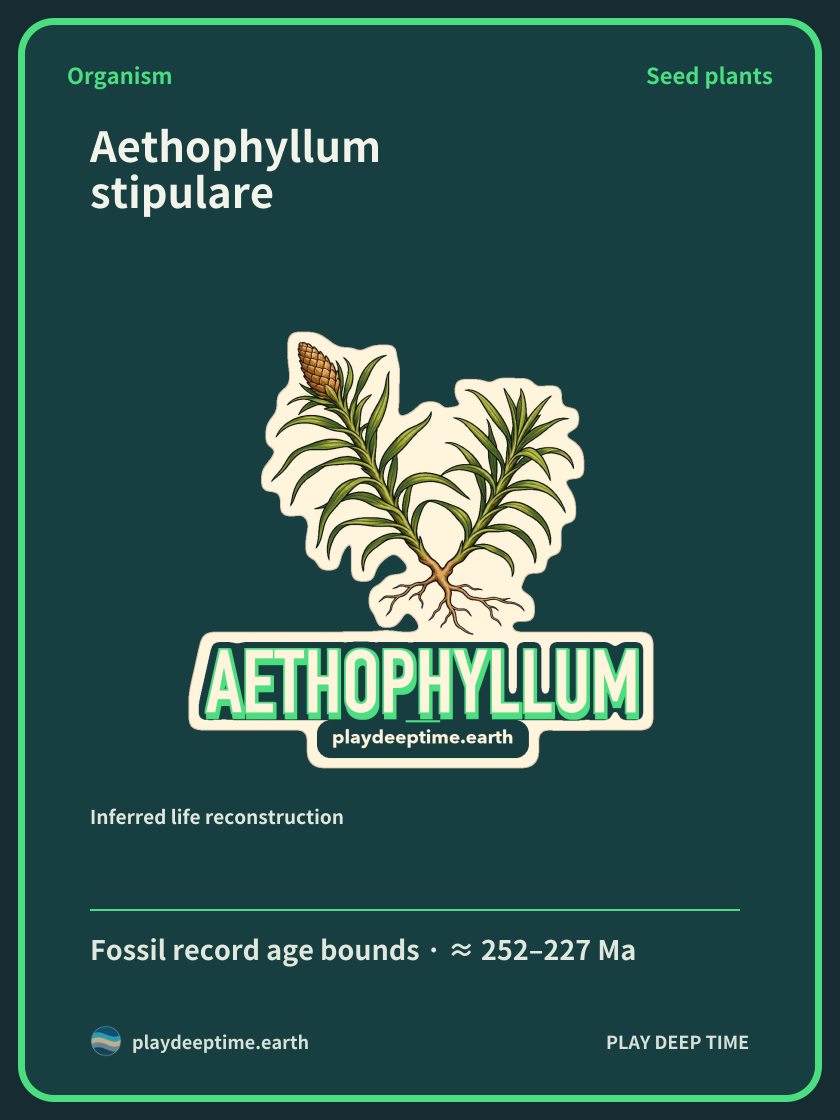
Aethophyllum stipulare is an ancient conifer that produced cones on a small body. The small fertile individual underlying the illustration has two stems emerging from a taproot, with a female cone preserved at the tip of one stem. Encounter a small conifer that differs from the familiar image of a large tree.[1]
Loading illustration…
Key facts
The smallest fertile individual presented in the paper was approximately 30 cm tall. A fertile individual means a reproductively capable plant bearing cones. The connection between its small body and a female cone already attached to one stem tip is a striking feature of this material.[1]
Time and place
A 2000 study examined material from the Grès à Voltzia delta in present-day eastern France. The paper presents this environment as a record from around the Early–Middle Triassic transition. Plant evidence preserved on river floodplains offers clues to ancient landscapes.[1]
The time range describes source context, not the complete duration of this species.
Size, form and skeleton
The small plant underlying this illustration preserves a taproot connected to two stems. Its leaves were described as long and strap-shaped, with several parallel veins. Follow the stems branching from the root upward to locate the female cone preserved at one tip.[1]
Loading illustration…
Habitat and reproduction
The researchers compared traces of floodplain plants with sediment characteristics. Intact seedling fossils mixed among larger plants whose organs remained connected led them to discuss the possibility of burial close to where the plants grew. The study reads plant form alongside the surrounding geological record.[1]
Fossil discovery
Rothwell, Grauvogel-Stamm, and Mapes reexamined Aethophyllum at several growth stages in the Grauvogel–Gall collection. Seedlings, young plants, and cone-bearing individuals provided material for comparing growth. Fossils from different stages were placed side by side to explore an ancient plant’s life history.[1]
References
Research questions
The researchers also compared material from living wetland conifers grown in a greenhouse. They examined how fossil plant size and growth stages related to growth records of living plants, exploring how quickly cones might have been produced. Rapid growth and an herbaceous habit are the authors’ interpretations based on stem structure together with these comparisons.[1]
Observation
The illustration is a qualitative reconstruction based on the paper’s description and figure captions for the small fertile individual. Focus on the connection between the taproot, its two stems, and the female cone at one stem tip. Detailed leaf arrangement, color, and depth are interpretations intended to make this plant’s form easier to read.[1]
Related organisms
 Pleuromeia sternbergiiVascular plantsSource time context (not species duration) · ≈ 252–201 Ma
Following the stems of Triassic plants
Compare the Early Triassic lycophyte Pleuromeia with the conifer Aethophyllum from around the Early–Middle Triassic transition. The authors’ reconstruction of Pleuromeia shows an unbranched stem extending upward, while a small fertile specimen of Aethophyllum has two stems emerging from a taproot. Looking upward from the roots reveals their different body arrangements.