Organism · Placental mammals
Aetiocetus cotylalveus
Source time context (not species duration) · ≈ 33.9–23 Ma
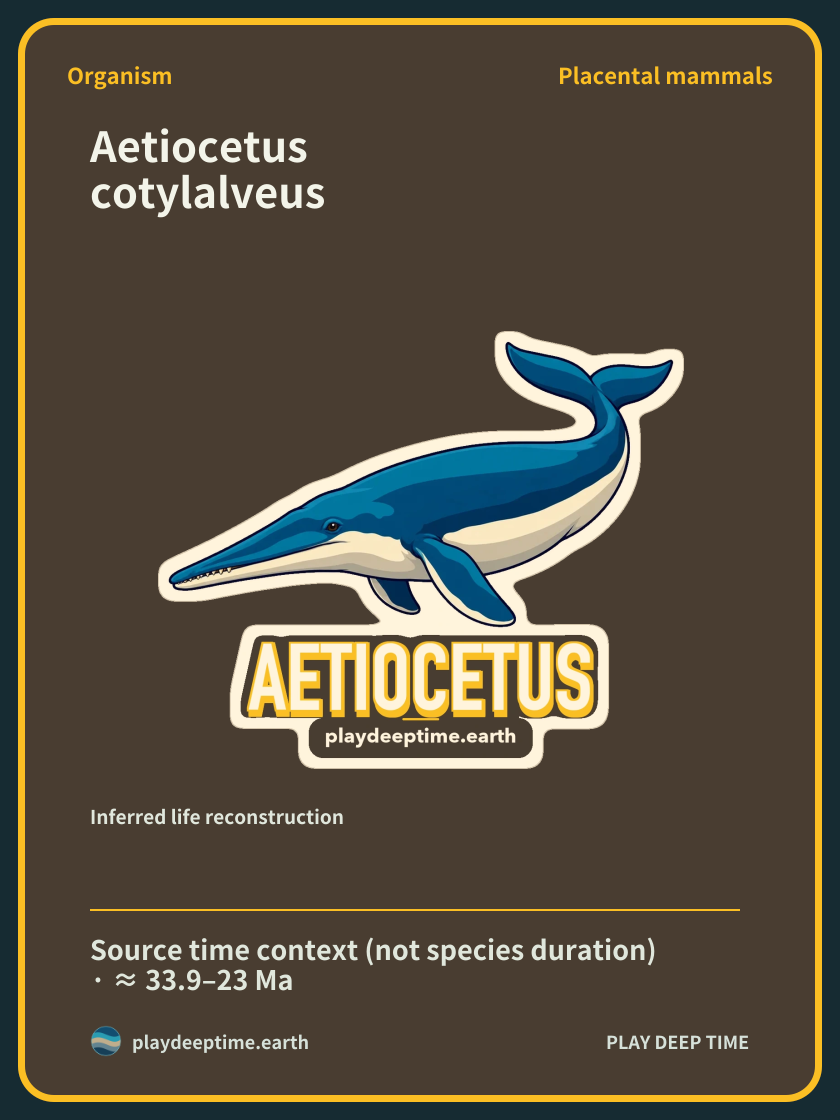
Inferred life reconstruction
Aetiocetus cotylalveus
Overview
Aetiocetus cotylalveus was an Oligocene whale studied from axial skeletal material as well as its skull and teeth. Fossils from present-day Oregon reveal several parts of its body. Questions can extend from the face to the neck and trunk.[2][3]
Loading illustration…
Key facts
The institutional inventory of the type specimen lists six isolated teeth. Skull elements and bones forming the body axis are also recorded. Following the specimen inventory allows us to examine which parts survive, one by one.[2]
Time and place
It was a late Oligocene whale known from the Yaquina Formation in present-day Oregon, United States. The Oligocene spans approximately 34–23 million years ago. Type material held by an institution and subsequent studies provide clues for comparing the bodies of ancient whales.[2][5]
The time range describes source context, not the complete duration of this species.
Size, form and skeleton
The skull, isolated teeth, and axial skeletal elements provide the research material. A later abstract compared postcranial bones and neck vertebrae.[1][2][3][4]
Loading illustration…
Habitat and reproduction
A whale’s head, neck, and body axis are interconnected structures. Material from this species prompts questions that compare bones behind the head as well as the teeth and face. The front and central regions of the body can be considered separately.[2][3]
Fossil discovery
Emlong described this whale in 1966. The institution cataloged skull, tooth, and axial skeletal material from the type specimen, and a conference abstract on its postcranial bones appeared in 2013. Its story extends from the naming study to anatomical comparisons of other regions.[1][2][3]
References
- Emlong (1966) — Retained search excerpt of the description concerning Aetiocetus cotylalveus
- Smithsonian Institution — Aetiocetus type specimen catalogue
- Sawamura et al. (2013) — Comparison of the body skeleton of Aetiocetus
- New York Tech — Body comparisons within the genus Aetiocetus
- International Commission on Stratigraphy (2024) — Geological time chart
- Fordyce (2002) — Simocetus with its unusual face
Research questions
How do questions change when postcranial bones are studied alongside the head? Teeth and the skull enable comparisons of the face, while the neck and axial skeleton reveal connections within the body. This process brings together information from different parts of the same whale.[2][3]
Observation
Move your gaze from the head and mouth toward the neck and trunk. Considering the body axis separately from the positions of the flippers on either side helps show how evidence from several regions contributes to a whole-body reconstruction.[2][3][4]
Related organisms
 Simocetus rayiPlacental mammalsSource time context (not species duration) · ≈ 33.9–23 Ma
Different bodies among whales
Compare the bodies of Aetiocetus cotylalveus and Simocetus rayi. Aetiocetus cotylalveus: an Oligocene whale studied from axial skeletal material as well as its skull and teeth. Simocetus rayi: an early toothed whale distinguished by a downturned snout and front tip of the lower jaw.