Organism · Arthropods
Agnostus pisiformis
Source time context (not species duration) · ≈ 539–487 Ma
Inferred life reconstruction
Agnostus pisiformis
Overview
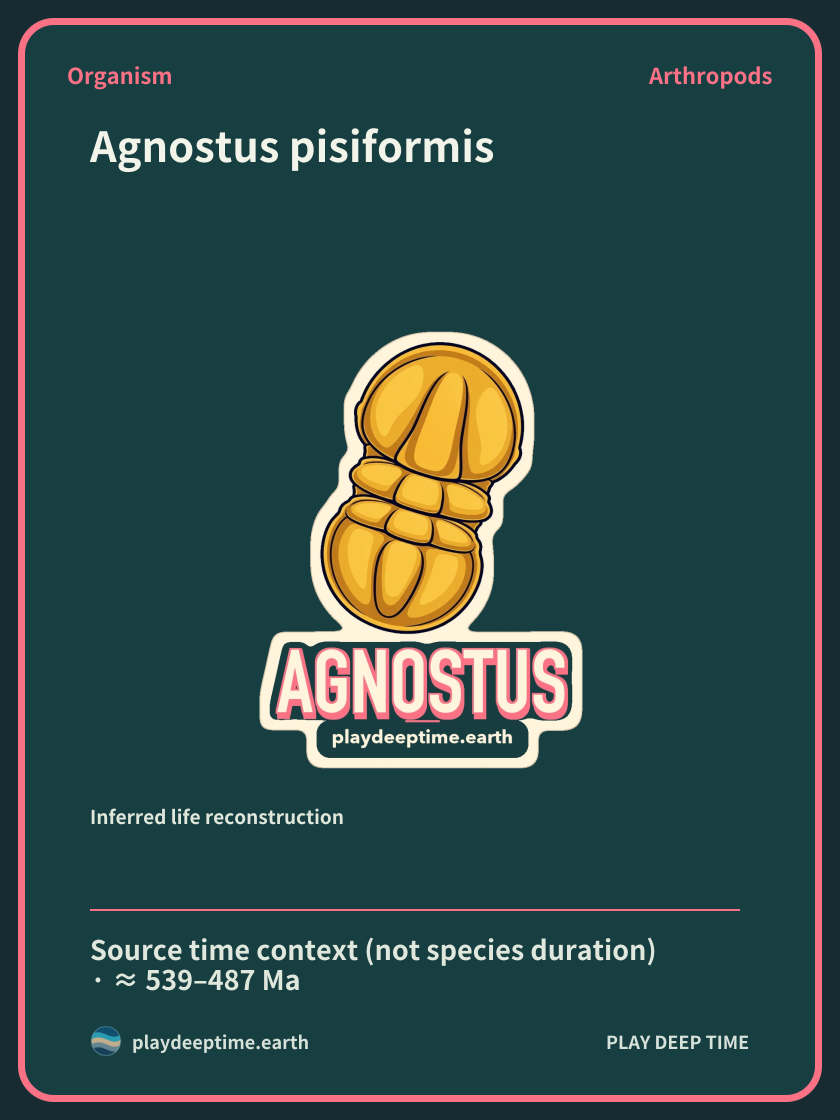
Agnostus pisiformis has a very short trunk between rounded head and tail shields. An almost complete dorsal exoskeleton is known. The contrast between the large shields at either end and the small segments in the middle is striking.[1]
Loading illustration…
Key facts
Two narrow thoracic elements connect the head and tail shields. Finding this small junction between two large shields makes the three body regions clear.[1]
Time and place
It is known from research on Late Cambrian material from Kakeled. The Cambrian as a whole spanned approximately 540–490 million years ago. Preservation of the dorsal exoskeleton provides clues to the connections within an ancient body.[1][2]
The time range describes source context, not the complete duration of this species.
Size, form and skeleton
Specimen LO8930t extends from a rounded head shield through two narrow thoracic elements to a rounded tail shield. The central axis is relatively raised above its surroundings. We can examine both the outline from above and differences in central elevation.[1]
Even fully grown Agnostus pisiformis reached only approximately 1 cm in body length. Cambrian rocks in Sweden preserve many fossils from early stages to adults, allowing us to examine the growth of a small arthropod.[3]
Loading illustration…
Habitat and reproduction
How does the short trunk connect the broad shields? Examining the positions of the two thoracic elements reveals the arrangement joining front and rear. Small connections in a hard exoskeleton also provide clues to the whole body.[1]
Fossil discovery
A 2003 study of trilobite stratigraphy and preservation at Kakeled presented LO8930t. Its almost complete dorsal exoskeleton allows comparison of how front, middle, and rear connect in one body.[1]
References
- Terfelt (2003) — Late Cambrian trilobites from Kakeled
- International Commission on Stratigraphy (2024) — Geological time chart
- Eriksson·Horn (2017) — The mystery of pea-sized Agnostus
- Eriksson·Horn (2017) — The mystery of pea-sized Agnostus
- Hong·Choi (2015) — Agnostids from the Machari Formation, Yeongwol
- Hildenbrand et al. (2021) — A study of Drumian trilobites from Newfoundland
Research questions
Where can two similarly rounded shields be distinguished? Examining the narrow central elements and the axial region together helps divide the broad outline into separate parts. It is an observation that finds body orientation through small connections.[1]
Observation
First examine the rounded shields at front and rear, then find the two thoracic elements between them. Following the central axis reveals the relationship between broad shields and a narrow trunk.[1]
Related organisms
 Ptychagnostus atavusArthropodsFossil record age bounds · ≈ 507–487 Ma
Head and tail shields of Cambrian fossils
Explore the different bodies and records of time preserved in these two organisms. Agnostus pisiformis: Agnostus pisiformis has a very short trunk between rounded head and tail shields. An almost complete dorsal exoskeleton is known. It is known from research on Late Cambrian material from Kakeled. The Cambrian as a whole spanned approximately 540–490 million years ago. Ptychagnostus atavus: Ptychagnostus atavus is an agnostid examined through small head and tail shields. A surface without spines or granules and the shape of the central tail axis provide clues to its identity. A 2015 study introduced it as a species connected with the Middle Cambrian timescale. The studied specimens came from the lower Machari Formation at the Deoksang section in Yeongwol, present-day Republic of Korea.