Organism · Cartilaginous fishes
Akmonistion zangerli
Fossil record age bounds · ≈ 330–327 Ma
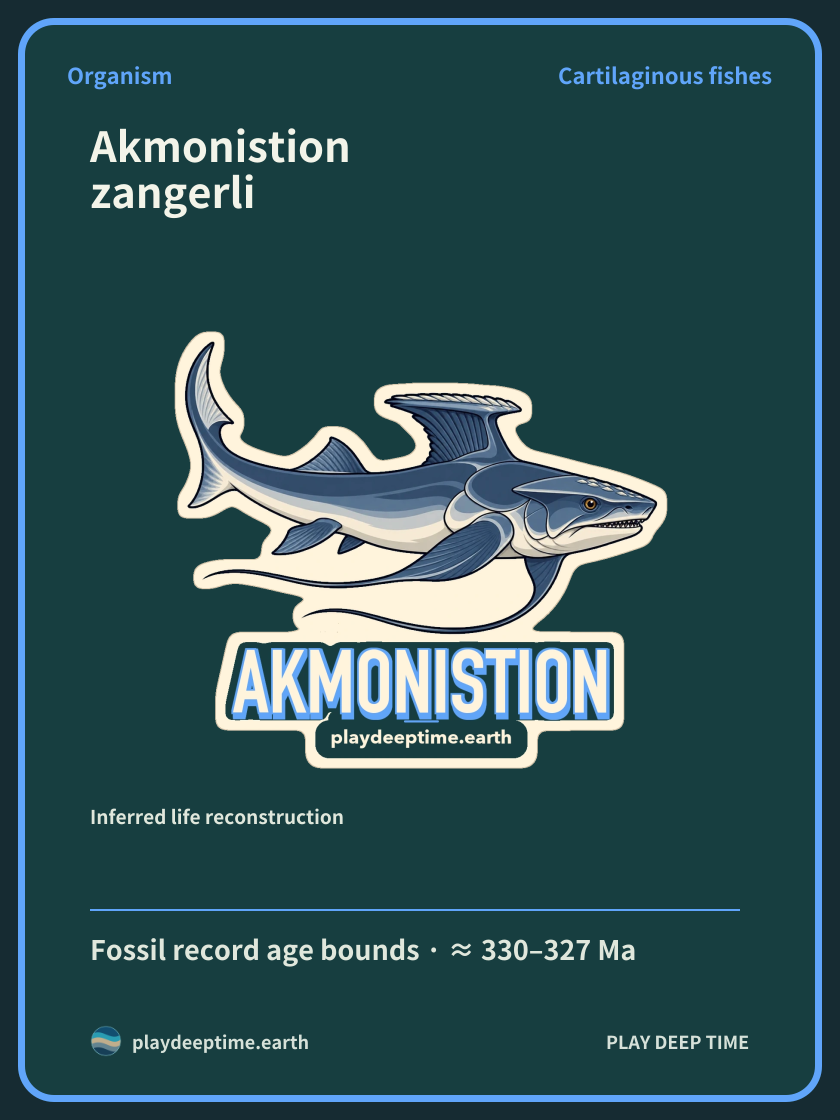
Inferred life reconstruction
Akmonistion zangerli
Overview
Akmonistion zangerli is a Carboniferous cartilaginous fish with a striking large structure on its back. An anvil-like structure rises above the pectoral fins of its elongated body. This unfamiliar silhouette reveals the diversity of body forms among ancient cartilaginous fishes.[1]
Loading illustration…
Key facts
The name Akmonistion combines the Greek akmon, meaning anvil, and istion, meaning sail. It refers to the spine and brush-shaped structure rising from the back. Even the unfamiliar scientific name captures the body feature that first draws the eye.[1]
Time and place
The fossils came from the Manse Burn Formation at Bearsden in present-day Scotland, United Kingdom. The 2001 description identifies these strata as Serpukhovian, in the Early Carboniferous. Knowing the locality and formation places this unusually shaped animal within the history of Carboniferous life.[1]
The time range describes source context, not the complete duration of this species.
Size, form and skeleton
The head has broad extensions above the eyes, and contours along the jaw margins accommodate rows of teeth. Long, trailing whip-like extensions behind the pectoral fins and a sharply upturned tail axis are also characteristic. The male type specimen HMV8246 was described as an approximately 620 mm long individual with a fully articulated skeleton.[1]
Loading illustration…
Habitat and reproduction
The enormous dorsal structure also raises questions about swimming. Considering it alongside the relatively small paired fins and other features, researchers interpreted the animal as poorly suited to sudden acceleration or prolonged high-speed pursuit of prey. This explores possible movements through body shape.[1]
Fossil discovery
The well-preserved Bearsden material was once treated under the names Cladodus or Stethacanthus. After closely examining the articulated skeleton from head to tail and its many features, Coates and Sequeira described Akmonistion zangerli as a new genus and species in 2001.[1]
References
Research questions
The paper presents separate skeletal and life reconstructions. Researchers interpreted how far the gill cover extended and how worn teeth remained outside the jaws by comparing preserved structures with other cartilaginous fishes. This connects reading a skeleton with depicting a living body.[1]
Observation
The illustration was based on the researchers’ whole-body reconstruction in the paper. Follow the arrangement from the head to the large dorsal structure, pectoral fins, and tail. The soft-tissue outline and coloration are interpretations added to represent the skeleton as a living animal.[1]
Related organisms
 Iniopteryx rushlauiCartilaginous fishesFossil record age bounds · ≈ 315–304 Ma
Different bodies among cartilaginous fishes
Explore the bodies and backgrounds of Akmonistion zangerli and Iniopteryx rushlaui together. Akmonistion zangerli is a Carboniferous cartilaginous fish with a striking large structure on its back. An anvil-like structure rises above the pectoral fins of its elongated body. Iniopteryx rushlaui is a cartilaginous fish known from Late Carboniferous North America. Explore its high-set pectoral fins and distinctive silhouette extending toward the tail.