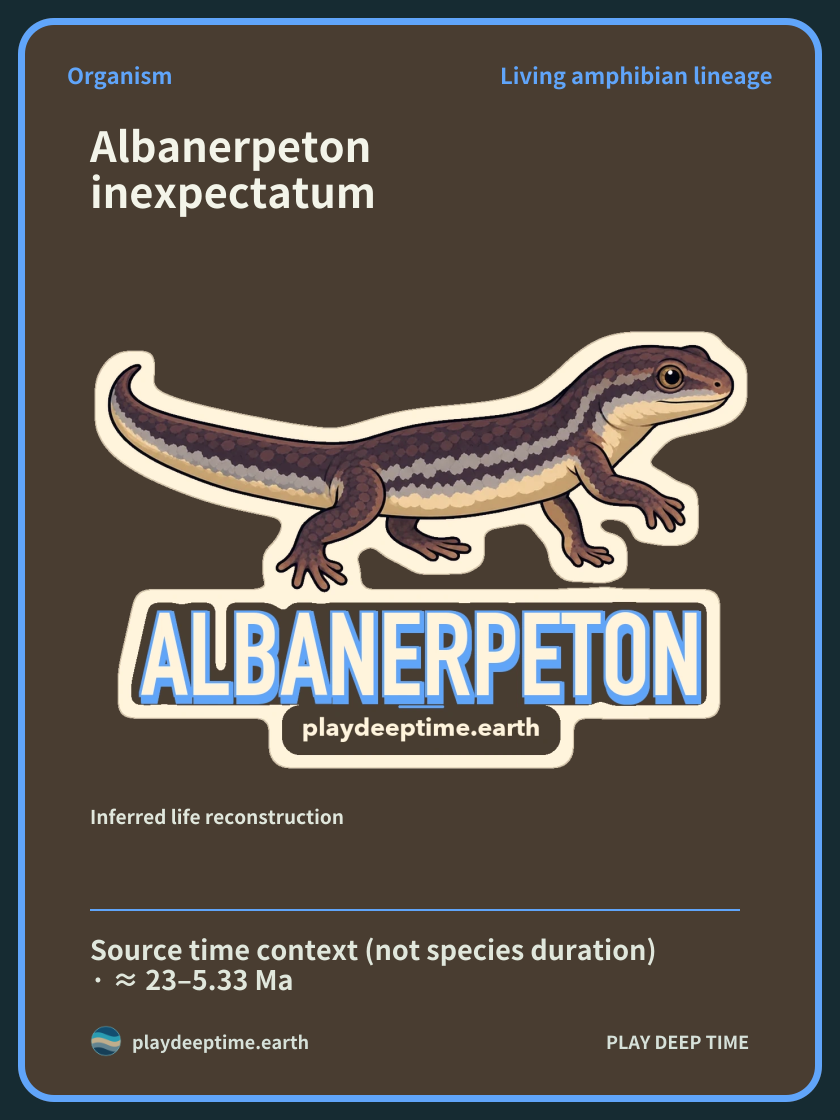
Organism · Living amphibian lineage
Albanerpeton inexpectatum
Source time context (not species duration) · ≈ 23–5.33 Ma
Inferred life reconstruction
Albanerpeton inexpectatum
Overview
Albanerpeton inexpectatum belongs to a group of small amphibians known from Miocene strata in France. Numerous jaws and frontal bones provided material for studying growth and differences between individuals. By assembling evidence from small bones, researchers explore the face of an ancient animal.[1][2]
Loading illustration…
Key facts
Even scattered bones can help reconstruct a face. This species' snout was reconstructed from isolated but well-preserved bones. Comparing many pieces became the key to recognizing the face of this small amphibian.[3]
Time and place
It is studied from material discovered near La Grive-Saint-Alban in present-day France. Jaws and frontal bones came from Miocene sediments filling fissures in the ground. The Miocene spans roughly 23–5.3 million years ago.[1][4]
The time range describes source context, not the complete duration of this species.
Size, form and skeleton
Jaws and frontal bones are the main evidence for understanding the head of this species. Albanerpetontids are described as having small bodies with robust limbs and tails. Looking at cranial details alongside the body configuration of the group helps with comparisons of appearance.[1][2]
Albanerpeton inexpectatum was a small amphibian of Cenozoic Europe. A study comparing frontal-bone length with body proportions in other albanerpetontids estimated that even large individuals measured about 5 cm from the tip of the snout to the centre of the pelvis. This length, excluding the tail, reconstructs living body size from small skull fragments.[10]
Loading illustration…
Habitat and reproduction
Research on albanerpetontids describes the group as terrestrial. It compared their small bodies, robust limbs and tails. Considering them alongside living amphibians reminds us that ancient amphibians also had diverse body forms.[2]
Fossil discovery
A 1999 redescription examined numerous jaws and frontal bones from La Grive-Saint-Alban. The researcher investigated both changes associated with growth and features that differed between individuals. These small fossils revealed diversity within a single species.[1]
References
- Gardner (1999) — Redescription of Albanerpeton from France
- McGowan (2002) — Bodies and classification of albanerpetontids
- 2018 study — Comparing albanerpetontid skulls
- International Commission on Stratigraphy (2024) — Geological time chart
- Berthet2003 — Classification and teeth of Cainotherium
- Gagnaison et al.2023 — Fossil mammals from Mauvières
- Gardner (1999) — Redescription of Albanerpeton from France
- International Commission on Stratigraphy (2024) — Geological time chart
- McGowan (2002) — Bodies and classification of albanerpetontids
- Wiechmann (2003) — Study of albanerpetontid morphology and size
Research questions
Do differences between similar jaw bones reflect different species or different stages of growth? Comparing numerous jaws and frontal bones allows such questions to be investigated. This goes beyond examining one form to understanding variation within a species.[1]
Observation
Move your gaze from the snout at the front of the head to the jaws and forehead. Remembering that small bones reveal different parts of the face helps explain how fragmentary fossils are compared.[1][3]
Related organisms
 Cainotherium lintillaePlacental mammalsFossil record age bounds · ≈ 41–7.25 Ma
Mammals and amphibians of Miocene France
Examine Caenotherium's jaws and teeth alongside Albanerpeton's jaws and frontal bones. Miocene material from different localities in present-day France reveals the different faces of a small even-toed ungulate and an amphibian.