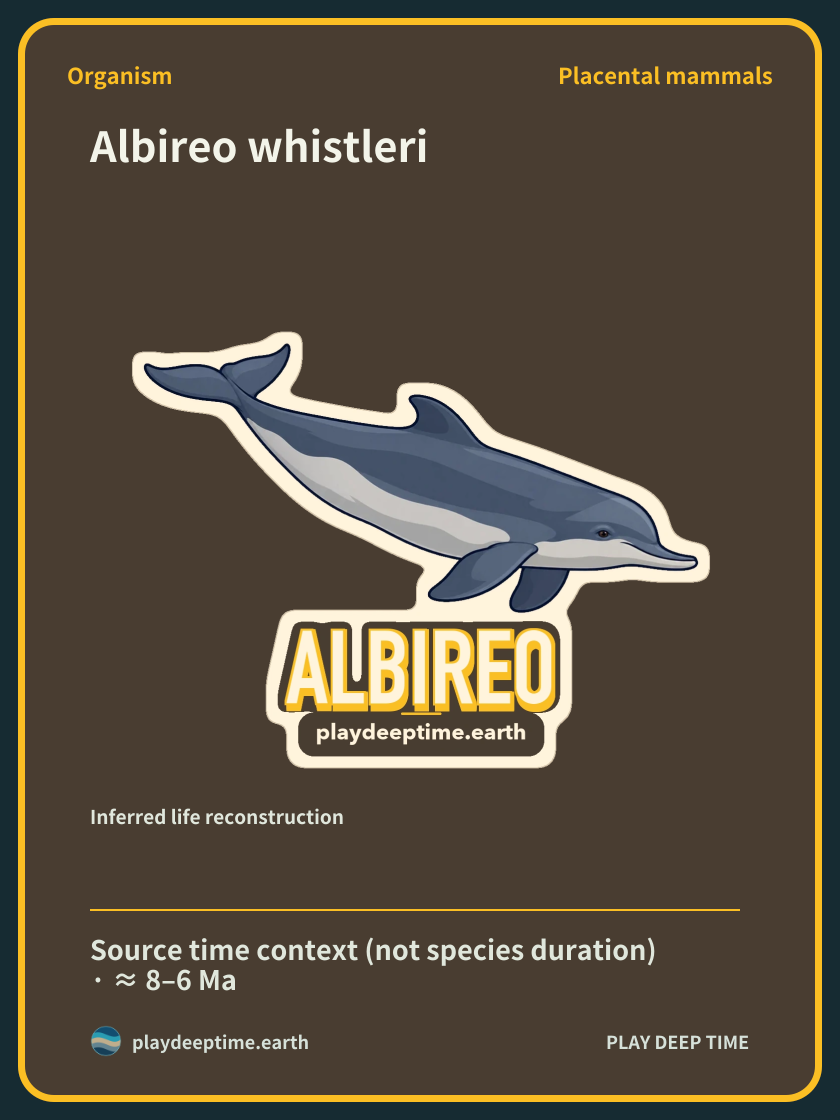
Organism · Placental mammals
Albireo whistleri
Source time context (not species duration) · ≈ 8–6 Ma
Inferred life reconstruction
Albireo whistleri
Overview
Albireo whistleri is a fossil dolphin known from a nearly complete holotype skeleton. Its describer introduced it as an unusual large dolphin. The fossil provides an opportunity to study many body bones together, rather than the skull alone.[3][4]
Loading illustration…
Key facts
A holotype is the specimen that represents a species name. Albireo whistleri is noteworthy because a nearly complete skeleton serves as that reference. A table comparing vertebrae also appears in research on this animal.[4][1]
Time and place
It appears in research on fossil toothed whales from the Almejas Formation on Cedros Island, Mexico. The lower Almejas Formation containing the holotype is described in a Late Miocene context, approximately 8–6 million years ago.[3][4]
The time range describes source context, not the complete duration of this species.
Size, form and skeleton
The holotype skeleton and comparisons of vertebrae are major sources of information about this animal. The researcher examined its dolphin bones alongside those of another Albireo species. Vertebrae forming the body’s central axis provide clues for comparing species.[4][1]
A body length of about 2.5 m is reported based on the nearly complete type specimen. A 2024 comparative study of marine organisms also summarized the size of Albireo whistleri using this specimen.[5]
Loading illustration…
Habitat and reproduction
How is a dolphin’s body organized along the spine? Comparing successive vertebrae allows us to consider different regions of its central axis. A nearly complete skeleton broadens questions from an individual bone to the organization of the whole body.[1][4]
Fossil discovery
Barnes’s research on Albireo and a catalog of aquatic mammal skeletons record this species’ holotype. A 2008 study also introduced the nearly complete reference skeleton. It illustrates how skeletal records support later taxonomic research.[2][4]
References
- Barnes — Vertebral comparisons of Albireo
- Vidal — Catalogue of aquatic mammal skeletal collections
- Study of fossil toothed whales from the Almejas Formation, Cedros Island
- 2008 study — Fossil dolphins of the family Albireonidae
- Pimiento et al. (2024) — Extinct large marine organisms of the Phanerozoic
- Literature on the skull of Parapontoporia and its relationships with dolphins
- NOAA specimen catalogue — The Parapontoporia holotype
Research questions
What differences might the vertebrae of two closely related species show? Research on Albireo compared vertebrae while distinguishing the species. Even the bones of an elongated body can raise questions about identifying different kinds.[1]
Observation
Examine the body from the head along the direction of the spine. Thinking of the elongated body as connected bones rather than a single mass changes how we compare fossil dolphins.[1]
Related organisms
 Parapontoporia pacificaPlacental mammalsSource time context (not species duration) · ≈ 7.2–5.3 Ma
Different bodies among whales
Compare the bodies of Albireo whistleri and Parapontoporia. Albireo whistleri: a fossil dolphin known from a nearly complete holotype skeleton. Parapontoporia: Parapontoporia pacifica is a fossil toothed whale known for its very long, slender snout.