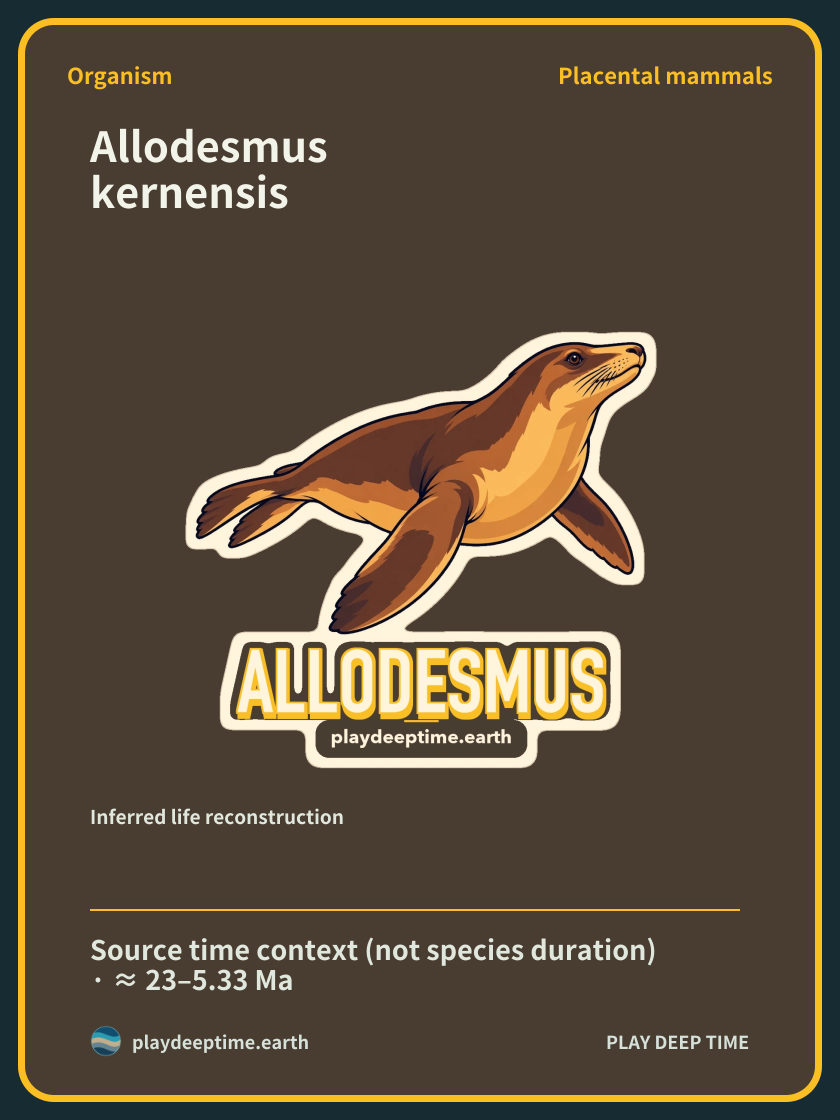
Organism · Placental mammals
Allodesmus kernensis
Source time context (not species duration) · ≈ 23–5.33 Ma
Inferred life reconstruction
Allodesmus kernensis
Overview
Allodesmus kernensis was an extinct pinniped with flipper-like limbs. It provides material for comparing ancient bodies of groups such as fur seals and true seals. Its long-headed form and nearly complete vertebral column offer intriguing research clues.[1][3]
Loading illustration…
Key facts
A nearly complete vertebral column is known for this species. The central body structure behind the head can be compared with living pinnipeds. An animal once viewed mainly through its face can be reconsidered through the relationship between its body axis and limbs.[3]
Time and place
An institutional record of a left navicular, a foot bone, identifies its locality as the Temblor Formation in present-day Kern County, California, United States. It is Miocene material; the Miocene spans approximately 23–5.3 million years ago. Even one bone connects to records of place and time.[2][5]
The time range describes source context, not the complete duration of this species.
Size, form and skeleton
In species comparisons, it is treated as a long-headed form. Separate skeletal material and a nearly complete vertebral column have also been studied.[1][3][4]
Even the skull of Allodesmus kernensis suggests considerable size. Comparative research reports skull lengths of about 37–40 cm. This measurement runs from the joint region at the back of the skull to the front and should be distinguished from body length including the tail.[6]
Loading illustration…
Habitat and reproduction
Which contributed more propulsion underwater: the forelimbs or hind limbs? A 2011 study compared its spine and limbs with living pinnipeds, and several interpretations of propulsion have been discussed. Different readings of body bones help explore movement.[3]
Fossil discovery
The research history of Allodesmus includes both assembling skeletons and revising species names. Later research sometimes grouped particular older species names under this species. This involves reading names from different times alongside skeletal evidence.[4][1]
References
- Head types and species comparison in Allodesmus
- Smithsonian — Allodesmus kernensis left navicular record nmnhpaleobiology_3446215
- 2011 study — Pinniped vertebrae and movement in water
- Research history and names of Allodesmus
- International Commission on Stratigraphy (2024) — Geological time chart
- Deméré·Berta (2002) — Comparing Miocene pinniped skulls
- de Muizon (1981) · Muséum national d’histoire naturelle, Paris — Acrophoca materials
Research questions
Can different swimming styles be inferred from the same skeleton? Explanations can vary depending on the material used to compare the body axis and forelimb and hind limb structures. New comparisons add questions about the movement of old fossils.[3]
Observation
Move your gaze from the elongated head to the axis of the neck and trunk. Examining the front and rear flippers separately helps relate central body structure to research on movement.[1][3]
Related organisms
 Acrophoca longirostrisPlacental mammalsSource time context (not species duration) · ≈ 12–5.3 Ma
Different bodies among pinnipeds
Compare the bodies and backgrounds of Allodesmus kernensis and Acrophoca. Allodesmus kernensis: an extinct pinniped with flipper-like limbs, providing material for comparing ancient bodies of groups such as fur seals and true seals. Acrophoca: Acrophoca longirostris is a fossil phocid known from records of the skull, lower jaw, vertebrae, and limbs. The inventory of MNHN.F.SAS563 records several body regions.