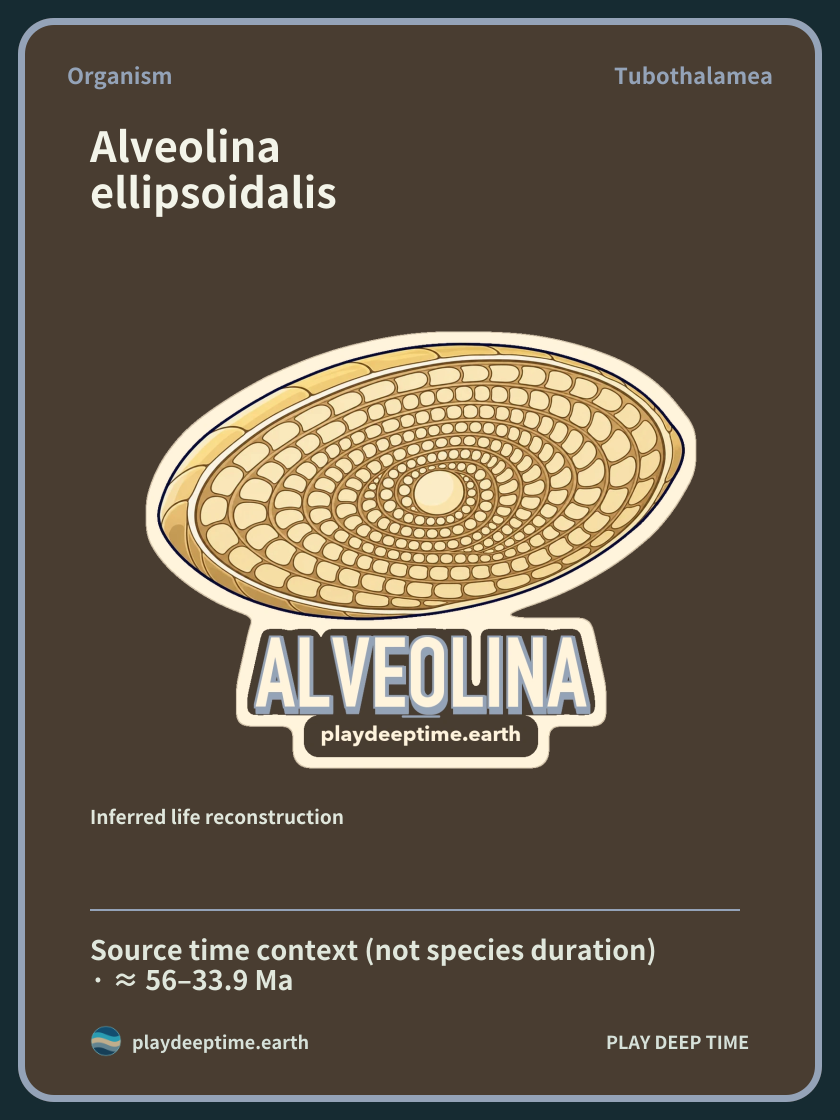
Organism · Tubothalamea
Alveolina ellipsoidalis
Source time context (not species duration) · ≈ 56–33.9 Ma
Inferred life reconstruction
Alveolina ellipsoidalis
Overview
A single cell lived inside a small shell resembling a grain of rice. Alveolina ellipsoidalis belongs to the foraminifera, a group of single-celled organisms. Though small, it plays a large role in reading ancient marine environments and the ages of strata.[1][4]
Loading illustration…
Key facts
How can we tell whether rocks far apart are the same age? Researchers compare the foraminiferal species they contain. Several Alveolina species act like small clocks for correlating marine time.[1][2][4]
Time and place
It is known from warm seas of the Early Eocene, within a range of approximately 56–48 million years ago. Specimens from the Isparta region of present-day Türkiye and the Trentinara Formation in the southern Apennines of Italy have been studied. Limestone now on land reveals an ancient sea.[1][2][5]
The time range describes source context, not the complete duration of this species.
Size, form and skeleton
The shell is oval, with rounded or slightly pointed ends. Five specimens were used to describe the species in the Isparta study. Comparing external outlines with internal sections reveals differences among small fossils.[1][2][3]
Alveolina ellipsoidalis is a foraminifer with a small oval shell. A studied specimen from Italy’s Trentinara Formation was reported as approximately 3.6 mm along its long axis and about 2.6 mm in transverse diameter.[15]
Loading illustration…
Habitat and reproduction
The Isparta fossil assemblage indicates settings ranging from lagoons to relatively quiet shallow seas. Alveolina is studied as a group of bottom-dwelling foraminifera. Less conspicuous than large fishes, such small organisms nevertheless filled marine ecosystems.[1][5]
Fossil discovery
Following a species description in 1975 and Italian research, a 2021 Isparta study examined specimens of this species. Shells from several localities have been compared by consistent criteria to establish distribution and stratigraphic sequences. Small differences under a microscope connect regions.[1][2][3]
References
- Systematics, Biostratigraphy and Paleoenvironmental Investigation of Early Ypresian Alveolina Assemblages in the Northern Part of Isparta Angle · Bull. Min. Res. Exp. 164 (2021):183–229
- Alveolina horizons in the Trentinara Formation (Southern Apennines, Italy): Stratigraphic and paleogeographic implications
- 1975 — Alveolina ellipsoidalis, Mitteilungen der Bayerischen Staatssammlung für Paläontologie und historische Geologie15:3–18
- ICZN — Palaeontology and Biostratigraphy
- The geographic, environmental and phylogenetic evolution of the Alveolinoidea
- 2020 — Distribution of Alveolina assemblages in the Ypresian successions from Iran and Turkey
- Systematics, Biostratigraphy and Paleoenvironmental Investigation of Early Ypresian Alveolina Assemblages in the Northern Part of Isparta Angle · Bull. Min. Res. Exp. 164 (2021):183–229
- ICZN — Palaeontology and Biostratigraphy
- Alveolina horizons in the Trentinara Formation (Southern Apennines, Italy): Stratigraphic and paleogeographic implications
- The geographic, environmental and phylogenetic evolution of the Alveolinoidea
- 1975 — Alveolina ellipsoidalis, Mitteilungen der Bayerischen Staatssammlung für Paläontologie und historische Geologie15:3–18
- Özcan et al.2001 — Late Paleocene foraminifera from the Haymana–Polatlı Basin
- British Geological Survey — The body and life of foraminifera
- Less et al.2007 — Early evolution and stratigraphic subdivision of Tethyan foraminifera
- Vecchio et al. (2007) — Alveolina from the Trentinara Formation
Research questions
The same species may appear in slightly younger strata in one region than another. Researchers therefore examine associated foraminifera and rock characteristics rather than relying on one species alone. Reading time through small fossils requires interpreting changes in both organisms and environments.[1][2][6]
Observation
Examine the oval outline together with the intricate structure inside the shell.[1]
Related organisms
 Discocyclina seunesiForaminiferaSource time context (not species duration) · ≈ 66–48 Ma
Elongated shells and discs from ancient seas
Alveolina and Discocyclina are foraminifera revealing seas of different times. Compare elongated oval shells and flattened disc-shaped shells in research material from the Early Eocene and Late Paleocene.