Organism · Dinosaurs
Anchiornis huxleyi
Source time context (not species duration) · ≈ 201–143 Ma
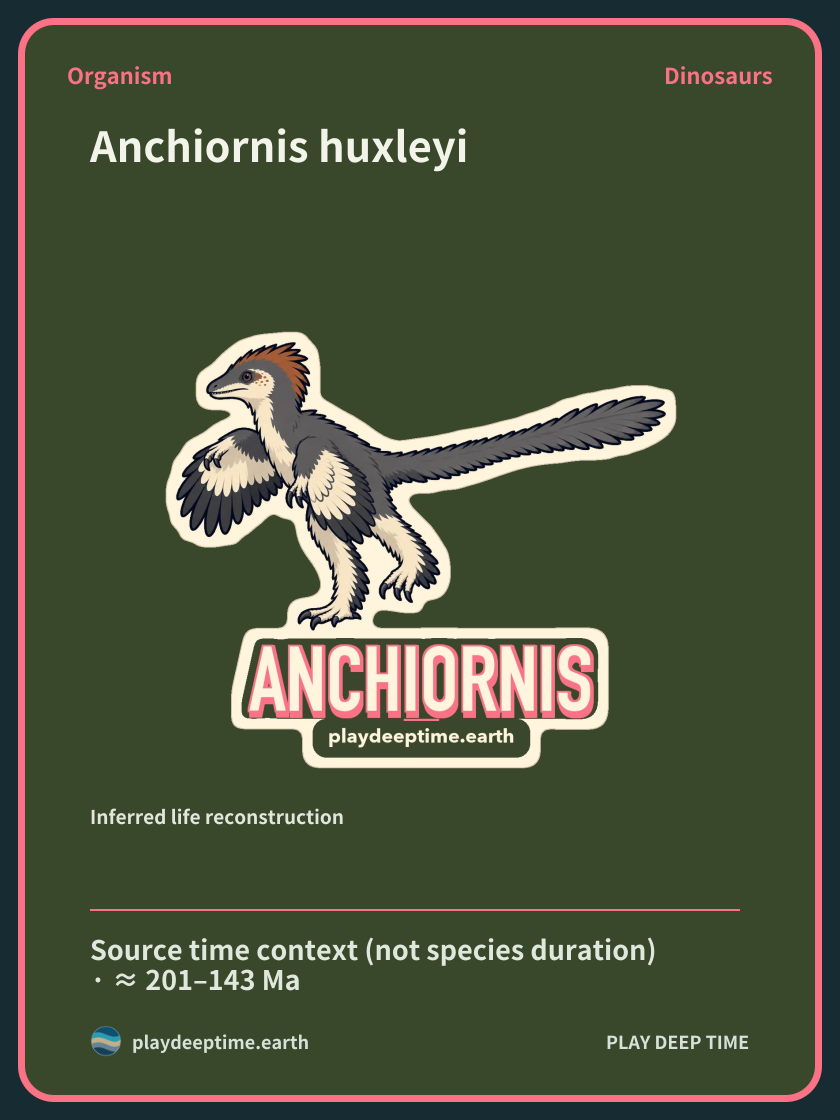
Inferred life reconstruction
Anchiornis huxleyi
Overview
Anchiornis huxleyi is a Jurassic dinosaur known for long feathers on its limbs, including its hands and feet. Its body feathers and the feather fringe along its long tail have also been studied. You can examine different feathers on different parts of the body.[2][4]
Loading illustration…
Key facts
A 2010 study examined twenty-nine feather samples from one specimen. It interpreted the coloration as a gray body, reddish-brown head feathers, and light limb feathers with black tips. Small samples from a single fossil became clues to the animal’s colors.[1]
Time and place
It is known from Late Jurassic material in present-day China. The Jurassic as a whole was roughly 200–140 million years ago. Feather shapes and pigments have been compared in different studies.[2][5]
The time range describes source context, not the complete duration of this species.
Size, form and skeleton
Long limb feathers, feathers covering the hands and feet, loose body plumage, and a fringe along the long tail are distinguished. Forked body feathers and partially open barbs have also been studied. You can examine the overall covering together with the structure of a single feather.[2][3][4]
The length given in the museum’s account of the genus Anchiornis is about 60cm.[2]
Loading illustration…
Habitat and reproduction
Were feathers the same shape on every part of the body? In Anchiornis, the long limb feathers can be compared with different body feathers. Several constructions occur within the same body covering.[3][4]
Fossil discovery
A 2010 institutional account reported an analysis of feather pigments in one specimen. Follow-up studies in 2017 and 2018 addressed looser body feathers and barb structure. The questions expanded from color to the form of the feathers themselves.[1][3][4]
References
Research questions
What different information do feather pigments and branching structures provide? Pigments offer clues for interpreting body patterns, while barbs allow comparisons of the covering’s form. This research explores one small feather from several perspectives.[1][3]
Observation
Move your gaze from the head feathers to the long feathers covering the limbs, hands, and feet. Examining the body feathers and the fringe along the long tail reveals different coverings on different body parts.[2][4]
Related organisms
 Stegosaurus stenopsDinosaursSource time context (not species duration) · ≈ 201–143 Ma
Different bodies among dinosaurs
Explore the bodies and living backgrounds of Anchiornis and Stegosaurus together. Anchiornis: Anchiornis huxleyi is a Jurassic dinosaur known for long feathers on its limbs, including its hands and feet. Its body feathers and the feather fringe along its long tail have also been studied. Stegosaurus: This herbivorous dinosaur had large upright plates on its back and spikes on its tail. Stegosaurus stenops is instantly memorable because its back and tail are far more conspicuous than its head.