Organism · Dinosaurs
Ankylosaurus magniventris
Source time context (not species duration) · ≈ 143–66 Ma
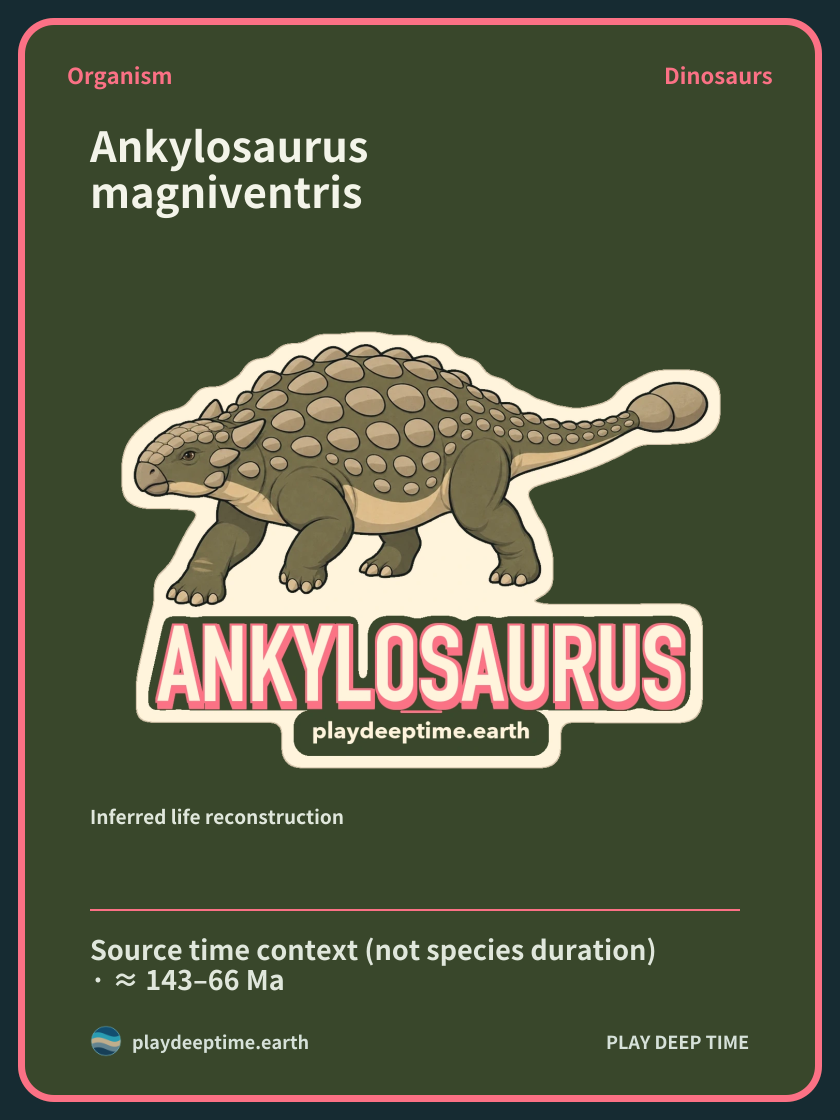
Inferred life reconstruction
Ankylosaurus magniventris
Overview
Ankylosaurus magniventris is a dinosaur armored across its body and equipped with a heavy club at the tail tip. It was a large herbivore that held its body low on four legs. It offers a useful comparison among different dinosaur bodies near the end of the Cretaceous.[1]
Loading illustration…
Key facts
The tail club was not known from the first discovery. Early fossils included armor pieces detached from the body, while the characteristic club was discovered later. Even a familiar dinosaur’s appearance was assembled through several discoveries.[1]
Time and place
It lived in the Late Cretaceous, roughly 68–66 million years ago. Fossils are known from the present-day USA and Canada. This herbivore represents North America’s final dinosaur faunas.[1]
The time range describes source context, not the complete duration of this species.
Size, form and skeleton
Museums describe it as a large dinosaur approximately 8 m long. Features include bony back plates, a broad, low body, and a club at the tail tip. A beak occupies the front of the head, with plant-processing teeth inside the mouth.[1]
Loading illustration…
Habitat and reproduction
It is interpreted as having eaten low-growing plants. While its beak and teeth processed plants, the tail club is studied as a structure used against large predators. A mainly sideways swinging motion has been proposed.[1]
Fossil discovery
Barnum Brown’s expedition first discovered bones in the Hell Creek Formation of Montana, USA, in 1906. The name Ankylosaurus was established in 1908. Later discoveries added further body features.[1]
References
Research questions
Where did detached armor pieces fit on the body? Researchers compare Ankylosaurus material with articulated skeletons of other armored dinosaurs. How armor and tail form related to growth and life habits remains a subject for investigation.[1]
Observation
Move your gaze from the bony back plates to the low trunk, four legs, and tail club. Examining armor and the large tail together brings its features into focus.[1]
Related organisms
 Triceratops horridusDinosaursSource time context (not species duration) · ≈ 143–66 Ma
Armor and a club, horns and a frill
Late Cretaceous Ankylosaurus and Triceratops had different body adornments. Set back armor and a tail club alongside head horns and a neck frill to explore varied herbivorous dinosaur bodies.