Organism · Birds and early avialans
Anthropornis grandis
Source time context (not species duration) · ≈ 56–33.9 Ma
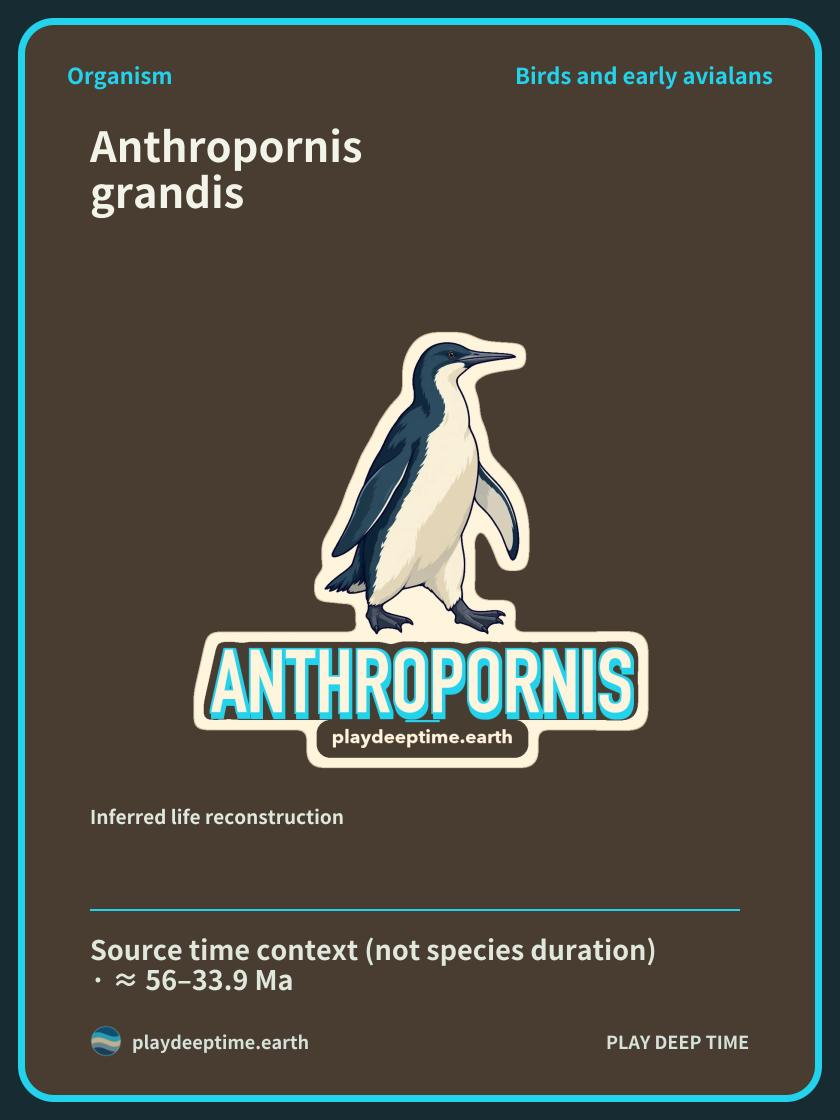
Inferred life reconstruction
Anthropornis grandis
Overview
Anthropornis grandis is a fossil penguin from Eocene Seymour Island, Antarctica. One specimen preserves a skull and lower jaw together with parts of the ankle bones. Connecting distant body regions provided clues for identifying this species’ head.[1]
Loading illustration…
Key facts
Why do a skull and ankle bones found together matter? The species name was established from a separate ankle bone in 1905. A new specimen opened the opportunity to compare ankle and skull features together.[1]
Time and place
It is reported from Eocene fossils on Seymour Island, Antarctica. The Eocene as a whole spans approximately 56–34 million years ago. Penguin records can be compared by region and age with Palaeeudyptes gunnari, known from the Eocene of the same island.[1][2][3]
The time range describes source context, not the complete duration of this species.
Size, form and skeleton
The studied specimen includes a skull, lower jaw, and parts of both ankle bones. The skull is compressed, requiring attention to the preservation of each region. Different parts—the skull and ankles—connect species comparisons.[1]
A body length of about 1.37 m was calculated from one foot-bone specimen of Anthropornis grandis. Based on a proportional equation from a 2001 study, it measures from beak tip to tail tip rather than upright standing height.[4]
Loading illustration…
Habitat and reproduction
How diverse were ancient Antarctic penguins? Eocene penguins from Seymour Island can be examined species by species. Specimens preserving several body regions together help compare differences between kinds.[1][2]
Fossil discovery
Following the 1905 reference ankle bone, a 2019 study introduced a specimen associating the skull with other body bones. This provided evidence for confidently comparing the species’ skull. Research under the same name expanded to a new body region.[1]
References
Research questions
How do skulls and ankles connect in recognizing one species? Features of associated bones can be compared with an already known type specimen. Connecting different body regions is an important question in fossil penguin research.[1]
Observation
Move your gaze from the skull to the lower jaw and then to both ankle bones. Comparing widely separated regions broadens the information revealed by a single fossil specimen.[1]
Related organisms
 Palaeeudyptes gunnariBirds and early avialansSource time context (not species duration) · ≈ 56–33.9 Ma
Another penguin of Eocene Seymour Island
Anthropornis grandis and Palaeeudyptes gunnari are both fossil penguins of Eocene Seymour Island, Antarctica. Records from the same region and broad time interval can be compared by species.