Organism · Birds and early avialans
Archaeopteryx lithographica
Source time context (not species duration) · ≈ 201–143 Ma
Inferred life reconstruction
Archaeopteryx lithographica
Overview
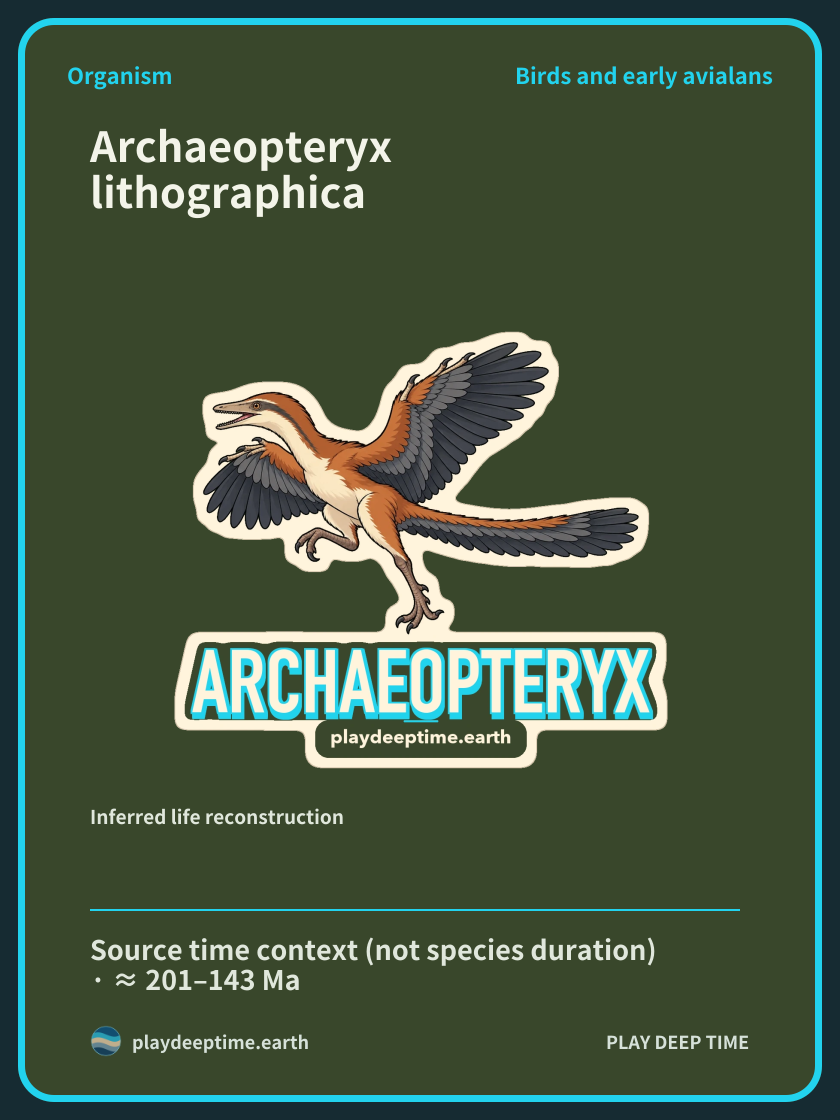
Its feathered wings suggest a bird, before teeth and a long bony tail surprise the viewer again. Archaeopteryx lithographica is a famous fossil that prompted connections between dinosaur and bird evolution.[1]
Loading illustration…
Key facts
Bird and dinosaur features coexist in one body. Broad feathered wings and small size suggest a bird, while teeth and a long bony tail invite comparison with other theropod dinosaurs. Evolution did not simply erase all other features at once.[1]
Time and place
It is known from the Late Jurassic around 150 million years ago near present-day Solnhofen, Germany. At the time, subtropical islands surrounded lagoons.[1]
The time range describes source context, not the complete duration of this species.
Size, form and skeleton
Picture a small animal approximately 50 cm long. Long wing and tail feathers are clearly preserved in fossils. Compare these feathers with small teeth in the head and a long tail made up of many bones.[1]
Loading illustration…
Habitat and reproduction
Small animals such as insects and lizards lived around the islands and lagoons. Researchers investigate the possibility that it used these as food. How much it used the ground, trees, and air remains a subject studied through body structure.[1]
Fossil discovery
German fossils attracted great attention when they became known to science in 1861. The London specimen, preserving skeleton and feather impressions together, entered the museum in 1862. The discovery changed ideas about evolution as well as establishing a species name.[1][3]
References
- Archaeopteryx
- Natural History Museum — Fossil bird collections
- Natural History Museum — Archaeopteryx lithographica, specimen PV OR37001
- Archaeopteryx lithographica — NHM genus guide
- Xu et al. (2003) — Four-winged dinosaurs from China
- Albrecht (1983) — Die Protastacidae n. fam., fossile Vorfahren der Flusskrebse?
Research questions
Feathers do not mean that all animals fly in the same way. Important questions concern the wingbeats and aerial movements it could perform. New specimens and fine skeletal comparisons gradually reveal more about the lives of early bird relatives.[1]
Observation
Examine wings and tail together. Within the birdlike outline created by feathers coexist teeth and a long bony tail.[1]
Related organisms
 Microraptor guiDinosaursSource time context (not species duration) · ≈ 143–66 Ma
Feather stories from the Jurassic and Cretaceous
Jurassic Archaeopteryx and Cretaceous Microraptor are feathered fossils from different times. Comparing feathers on wings, legs, and tails reveals several forms of bodies that moved through the air.
 Pseudastacus pustulosusArthropodsSource time context (not species duration) · ≈ 201–143 Ma
Another fossil encountered at Solnhofen
Jurassic fossils from the Solnhofen area also include the crustacean Pseudastacus. Considering a feathered animal alongside an aquatic crustacean broadens the biological world revealed by the region’s fossils.