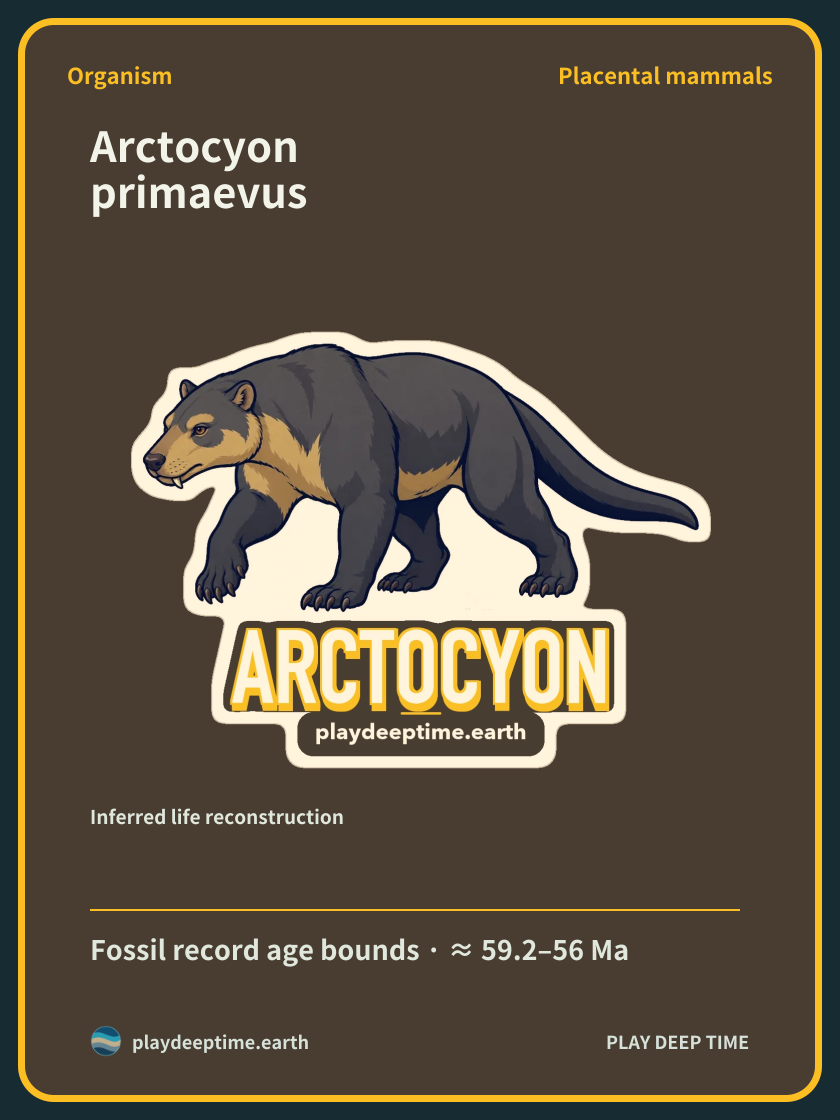
Organism · Placental mammals
Arctocyon primaevus
Fossil record age bounds · ≈ 59.2–56 Ma
Inferred life reconstruction
Arctocyon primaevus
Overview
Arctocyon primaevus is an extinct mammal from late Paleocene France. Its trunk and limbs have been studied alongside its skull. The shapes of hands, feet, and joints invite investigation of how it used its body.[2]
Loading illustration…
Key facts
Feet that rested on the whole sole and highly mobile joints reveal clues to an ancient mammal’s life. A researcher in 2013 compared the forelimbs and feet of Arctocyon with living animals and proposed that it may have been capable of climbing trees.[2]
Time and place
This mammal is studied through late Paleocene material from present-day France. The final part of the Paleocene spans roughly 59–56 million years ago. Skeletons from this time provide evidence for comparing ancient mammal bodies and movements.[2][3]
The time range describes source context, not the complete duration of this species.
Size, form and skeleton
Postcranial research describes five-toed, plantigrade feet and highly mobile joints. Forelimb studies examined structures associated with muscles that flexed the fingers, among others. A separate skull at the natural history museum in Paris preserves cheek teeth on both sides and a right canine.[2][1]
A comparative study of brain size lists a body mass of approximately 30–41 kg for Arctocyon primaevus. This range compiled body-mass estimates from earlier fossil research for comparisons of brain size relative to the body.[11]
Loading illustration…
Habitat and reproduction
The researcher compared bones of climbing and digging animals. Forelimb muscle and joint structures informed interpretations of grasping and manipulation and possible tree climbing in Arctocyon. Several whole-body features provided clues to its way of life.[2]
Fossil discovery
BR17499 at the natural history museum in Paris is a nearly complete skull preserved in a compressed state. The museum also retains its old Louis Collection number, Berru L-1. Separate research on the trunk and limbs was based on articulated partial skeletons.[1][2]
References
- National Museum of Natural History, Paris — Arctocyon skull specimen
- Argot (2013) — Postcranial bones and lifestyle of Arctocyon
- International Commission on Stratigraphy (2024) — Geological time chart
- Szalay (1971) · Cranium of the Late Palaeocene Primate Plesiadapis tricuspidens · Nature230:324–325
- Bloch et al. (2007) · New Paleocene skeletons and the relationship of plesiadapiforms to crown-clade primates
- Boyer et al. 2013 — Hands of early primates
- 2014 — Endocranial morphology of Palaeocene Plesiadapis tricuspidens
- Youlatos & Godinot 2004 — Locomotor adaptations of Plesiadapis tricuspidens
- Argot (2013) — Postcranial bones and lifestyle of Arctocyon
- International Commission on Stratigraphy (2024) — Geological time chart
- Orliac et al. (2012) — Brain and body-size comparisons in early mammals
Research questions
How did ancient mammals move? The researcher studying Arctocyon compared joint surfaces and muscle-attachment structures with living animals. Information from skulls and limbs together allows several possible lifestyles to be explored.[2]
Observation
Move your gaze from the trunk to the forelimbs and hands, then to the hind limbs and feet. Picture a plantigrade stance and the connections of hand and foot joints to connect skeletal comparisons with questions about life.[2]
Related organisms
 Plesiadapis tricuspidensPrimatesSource time context (not species duration) · ≈ 59–48 Ma
Mammals of late Paleocene France
Plesiadapis and Arctocyon are known from late Paleocene fossils in present-day France. Connect studies of their skulls, hands, feet, and limbs to explore varied mammalian bodies after the age of dinosaurs ended.