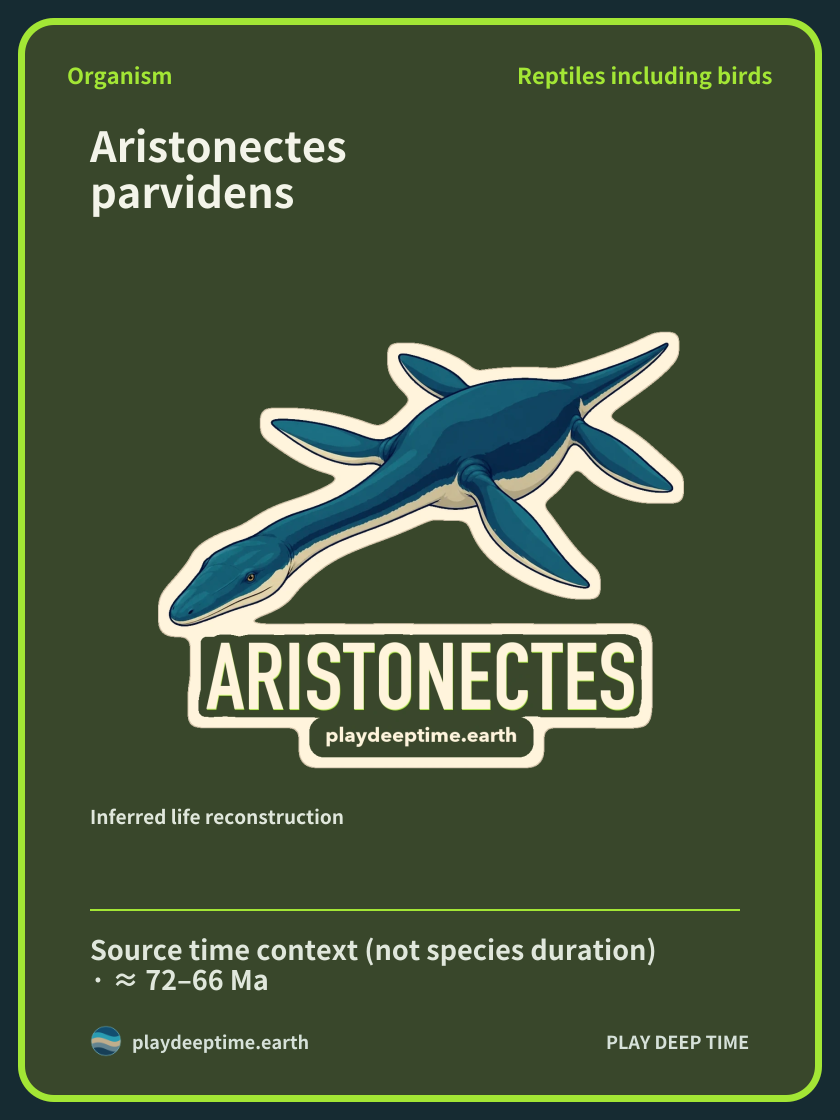
Organism · Reptiles including birds
Aristonectes parvidens
Source time context (not species duration) · ≈ 72–66 Ma
Inferred life reconstruction
Aristonectes parvidens
Overview
Aristonectes parvidens is a plesiosaur from seas at the end of the Cretaceous. Its small teeth, densely arranged along the jaws, attracted particular attention. Long-necked marine reptiles probably did not all capture food in the same way.[1][4]
Loading illustration…
Key facts
Does accommodating many teeth require only a longer jaw? The study focused on the tooth sockets themselves becoming smaller and the gaps between them narrowing. Changes in many small structures thus altered the appearance of the entire mouth.[4]
Time and place
It is known from the Maastrichtian, at the end of the Cretaceous, about 72–66 million years ago. Important fossils of the species came from present-day Chubut Province, Argentina. They offer a view of diverse plesiosaurs that lived in South American seas.[1]
The time range describes source context, not the complete duration of this species.
Size, form and skeleton
Small tooth sockets are densely arranged in the jaws. Changes in relative width can be examined in the neck vertebrae. A 2016 study read these features together to analyze how the head and neck differed from those of other elasmosaurids.[4]
Aristonectes parvidens was a plesiosaur that lived in southern seas at the end of the Cretaceous. A study reexamining the type specimen from present-day Chubut, Argentina, recorded a skull length of about 60cm. The large head preserves space for closely packed small teeth, revealing a mouth shape different from those of other plesiosaurs.[5]
Loading illustration…
Habitat and reproduction
What food might suit numerous small teeth? Researchers discussed possibilities such as using smaller fish or invertebrates, or capturing several prey items together. A large body in the sea does not always imply feeding only on large prey.[4]
Fossil discovery
A 2016 study reexamined the already known type specimen and added information on the jaw and neck vertebrae. Other skeletal studies of the genus Aristonectes also provide a background for comparing bodies. This is a case of continuing discovery by reading old specimens with new questions.[4][2]
References
- O’Gorman (2016), “New Insights on the Aristonectes parvidens Holotype: News on an Old Specimen,” Ameghiniana 53(4):397–417. DOI 10.5710/AMGH.24.11.2015.2921.
- Otero & O’Gorman (2013), “Identification of the first postcranial skeleton of Aristonectes Cabrera (Plesiosauroidea, Elasmosauridae) from the upper Maastrichtian of the south-eastern Pacific, based on a bivariate graphic analysis,” Cretaceous Research 41:86–89. DOI 10.1016/j.cretres.2012.11.001.
- Benson, Evans & Druckenmiller (2012) — High Diversity, Low Disparity and Small Body Size in Plesiosaurs
- O’Gorman2016 — New insights on the Aristonectes parvidens holotype
- O’Gorman (2016) — Reassessment of the Aristonectes type specimen
Research questions
How can we move from the presence of many small teeth to understanding prey capture? Tooth-row length, gaps between teeth, and neck movement need to be considered together. This animal raises questions about how diverse plesiosaur feeding strategies may have been.[4]
Observation
Examine the widened mouth, densely packed tooth rows, and the neck continuing behind them.[4]
Related organisms
 Plesiosaurus dolichodeirusReptiles including birdsSource time context (not species duration) · ≈ 201–143 Ma
Comparing Jurassic and Cretaceous plesiosaurs
Look at Jurassic Plesiosaurus and Cretaceous Aristonectes side by side. Comparing the head, tooth rows, and neck makes it difficult to think of plesiosaurs as having one fixed appearance.