Organism · Arthropods
Arthropleura armata
Source time context (not species duration) · ≈ 359–299 Ma
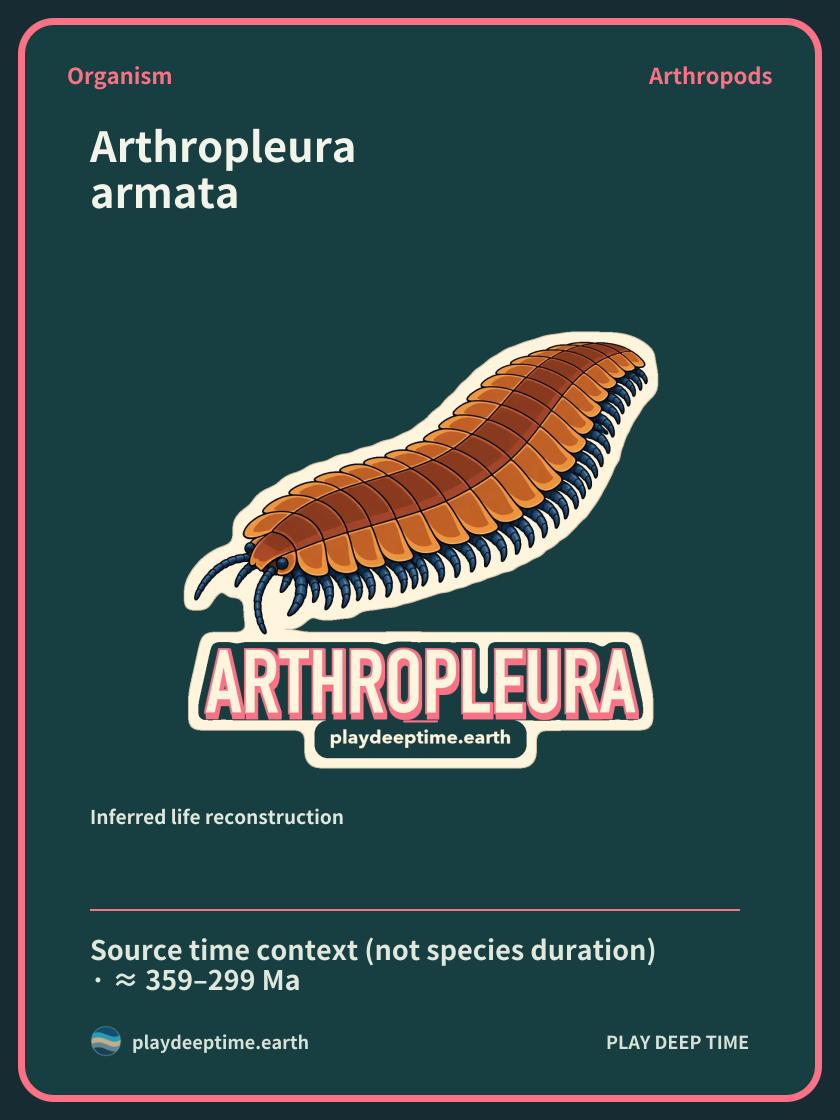
Inferred life reconstruction
Arthropleura armata
Overview
Arthropleura armata is an arthropleurid species known for broad dorsal plates and many short legs. One fragmentary fossil from Writhlington was assigned to this species. It provides evidence for exploring an ancient arthropod with repeated body segments.[1][3]
Loading illustration…
Key facts
The broad dorsal plates are divided into central and lateral portions. Repetition of such plates along the body is a major arthropleurid feature. Even one armor-like body is, on closer examination, a combination of several parts.[3]
Time and place
This species is associated with Late Carboniferous material from Writhlington. The Carboniferous was roughly 360–300 million years ago. Fragments of dorsal plates and legs provide material for comparing arthropod forms of this time.[1][4]
The time range describes source context, not the complete duration of this species.
Size, form and skeleton
Arthropleurids are described as having repeated dorsal plates divided into central and lateral parts, broad side regions, and many short legs. Material addressing the assignment to armata consists of fragmentary fossils. The forms of body-covering plates and legs can be examined separately.[1][3]
The German Palaeontological Society introduces Arthropleura armata as a giant terrestrial arthropod that grew to about 2.5m in length.[5]
Loading illustration…
Habitat and reproduction
The many body segments and legs invite exploration of changes in construction during growth. In small juvenile specimens of the same genus, the head, antennae, and growth of body segments were studied. Comparing juvenile and adult material is one way to explore ancient myriapods.[2]
Fossil discovery
The Writhlington study addressed fragments of dorsal plates, legs, and rosette plates, identifying one as armata. Later genus-level research examined the head in small juvenile specimens from Montceau. Evidence of different sizes and regions broadens arthropleurid research.[1][2]
References
- Arthropleurid fossils from Writhlington
- Study of arthropleurid heads and relationships
- Study of new morphological traits in arthropleurids
- International Commission on Stratigraphy (2024) — Geological time chart
- Paläontologische Gesellschaft — Arthropleura, Fossil of the Year 2015
- Bicknell et al. (2019) — Euproops specimens preserved together
- Bicknell·Pates (2020) — An atlas of fossil and living horseshoe crabs
Research questions
How can similar dorsal-plate fragments be distinguished as different species? Surface tubercles and plate forms are compared when reconsidering species diagnoses. Another question involves studying together the information from small juveniles and that from fragments of large bodies.[3][2]
Observation
Distinguish the central and lateral portions of the broad dorsal plates, then examine the plates repeating along the body. Imagining the many short legs beneath makes its repeating construction clearer.[3]
Related organisms
 Euproops danaeArthropodsSource time context (not species duration) · ≈ 359–299 Ma
Different bodies among arthropods
Explore the bodies and living backgrounds of Arthropleura and Euproops danae together. Arthropleura: Arthropleura armata is an arthropleurid species known for broad dorsal plates and many short legs. One fragmentary fossil from Writhlington was assigned to this species. Euproops danae: Euproops danae is an arthropod characterized by a broad anterior shield, rounded rear body, and long telson. Fossils with the front and rear body connected are known.