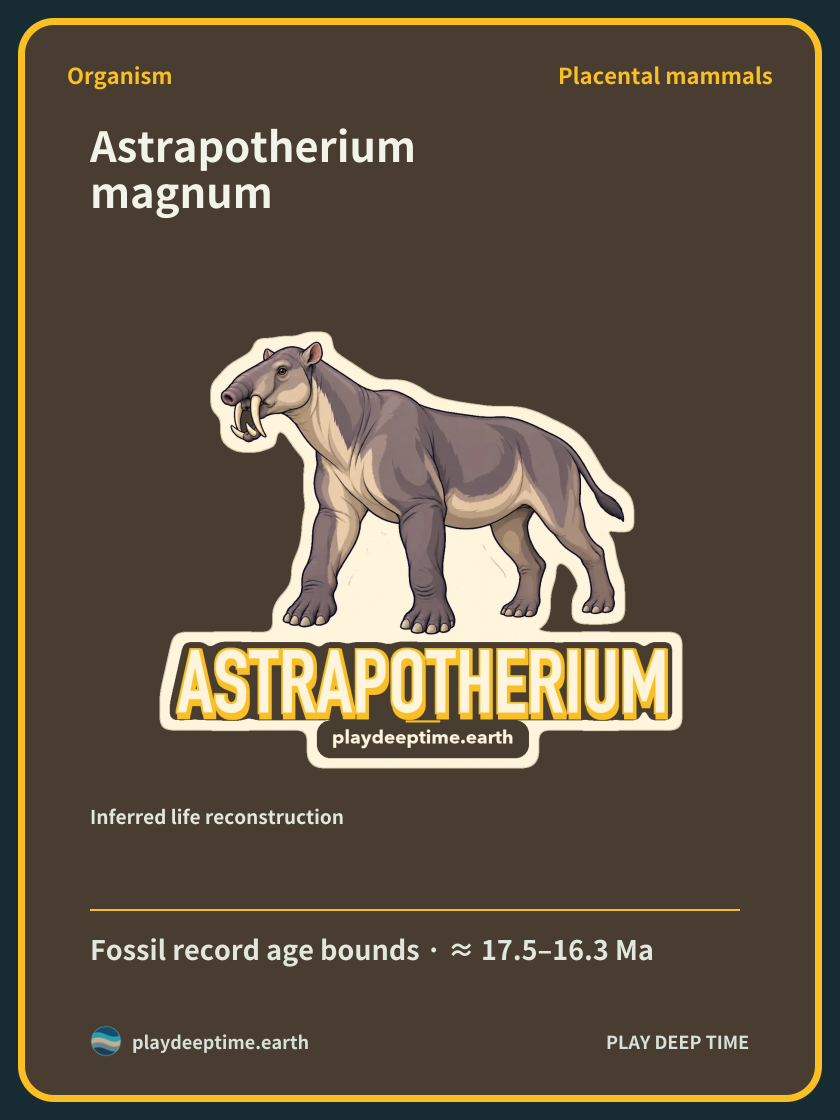
Organism · Placental mammals
Astrapotherium magnum
Fossil record age bounds · ≈ 17.5–16.3 Ma
Inferred life reconstruction
Astrapotherium magnum
Overview
Astrapotherium magnum is an extinct South American mammal studied for large canine teeth and a distinctive head structure. In addition to skulls and teeth, records exist of a body skeleton displayed in a museum. The story extends from an unfamiliar head to the trunk and limbs.[1][2][3]
Loading illustration…
Key facts
A 1935 Field Museum bulletin reported the display of an articulated skeleton of this animal. The skeleton was mounted to show the animal lying down. How a museum presented an ancient animal to visitors also remains part of research history.[1]
Time and place
The historical museum article introduced this animal as a Miocene South American mammal and described fossil material from southern Argentina. The Miocene was roughly 23–5 million years ago. It appears in stories exploring ancient South American mammals.[1][4]
The time range describes source context, not the complete duration of this species.
Size, form and skeleton
Large canine teeth and a broad nasal cavity are treated as comparative head features. The account of the skeleton displayed in 1935 describes a deep, narrow chest, relatively robust forelimbs, and more slender hind limbs. The head and front–rear body differences can be examined separately.[1][3]
Astrapotherium magnum is introduced as having a head-and-body length of about 3m based on the skeleton displayed at the Field Museum. This differs from total length including the tail, and the contrast between a long trunk and short legs stands out.[5]
Loading illustration…
Habitat and reproduction
The broad nasal cavity was a clue that led researchers to consider a soft-tissue nose. It is a case of inferring other tissues in life from spaces left by bones. Teeth and structures around the nose convey different questions within the same head.[3]
Fossil discovery
The Field Museum’s 1935 display article and skull and tooth catalogues of the Paris natural history museum convey different evidence. One records the displayed body skeleton and its features; the other records particular fossils in a collection. Several kinds of records can reveal the same organism.[1][2]
References
- Riggs (1935) — Astrapotherium on museum display
- National Museum of Natural History, Paris — Skull and teeth of Astrapotherium
- Santa Cruz Formation study — Teeth and nose of Astrapotherium
- International Commission on Stratigraphy (2024) — Geological time chart
- Croft et al. (2020) — Evolution of South American native ungulates
- Homalodotherium — Reassessment of an old naming problem
- Elissamburu — A study of the functional morphology of the limbs of Homalodotherium
Research questions
Can a soft-tissue nose be considered when only head bones remain? Researchers sought clues in the broad nasal cavity and surrounding structures. This shows a process of inference connecting bone shape with tissues present in life.[3]
Observation
Move your gaze from the large canines to the area around the nose and the head outline. Then examine the chest, forelimbs, and hind limbs separately to see how different regions of this unfamiliar mammal convey different impressions.[1][3]
Related organisms
 Homalodotherium cunninghamiPlacental mammalsSource time context (not species duration) · ≈ 23–5.33 Ma
Different bodies among mammals
Explore the bodies and living backgrounds of Astrapotherium magnum and Homalodotherium cunninghami together. Astrapotherium magnum: Astrapotherium magnum is an extinct South American mammal studied for large canine teeth and a distinctive head structure. In addition to skulls and teeth, records exist of a body skeleton displayed in a museum. Homalodotherium cunninghami: Homalodotherium cunninghami is a Miocene mammal known from teeth and partial skulls. Research on the genus including this species describes long forelimbs and a body profile sloping downward behind the shoulders.