Organism · Trilobites
Aulacopleura koninckii
Fossil record age bounds · ≈ 433–423 Ma
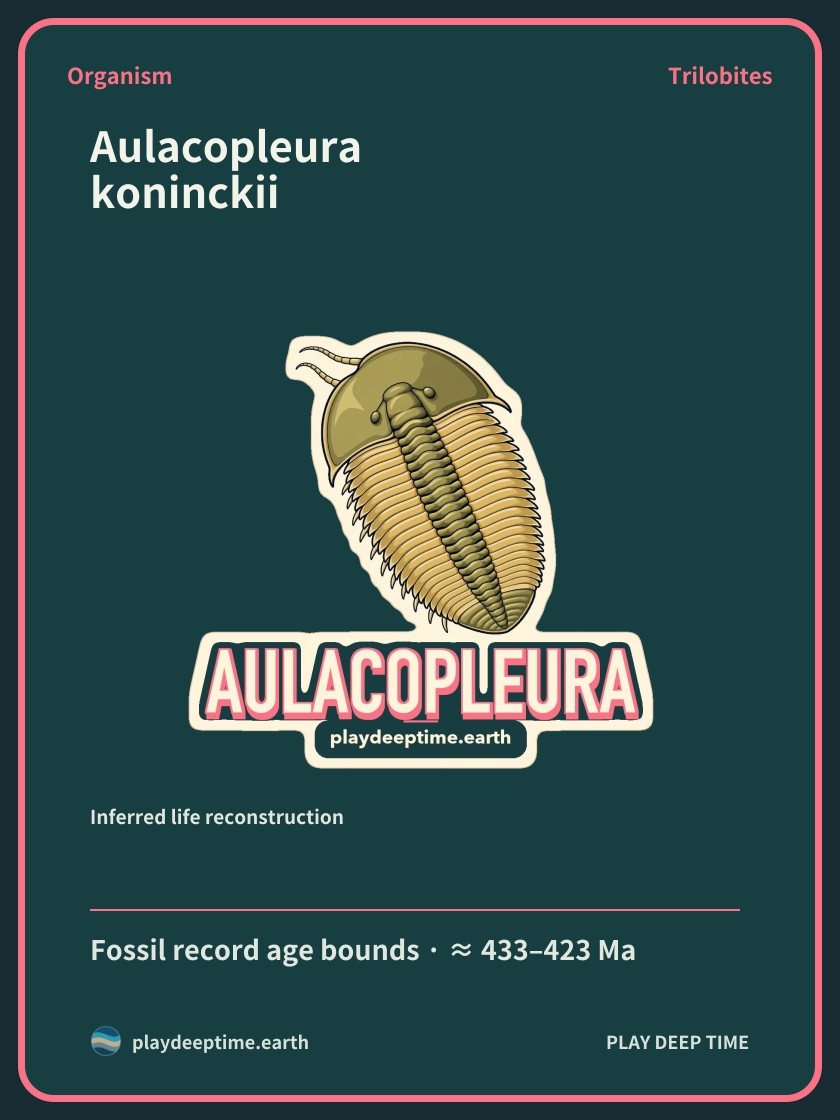
Inferred life reconstruction
Aulacopleura koninckii
Overview
Aulacopleura koninckii is a Silurian trilobite with a long series of body segments. Fossils from many growth stages make it important evidence for studying how ancient animals grew. This illustration shows the hard dorsal exoskeleton from above.[1]
Loading illustration…
Key facts
Thoracic segment numbers varied even within one species. The paper describes five forms with 18–22 thoracic segments among individuals that had finished adding segments. It explains that such variation within a species is especially uncommon among post-Cambrian trilobites.[1]
Time and place
A 2017 study presents it as a middle Silurian animal from approximately 429 million years ago. The material underlying the illustration came from the Na Černidlech locality near Loděnice in present-day Czechia. Ancient mudstone preserves trilobites at several growth stages.[1]
The time range describes source context, not the complete duration of this species.
Size, form and skeleton
A long series of thoracic segments connects the rounded head with a small tail region. A narrow central axis runs along the body, with repeated segments on either side. Follow the head through the trunk to the small terminal region to examine the arrangement of the dorsal exoskeleton.[1]
Aulacopleura koninckii is a very flat-bodied trilobite. A 2020 study of its eyes describes its body height as usually no more than 1–2 mm. This is its height above the seafloor, not its front-to-back length.[4]
Loading illustration…
Habitat and reproduction
Exoskeletons at several growth stages were found on multiple bedding surfaces in the mudstone interval. Citing earlier environmental research, the 2017 paper describes fluctuating oxygen supply at the site. It discusses the possibility that Aulacopleura populations sometimes increased greatly in these conditions.[1]
Fossil discovery
The paper identifies paleontologist Joachim Barrande as the first to excavate the locality, probably in the 1840s. Almost all the material used in the study also came from that excavation. Numerous exoskeletons collected long ago provided evidence for comparing growth sequences. Old collections were revisited with new questions.[1]
References
Research questions
Researchers reconstructed growth in models by comparing fossil size, shape, and segment numbers. They distinguished stages of segment addition from later stages when the body continued growing and molting without adding segments. Comparing which regions grew faster revealed changes in body proportions.[1]
Observation
The illustration is based on an articulated dorsal exoskeleton photographed in Fig1D of the 2017 paper. Follow the rounded head, repeated body segments, and small tail region from above. The removal of background, tidying of cracks, and chosen colors are interpretive decisions intended to make the exoskeleton’s outline easier to read.[1]
Related organisms
 Suminia getmanoviSynapsidsFossil record age bounds · ≈ 264–260 Ma
Growth records found in body segments and inside bones
Researchers reconstructed growth by comparing size and segmentation in Silurian Aulacopleura exoskeletons. Studies of Permian Suminia found growth clues in tissues inside long bones. Explore how ancient animals grew through two different records: a hard external covering and bones within the body.