Organism · Animals
Aysheaia pedunculata
Source time context (not species duration) · ≈ 539–487 Ma
Inferred life reconstruction
Aysheaia pedunculata
Overview
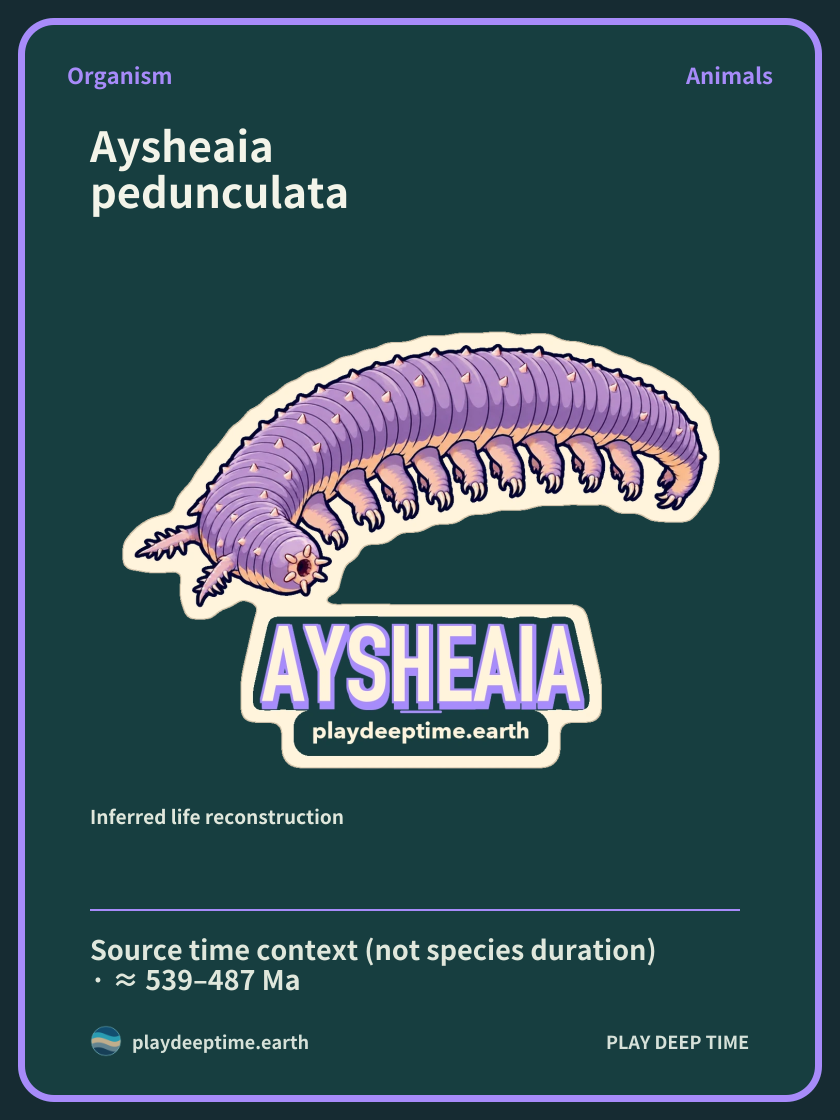
Aysheaia pedunculata is known for a soft, annulated body and numerous legs. Claws occur at the leg tips, and projections around the mouth and anterior appendages are also described. We can examine repeated body structures together with different features at the front end.[1]
Loading illustration…
Key facts
Ten pairs of legs are reported. The final pair is described as pointing forward. Even legs arranged in rows along one body should be examined with their directions in mind.[1]
Time and place
It is a Cambrian organism. The Cambrian spanned approximately 540–490 million years ago. The museum’s morphological account describes the annulated body, legs, and appendages at the front end.[1][2]
The time range describes source context, not the complete duration of this species.
Size, form and skeleton
The body is soft and annulated. Ten pairs of clawed legs extend along it, while separate appendages and projections around the mouth occur at the front. The forward orientation of the final legs is also part of its arrangement.[1]
The museum species account gives a maximum length of 60 mm.[1]
Loading illustration…
Habitat and reproduction
Do numerous legs arranged in rows all point the same way? In Aysheaia, the last pair is described as facing forward. Among repeated legs, we can find a different arrangement at the end.[1]
Fossil discovery
The museum’s species account describes body annulations and legs together with claws and the mouth region. Observation can extend from repeated trunk structures to small anterior appendages.[1]
References
Research questions
How are body rings and legs positioned relative to one another? We can examine the whole outline, paired legs, and direction of the final pair separately. Observation rereads the broad repetition of rings through several structures.[1]
Observation
Follow the annulated body to examine ten pairs of legs and their terminal claws. Moving your gaze to the anterior appendages and projections around the mouth reveals a front-end arrangement different from the repeated body structures.[1]
Related organisms
 Isoxys auritusArthropodsSource time context (not species duration) · ≈ 539–487 Ma
Different bodies and appendages of Cambrian fossils
Explore the different bodies and records of time preserved in these two organisms. Aysheaia: Aysheaia pedunculata is known for a soft, annulated body and numerous legs. Claws occur at the leg tips, and projections around the mouth and anterior appendages are also described. It is a Cambrian organism. The Cambrian spanned approximately 540–490 million years ago. Isoxys auritus: Isoxys auritus is an arthropod known for its rounded carapace, rear spines, and projecting stalked eyes. The appendages beneath its carapace are also compared. It is known from studies of appendages and eyes in Cambrian arthropods. The Cambrian spanned approximately 540–490 million years ago.