Organism · Placental mammals
Basilosaurus isis
Source time context (not species duration) · ≈ 66–23 Ma
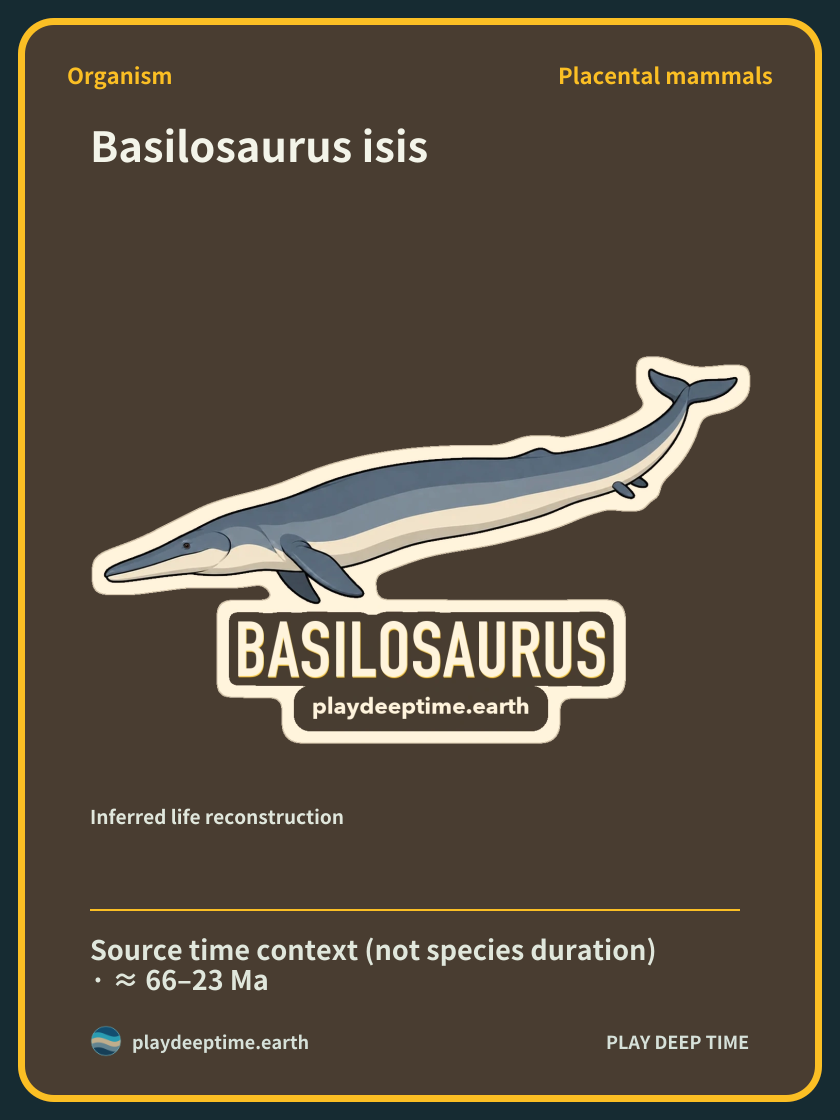
Inferred life reconstruction
Basilosaurus isis
Overview
Basilosaurus isis was a large Eocene whale with an elongated body. Even in a body already adapted to the sea, very small hind limbs remained. Fossils in what is now a desert tell a story about the food of ancient whales.[1]
Loading illustration…
Key facts
The bones of another whale can reveal what a large whale ate. Bones and fragments of juvenile Dorudon were studied around one Basilosaurus skeleton. The researchers interpreted them as stomach contents and presented them as evidence of predation.[1]
Time and place
It lived in seas of the late Eocene, around 37 million years ago. Important fossils came from Wadi Al-Hitan in present-day Egypt. Marine sedimentary layers preserved in the desert hold the history of several whales.[1]
The time range describes source context, not the complete duration of this species.
Size, form and skeleton
Adults are estimated to have been about 15–18 m long. A body axis extending through an elongated trunk and tail is characteristic. The hind limbs were very small relative to the large body, illustrating an evolutionary stage different from whales today.[1]
Loading illustration…
Habitat and reproduction
It is studied as a large marine predator. Fragments of juvenile Dorudon bones and bite marks provide material for investigating its prey. Researchers examine the relationship between bones interpreted as stomach contents and the surrounding sediment to learn about its diet.[1]
Fossil discovery
A 2019 study analyzed specimen WH10001 from Wadi Al-Hitan and the bones around it. It distinguished the remains of the large whale from those of juvenile Dorudon and compared their locations. Examining the area around a skeleton led to a new ecological story.[1]
References
Research questions
Were nearby bones food remains, or were they mixed together after burial? Researchers compare bone positions, breakage, bite marks, and sediment movement. This is an example of combining several clues to explore feeding relationships in the seas where these whales lived.[1]
Observation
Look for the small hind limbs along the elongated trunk and tail. Remember that not only the skeleton of the large animal but also the bones of other animals nearby can tell a story.[1]
Related organisms
 Dorudon atroxPlacental mammalsSource time context (not species duration) · ≈ 56–33.9 Ma
Fossils revealing feeding relationships among whales
Bones of juvenile Dorudon were studied around one Basilosaurus isis skeleton. Based on fragments, bite marks, and bone positions, researchers interpreted them as stomach contents. These fossils tell a story about feeding relationships among whales.