Organism · Ray-finned fishes
Berycopsis elegans
Source time context (not species duration) · ≈ 143–66 Ma
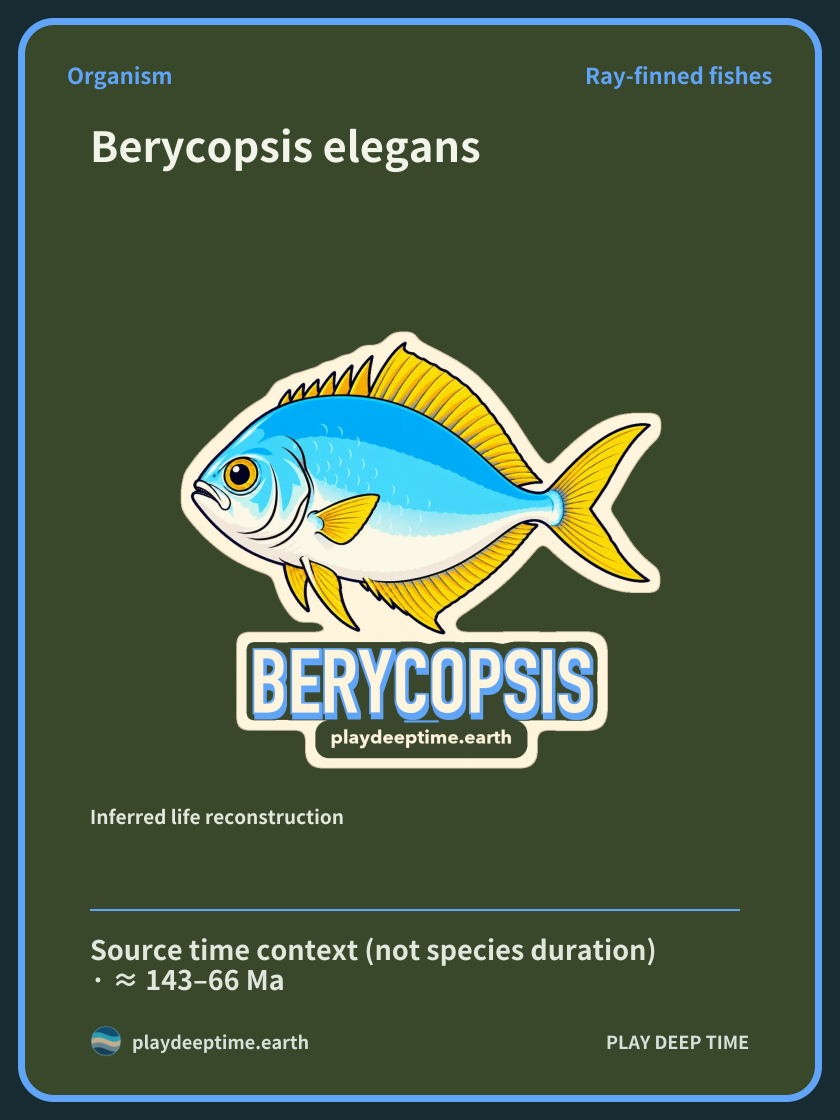
Inferred life reconstruction
Berycopsis elegans
Overview
Berycopsis elegans is a Cretaceous fish with a deep, laterally flattened body. Large eyes, six short anterior dorsal spines, and an elongated fin farther back stand out. It offers a way to examine distinctions between rigid spines and delicate fins within a fish’s body.[1]
Loading illustration…
Key facts
Look separately at the front and rear of the back. Six short dorsal spines lie at the front, followed by an elongated fin. Different structures can be distinguished within what appears to be one continuous dorsal outline.[1]
Time and place
This fossil was described in Woodward’s 1902 study of fishes from the British Chalk. The Cretaceous spanned approximately 140–66 million years ago. Old descriptions and reconstruction drawings remain evidence for examining its body organization.[1][2]
The time range describes source context, not the complete duration of this species.
Size, form and skeleton
The trunk is deep and laterally flattened, with large eyes and gill covers. Anterior dorsal spines, the framework of elongated median fins, and small, delicate pectoral fins are described. The broad outlines around the belly and tail are interpretations connecting the author’s reconstruction with the body arrangement.[1]
Berycopsis elegans was described as reaching approximately 30 cm in body length. A body about as long as a 30 cm ruler combines a laterally flattened trunk with a forked tail fin.[8]
Loading illustration…
Habitat and reproduction
Compare the small pectoral fins with the elongated median fins. Structures of different sizes and positions occupy one body. In side view, the far-side fins may be hidden, prompting consideration of the visible outline alongside the three-dimensional animal.[1]
Fossil discovery
Woodward’s 1902 description explained the form of Berycopsis and presented a whole-body reconstruction. The illustration connected several anatomical clues to understand the entire animal. It combines reading preserved regions with interpretation linking the gaps.[1]
References
- Woodward (1902) — Berycopsis from the British Chalk
- International Commission on Stratigraphy (2024) — Geological time chart
- 2010 study — Giant plankton-feeding fishes of Mesozoic seas
- International Commission on Stratigraphy (2024) — Geological time chart
- Rhinconichthys — Study of the head of a specialized filter-feeding fish
- Woodward (1902) — Berycopsis from the British Chalk
- International Commission on Stratigraphy (2024) — Geological time chart
- Woodward (1902), The Fossil Fishes of the English Chalk, Berycopsis elegans
Research questions
How do bones revealed by fossils differ from outlines connected in a reconstruction? Research on this fish distinguishes fin frameworks from the overall outline. Examining fossil and drawing together invites questions about the structures used to depict the body.[1]
Observation
Move your gaze from the large eyes to the short spines at the front of the back. Comparing the long fin outline with the small pectoral fins in sequence reveals the arrangement around the deep trunk.[1]
Related organisms
 Rhinconichthys tayloriRay-finned fishesSource time context (not species duration) · ≈ 143–66 Ma
Different Cretaceous fishes from present-day Britain
Rhinconichthys and Berycopsis are fishes known from Cretaceous material in present-day Britain. Examine separately a large head and gill region in one, and a deep, laterally flattened body and dorsal spines in the other.