Organism · Reptiles including birds
Besanosaurus leptorhynchus
Source time context (not species duration) · ≈ 252–201 Ma
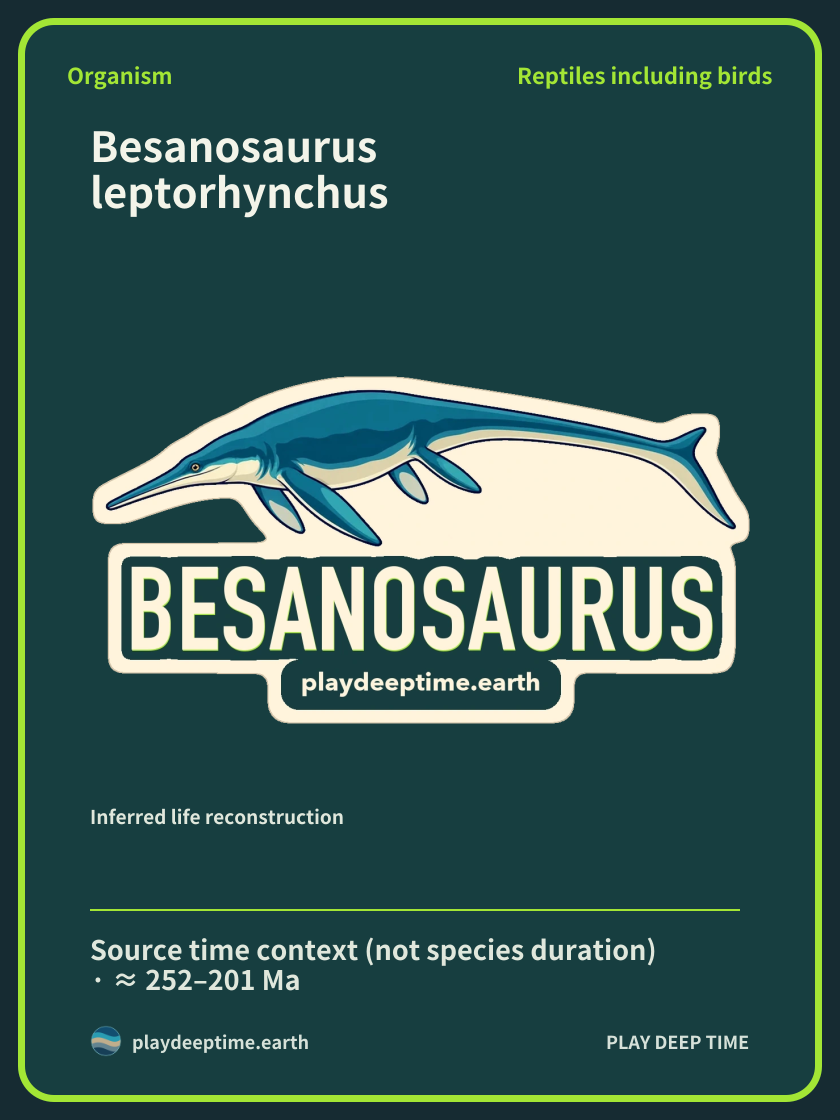
Inferred life reconstruction
Besanosaurus leptorhynchus
Overview
Besanosaurus leptorhynchus is an ichthyosaur known for a long snout and neck and a trunk narrowing toward the pelvis. The type specimen is described as a nearly complete skeleton. Its construction can be compared from the head to the rear of the body.[1]
Loading illustration…
Key facts
The type specimen BES SC999 is exposed on its ventral side. Even in the same skeleton, the bones visible depend on which face is exposed. The direction from which a fossil is viewed itself provides a clue to anatomy.[1]
Time and place
It is studied in species-specific literature on Triassic ichthyosaurs. The Triassic was roughly 250–200 million years ago. The type specimen and other material assigned to the species were used for comparisons of the trunk and limbs.[1][2]
The time range describes source context, not the complete duration of this species.
Size, form and skeleton
The trunk follows the long snout and neck, and the body narrows toward the pelvis. One pair of forefins, one pair of hind fins and a tail make up the main construction. The text also addresses the close positions of the sacral rib and ilium.[1]
The large Besanosaurus specimen PIMUZ T 4847 does not preserve the entire body. In 2021, researchers regarded this individual as a fully grown adult and estimated its body length at about 8m.[10]
Loading illustration…
Habitat and reproduction
Where do a marine reptile’s fins connect to its trunk? This study separately examined the shoulder, forefin, and structures around the pelvis. It is a way of dividing a broad outline into connections among several parts.[1]
Fossil discovery
Researchers compared information from the nearly complete BES SC999 with other specimens assigned to the species. Evidence from the neck and back vertebrae, pelvic region, and anterior tail is complementary. The study explores the same body construction from different orientations and specimens.[1]
References
- Study — Trunk and fins of Besanosaurus
- International Commission on Stratigraphy (2024) — Geological time chart
- Study — Forefins and classification of Chaohusaurus
- Merriam — Cymbospondylus, a Triassic ichthyosaur
- Ferrante·Cavin (2023) — A new view of a short, plump coelacanth
- Study — Trunk and fins of Besanosaurus
- International Commission on Stratigraphy (2024) — Geological time chart
- Postcranial anatomy of Besanosaurus leptorhynchus from the Middle Triassic Besano Formation of Monte San Giorgio
- The research history of the Middle Triassic fishes of Monte San Giorgio: getting out of the shadow of aquatic reptiles
- Bindellini et al. (2021) — Skull anatomy of Besanosaurus
Research questions
What should be examined if a fossil’s left and right sides were compressed differently? Research on the limbs of Besanosaurus also addresses deformation caused by compression. Comparing the positions and shapes of preserved bones helps distinguish biological structure from preservation processes.[1]
Observation
Follow the long snout and neck to the trunk narrowing toward the pelvis. Examining the positions of the forefins, hind fins, and tail in sequence reveals several connections within the long body.[1]
Related organisms
 Chaohusaurus geishanensisReptiles including birdsSource time context (not species duration) · ≈ 252–201 Ma
Comparing ichthyosaur forefins
Examine forefin material from Chaohusaurus and Besanosaurus side by side. You can compare each animal’s construction through the upper arm, forearm, and connection to the trunk.
 Cymbospondylus petrinusReptiles including birdsSource time context (not species duration) · ≈ 252–201 Ma
Comparing long-bodied ichthyosaurs
Compare the trunks and four fins of Cymbospondylus and Besanosaurus. Several skeletal sources provide information for understanding different regions of their long bodies.
 Rieppelia heinzfurreriCoelacanthsFossil record age bounds · ≈ 243–241 Ma
Short fishes and long ichthyosaurs of Monte San Giorgio
The Middle Triassic Besano Formation at Monte San Giorgio preserves records of fishes and marine reptiles together. Look in turn at Rieppelia heinzfurreri, with a short trunk and large gill cover, and Besanosaurus leptorhynchus, with a long snout and one pair of forefins and one pair of hind fins. A locality spanning present-day Switzerland and Italy offers different body constructions.