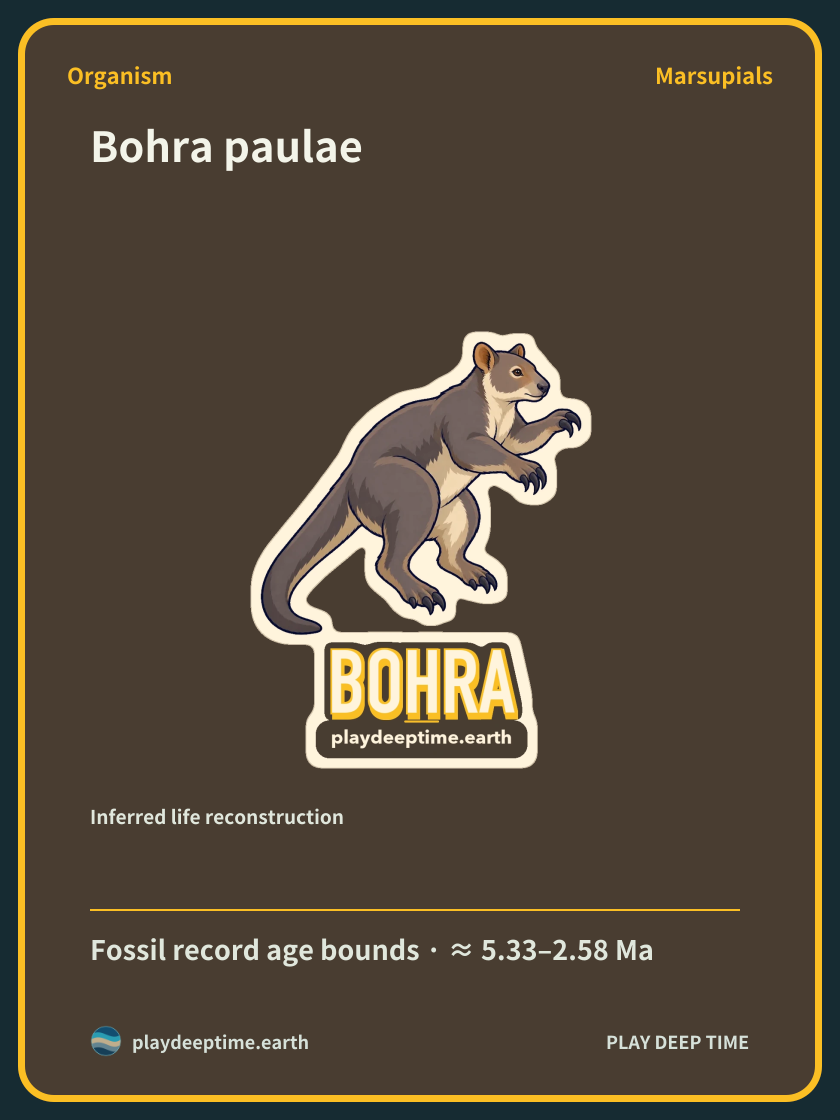
Organism · Marsupials
Bohra paulae
Fossil record age bounds · ≈ 5.33–2.58 Ma
Inferred life reconstruction
Bohra paulae
Overview
Bohra paulae is an extinct kangaroo known from hind-limb fossils. Researchers compared ankle and leg bones and proposed a close relationship with tree kangaroos. Small joint bones offer clues to the bodies and lifestyles of kangaroos.[1]
Loading illustration…
Key facts
Ankle bones kept separately can turn out to belong to the same animal. The calcaneus AM F62099 and talus AM F62100 were treated as bones of one individual after their fit and preservation were compared. The way the bones articulate helped unravel their fossil history.[2]
Time and place
This kangaroo is known from Wellington Caves in east-central New South Wales, present-day Australia. The study of its specimens tentatively assigned their occurrence to the Pleistocene. The Pleistocene spanned approximately 2.6 million–12,000 years ago.[2][3][4]
The time range describes source context, not the complete duration of this species.
Size, form and skeleton
The calcaneus and talus form part of the ankle, while the tibia is the long bone of the lower leg. Bohra paulae is studied through this hind-limb material. Comparing ankle joint surfaces and the shinbone reveals features supplied by different parts of the leg.[2]
Body mass calculated from the heel-bone specimen AM F 62099 of Bohra paulae ranges from approximately 26–44 kg. A 2023 study obtained these results by applying six equations to the same bone; estimates differed according to the model used.[5]
Loading illustration…
Habitat and reproduction
In 1982, a researcher interpreted hind-limb features as adaptations to life in trees and proposed a relationship with living tree kangaroos. Exploring tree kangaroos alongside it helps explain why kangaroos are studied in terms of diverse lifestyles.[1]
Fossil discovery
The original 1982 description explained this animal using hind-limb material. Later work reexamined the assignment of its ankle bones and how they fit together. Evidence used when the animal was first named and subsequent comparisons clarified the composition of the fossil material.[1][2]
References
- 1982 study — The extinct kangaroo Bohra paulae
- Bohra paulae — Reassessment of ankle specimens
- International Commission on Stratigraphy (2024) — Geological time chart
- Prideaux·Warburton(2009). Bohra nullarbora sp. nov. Records of the Western Australian Museum 25:165–179.
- Prideaux·Warburton (2023) — Bohra and the evolution of tree kangaroos
- Stirton·Marcus (1966) — Reassessment of genus and species diagnoses in Procoptodon
Research questions
Can a kangaroo’s hind limbs reveal clues to life in trees? One approach is to compare ankle shapes and joint connections with those of living kangaroos. This research prompts thoughts about the movement of a large body from the shapes of small bones.[1][2]
Observation
Follow the hind limb from the shin to the ankle. Imagining where the calcaneus and talus meet helps explain why two separately discovered bones were linked to one individual.[2]
Related organisms
 Macropus goliahMarsupialsFossil record age bounds · ≈ 5.33–0 Ma
Different bodies among kangaroos
Explore the bodies of Bohra and Macropus goliah together. Bohra paulae is an extinct kangaroo known from hind-limb fossils. Macropus goliah is an extinct member of the kangaroo family also linked to the name Procoptodon goliah.