Organism · Dinosaurs
Borealopelta markmitchelli
Source time context (not species duration) · ≈ 143–66 Ma
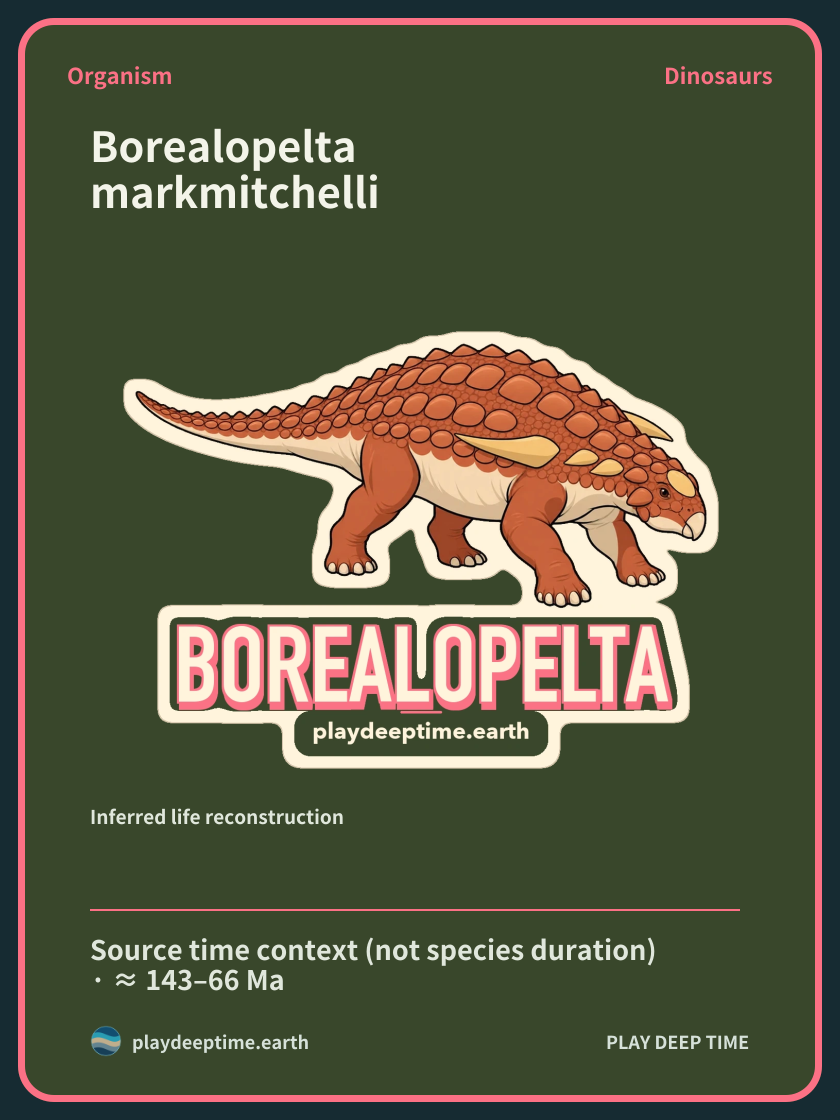
Inferred life reconstruction
Borealopelta markmitchelli
Overview
Borealopelta markmitchelli was a dinosaur with hard armor and large shoulder spines. Scales between the bony armor and even clues to body color survive. This fossil allowed research to go beyond a stone skeleton to investigate its appearance in life.[1]
Loading illustration…
Key facts
Even the color of an armored dinosaur can be studied in fossils. A 2017 study analyzed pigments and their distribution, interpreting the upper body as reddish brown and the underside as lighter. The contrast invites us to consider how light and dark areas affected its appearance.[1]
Time and place
It is known from the Early Cretaceous of present-day Canada. The rock surrounding the specimen was assigned to the Wabiskaw Member. The Early Cretaceous spanned approximately 140–100 million years ago.[1][2]
The time range describes source context, not the complete duration of this species.
Size, form and skeleton
Its low, broad body had transverse rows of bony plates with rows of scales between them. The largest shoulder spines curve backward and outward. A 2017 study reconstructed a total length of approximately 5.5 m from the incomplete type specimen.[1]
Loading illustration…
Habitat and reproduction
A mass containing plant tissues also survived inside the type specimen’s abdomen. In 2020, researchers interpreted it as ingested stomach contents based on its position and composition, among other evidence. Fern leaves are prominent, prompting investigation of this individual’s final meal.[3]
The authors explained that this material represents a brief event, perhaps the last few hours of one individual’s life. It offers a glimpse of one moment among meals that could vary with season and terrain. The outer armor and plant traces inside the body tell different stories about its life.[3]
Fossil discovery
In March 2011, a worker at the Suncor Millennium Mine discovered the fossil while removing overlying soil and rock at the mine in northeastern Alberta, Canada. The specimen recovered by Royal Tyrrell Museum and Suncor staff led to a 2017 study of an armored dinosaur preserved in three dimensions.[1][4]
References
- Three-dimensional preservation and pigment interpretation of an armoured dinosaur
- International Commission on Stratigraphy (2024) — Geological time chart
- Brown et al. (2020) — Research on the stomach contents and diet of Borealopelta
- Royal Tyrrell Museum. Grounds for Discovery: Specimen Fact Sheet.
- Prieto-Márquez & Salinas2010 — Secernosaurus and South American hadrosaurs
- Aragosaurus — Bonapartesaurus and Patagonian hadrosaurs
Research questions
What role might body color have played for a large, armored dinosaur? Researchers compared pigments and their preserved positions to propose a difference between upper and lower coloration called countershading. This research reads chemical traces in the fossil alongside the shapes of bones.[1]
Observation
Distinguish the rows of bony plates crossing the back from the rows of scales between them. Following the large spines backward and outward from the shoulders reveals characteristic features of this armored dinosaur.[1]
Related organisms
 Secernosaurus koerneriDinosaursSource time context (not species duration) · ≈ 143–66 Ma
Different bodies among dinosaurs
Explore the bodies and life settings of Borealopelta and Secernosaurus koerneri together. Borealopelta: Borealopelta markmitchelli was a dinosaur with hard armor and large shoulder spines. Scales between the bony armor and even clues to body color survive. Secernosaurus koerneri: Plant-eating dinosaurs with broad, duck-like mouths did not live only in North America. Secernosaurus koerneri is a hadrosaur from Patagonia in South America.