Organism · Synapsids
Brasilodon quadrangularis
Source time context (not species duration) · ≈ 252–201 Ma
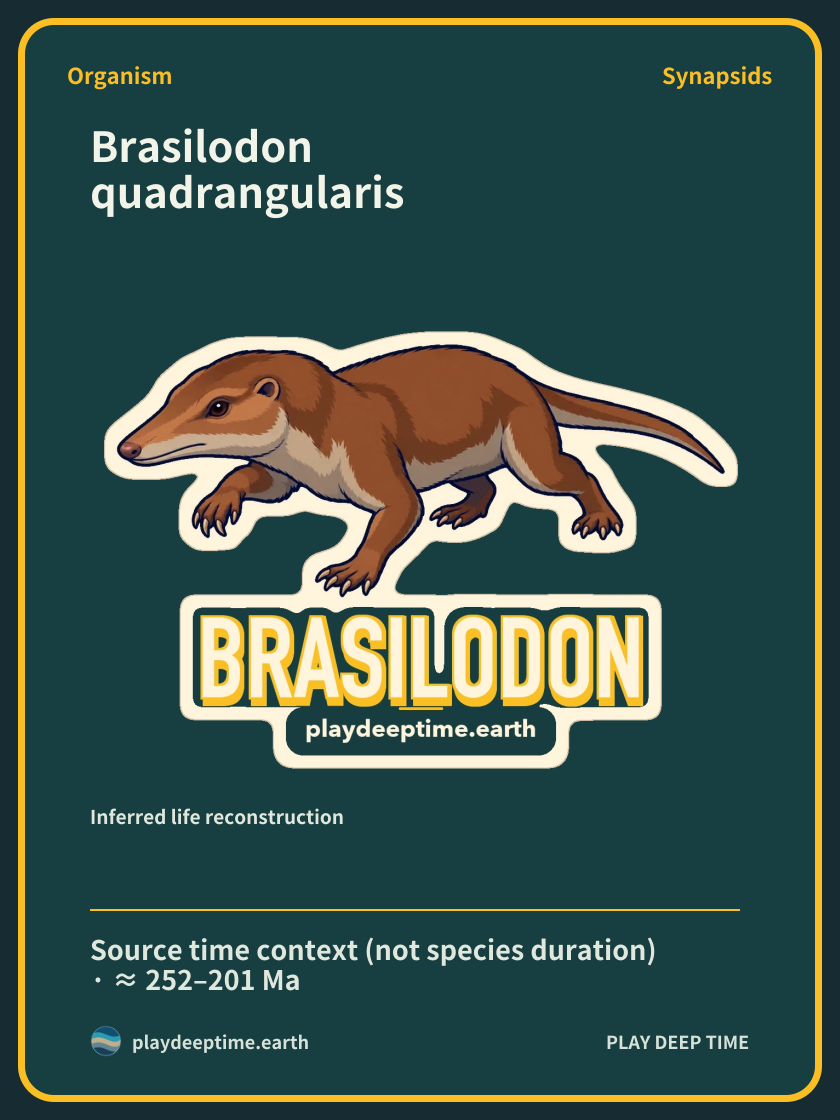
Inferred life reconstruction
Brasilodon quadrangularis
Overview
Brasilodon is a Late Triassic animal studied from heads, jaws, and partial body skeletons. Shoulder, pelvic, forelimb, and hind-limb structures were compared across several specimens. It appears in research examining how mammal-like features emerge.[1]
Loading illustration…
Key facts
Researchers interpreted a construction with somewhat sprawling forelimbs and more erect hind limbs. The front and rear limbs may not have been positioned in the same way. This difference emerges by examining the two regions separately.[1]
Time and place
It was studied from the Candelária sequence and Riograndia assemblage in present-day southern Brazil. It is a Late Triassic animal. The Triassic as a whole was roughly 250–200 million years ago.[1][2]
The time range describes source context, not the complete duration of this species.
Size, form and skeleton
One specimen includes an incomplete skull and lower jaw and a right ulna, among other remains. Another adds evidence from the axial skeleton, limbs, shoulder, and pelvis to the head and jaw. Clues to the body come together from different regions.[1]
Brasilodon quadrangularis is introduced as a small animal about 20cm long. The Natural History Museum in the United Kingdom described this size in a 2022 research account while introducing growth traces preserved in small teeth.[3]
Loading illustration…
Habitat and reproduction
Where can we recognize structures supporting the forelimbs and hind limbs differently? Researchers interpreted posture by comparing the shoulder, pelvis, and limb bones. The forms of small body bones lead to questions about how the whole body was supported.[1]
Fossil discovery
One specimen in the study of body bones had originally been assigned to Brasilitherium. The paper compared it while treating that name as a synonym of Brasilodon. This is a case in which a taxonomic judgment changed the range of specimens considered together.[1]
References
- Study — Postcranial skeleton and mammal-like traits of Brasilodon
- International Commission on Stratigraphy (2024) — Geological time chart
- Natural History Museum, UK (2022) — Study of Brasilodon teeth and growth
- Natural History Museum, UK (2022) — Study of Brasilodon teeth and growth
- US National Science Foundation (2007) — Discovery announcement of the Mesozoic mammal Yanoconodon
- 2017 study — The postcranial skeleton and locomotor adaptations of Yanoconodon
- Yanoconodon — Study of ear and jaw development in early mammals
Research questions
What more can be learned when more material is regarded as belonging to the same species? Features of the shoulder, pelvis, and limbs can be compared alongside the head. Questions of names connect with research on body structure.[1]
Observation
Move your gaze from the head to the trunk and forelimbs, then to the pelvis and hind limbs. Examining the front and rear limbs separately helps you consider the different support arrangements proposed by researchers.[1]
Related organisms
 Yanoconodon alliniMammalsSource time context (not species duration) · ≈ 143–66 Ma
Skeletons from different times revealing mammal-like features
Explore the different records of bodies and time preserved in these two organisms. Brasilodon: Brasilodon is a Late Triassic animal studied from heads, jaws, and partial body skeletons. Shoulder, pelvic, forelimb, and hind-limb structures were compared across several specimens. It was studied from the Candelária sequence and Riograndia assemblage in present-day southern Brazil. It is a Late Triassic animal. Yanoconodon allini: Yanoconodon allini is an early mammal with a small head, elongated trunk, and short limbs. The connection between its ear and jaw is also an intriguing research clue. It is studied from Early Cretaceous material in present-day Hebei, China. The Cretaceous was roughly 140–66 million years ago.