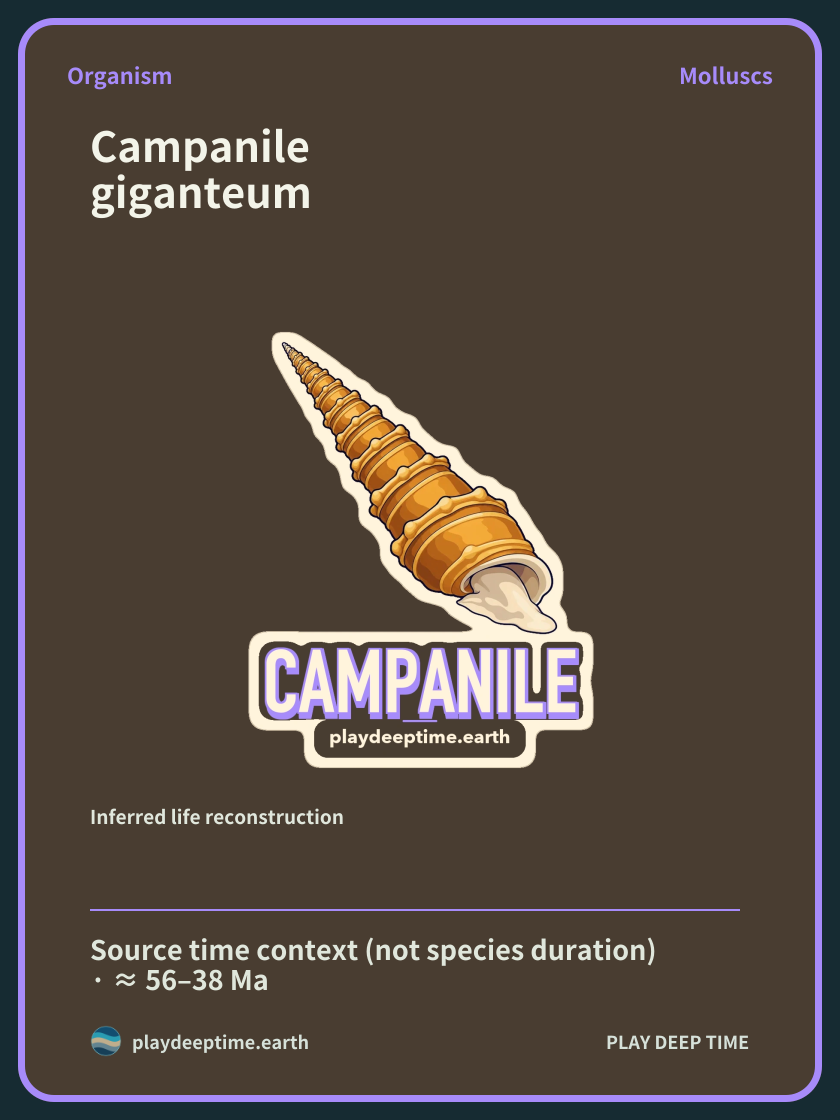
Organism · Molluscs
Campanile giganteum
Source time context (not species duration) · ≈ 56–38 Ma
Inferred life reconstruction
Campanile giganteum
Overview
The seasons of an ancient sea are hidden within a large, tower-like spiral shell. Campanile giganteum was a marine snail that lived in the seas of Eocene Europe. Fossils can reveal not only an organism's appearance, but also the summers and winters it experienced.[1]
Loading illustration…
Key facts
The shell did not form all at once; it was added to gradually as the snail grew. In 2020, researchers read its chemical composition along this growth sequence to identify seasonal changes. An ancient snail became a record of weather from tens of millions of years ago.[1]
Time and place
The fossils used in the study date to the Middle Eocene, about 45 million years ago. They came from Fleury-la-Rivière in the Champagne region of present-day France. Warm, shallow seas covered what is now dry land.[1][2]
The time range describes source context, not the complete duration of this species.
Size, form and skeleton
The tall shell consists of many spiral whorls and a central internal column. A shiny nacreous layer remains inside the opening. After examining the outer outline, imagine the internal structure and consider how such a large shell grew.[1]
Specimen MNHN-F-B70270 at the natural history museum in Paris has a shell length of 60 cm. It shows just how large the towering spiral shell could be.[7]
Loading illustration…
Habitat and reproduction
It lived in warm, shallow seas. The shell of the study specimen was interpreted as recording growth through almost the entire year, with slower growth in winter. Even in the same sea, the snail's growth rate varied with the seasons.[1][2]
Fossil discovery
A 2020 study compared French fossil shells designated E1, E2 and E3 with living snails of the genus Campanile. Fossil research expanded from classifying external appearance to reading microscopic growth traces within the shell.[1]
References
- de Winter et al. (2020), “The Giant Marine Gastropod Campanile giganteum (Lamarck, 1804) as a High-Resolution Archive of Seasonality in the Eocene Greenhouse World.”
- VUB — Giant sea snail fossil reveals climate of French Champagne region
- de Winter et al. (2020), “The Giant Marine Gastropod Campanile giganteum (Lamarck, 1804) as a High-Resolution Archive of Seasonality in the Eocene Greenhouse World.”
- VUB — Giant sea snail fossil reveals climate of French Champagne region
- Maxwell1969 — Middle Tertiary Mollusca from North Otago and South Canterbury
- Treatise — Shell features of Venericardia
- National Museum of Natural History, Paris — Campanile giganteum
Research questions
Winters when the shell grew slowly may occupy only a short part of the record. Researchers account for this difference when reconstructing ancient water temperatures. It is a fascinating line of research that asks not only what a fossil recorded, but how it recorded it.[1]
Observation
Examine the direction of the spiral, then the shell opening.[1]
Related organisms
 Venericardia imbricataMolluscsSource time context (not species duration) · ≈ 56–33.9 Ma
Two shells from the Eocene seas of France
Campanile and Venericardia are represented by different Middle Eocene material from present-day France. Compare the tower-like spiral of a snail shell with the two valves of a bivalve shell bearing scale-like rows, and explore the varied shapes of an ancient sea.