Organism · Turtle lineage
Carbonemys cofrinii
Source time context (not species duration) · ≈ 62–56 Ma
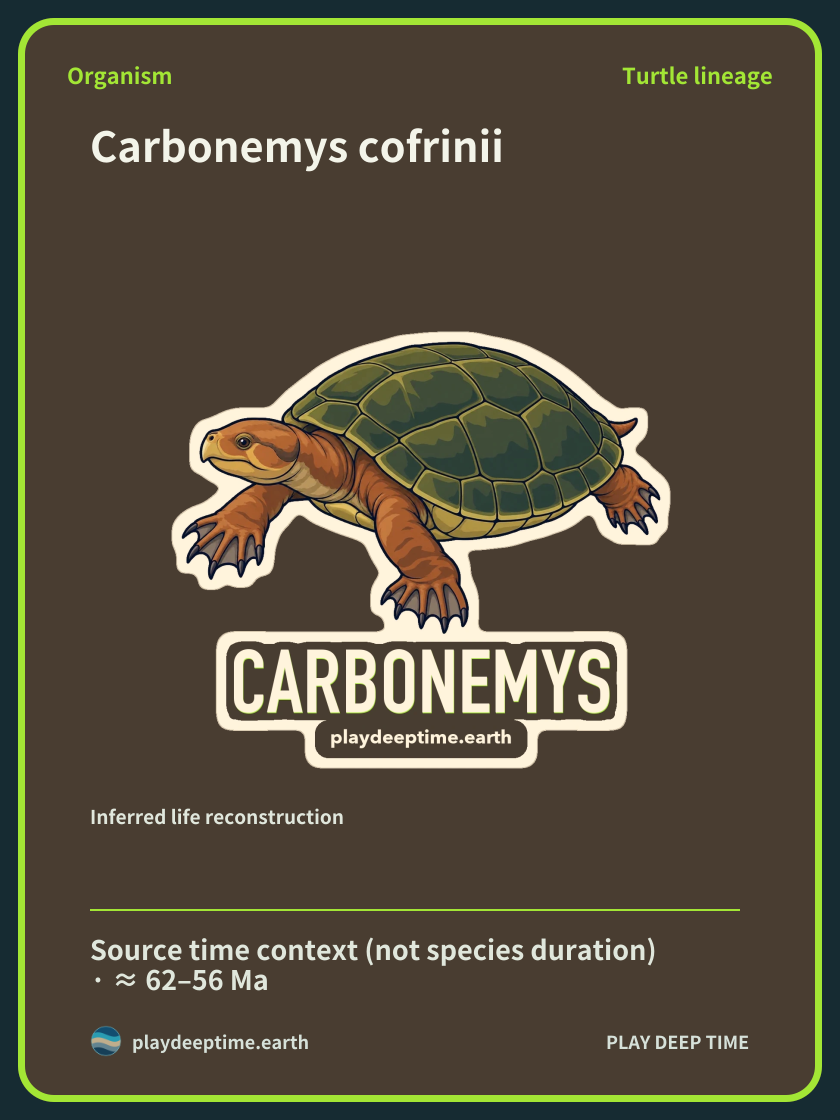
Inferred life reconstruction
Carbonemys cofrinii
Overview
Carbonemys cofrinii is an ancient turtle with a large head and robust jaws. It is known from warm waterside settings in Paleocene South America. It reveals the long-standing diversity of relatives of side-necked turtles, which fold their necks sideways.[1][4]
Loading illustration…
Key facts
The giant snake Titanoboa was also discovered at the Cerrejón coal mine where this turtle was found. Both organisms illuminate the tropical environment of the same time and region. Connecting turtle, snake, and plant fossils broadens the ancient landscape beyond a single organism.[2][3]
Time and place
Its fossils date to the late Paleocene, around 58–55 million years ago. The locality lies in the Cerrejón Formation in La Guajira, present-day northern Colombia. This is a tropical record preserving coal-forming plants and animals of waterside environments.[1]
The time range describes source context, not the complete duration of this species.
Size, form and skeleton
A large skull called UF/IGM41 is the key specimen of this species. The front of the head and its broad, robust jaws have been studied. Exploring what its head and mouth might have done is rewarding.[1]
Loading illustration…
Habitat and reproduction
Researchers compared the environment with waterside settings warmer than the present-day Orinoco or Amazon deltas. Its robust jaws were interpreted in relation to processing a variety of foods. Imagine this turtle in a landscape of warm water and abundant food.[4]
Fossil discovery
Discovered in the coal mine in 2005, the fossil was introduced as a new genus and species in a 2012 study. Its name includes a word meaning coal, recalling the discovery site. Rocks from a mine thus yielded the story of a turtle from a tropical waterside environment.[4][1]
References
- New pelomedusoid turtles from the late Palaeocene Cerrejón Formation of Colombia and their implications for phylogeny and body size evolution.
- Giant boid snake from the Palaeocene neotropics reveals hotter past equatorial temperatures.
- UF researchers name new extinct giant turtle found near world’s largest snake
- NC State — Ancient Giant Turtle Fossil Revealed
Research questions
Why did ancient turtles become larger and then smaller? Research comparing several side-necked turtles from Cerrejón considered changes in size alongside relationships. New specimens preserving a large shell and head together could reveal the complete animal in greater detail.[1]
Observation
First examine the width of the head and the shape of the jaws.[1]
Related organisms
 Titanoboa cerrejonensisLizards and snakesSource time context (not species duration) · ≈ 62–56 Ma
Neighbors along Paleocene Cerrejón waters
Fossils of Carbonemys and the giant snake Titanoboa are both known from Cerrejón. Connecting turtles, snakes, and plants offers a broader view of the warm South American waterside landscape.