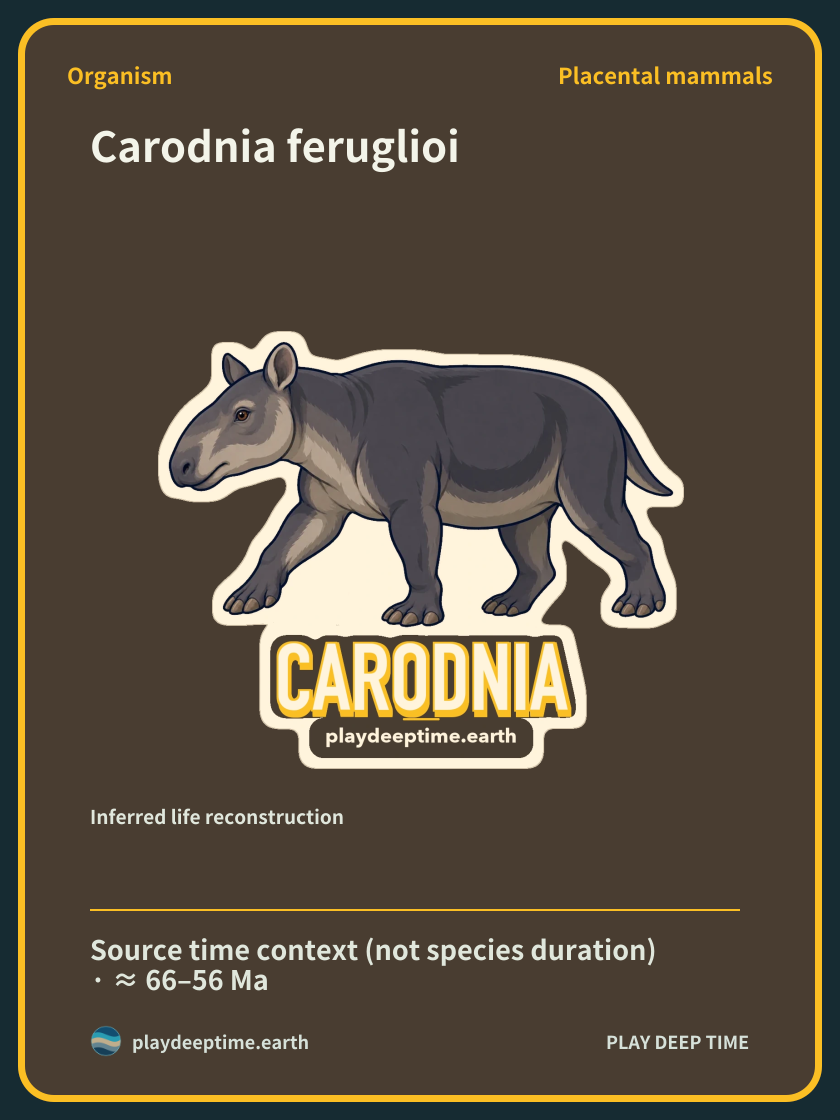
Organism · Placental mammals
Carodnia feruglioi
Source time context (not species duration) · ≈ 66–56 Ma
Inferred life reconstruction
Carodnia feruglioi
Overview
Carodnia feruglioi was an unusual hoofed mammal of Paleocene South America. It belonged to an ancient group native to South America, different from modern horses or cattle. Jaws and teeth tell most of its story.[1]
Loading illustration…
Key facts
The molars have two transverse ridges. Similar structures occur in other, distantly related mammal groups. Animals on different family trees can solve the problem of processing similar food in similar ways.[1][2]
Time and place
A 2024 study treated this species as early Paleocene Patagonian material. Think roughly of the interval around 60 million years ago. Important localities include Bajo Palangana and areas around the Río Chico Group in present-day Chubut Province, Argentina.[1]
The time range describes source context, not the complete duration of this species.
Size, form and skeleton
Reference specimen MGP-PD29046 is a lower jaw fragment preserving the last left molar. New jaw material enabled comparisons of tooth ridges and cusps. Richer postcranial evidence for the genus Carodnia can be examined alongside material of other species.[1]
Loading illustration…
Habitat and reproduction
Xenungulata, the group containing Carodnia, is studied as an ancient group of plant-eating hoofed mammals. Transverse molar ridges are structures for cutting and processing food. Tooth form and wear help explore which plants were chewed and how.[2]
Fossil discovery
After Simpson named it in 1935, old collections and new jaw material continued to be compared. A 2024 study revised the species’ dental features and introduced another species in the genus. Research beginning with one molar expanded into the broad history of South American mammals.[1]
References
- Gelfo, López & Bond (2024) · New insights on the anatomy, paleobiology, and biostratigraphy of Xenungulata (Mammalia) from the Paleogene of South America · Palaeontologia Electronica 27(2):a30 · DOI 10.26879/1360
- 2026 — Feeding the fire beasts: mesowear angles in bilophodont South American herbivores
- Ladevèze et al.2011 — Earliest evidence of mammalian social behaviour in the basal Tertiary of Bolivia
- Gelfo, López & Bond (2024) · New insights on the anatomy, paleobiology, and biostratigraphy of Xenungulata (Mammalia) from the Paleogene of South America · Palaeontologia Electronica 27(2):a30 · DOI 10.26879/1360
Research questions
Do differences in jaw breadth and height indicate different species? A 2024 study also proposed the possibility of sex-related variation within Carodnia. Multiple specimens help distinguish individual variation from species differences.[1]
Observation
Related organisms
 Pucadelphys andinusTheriansSource time context (not species duration) · ≈ 66–56 Ma
South American mammals after the dinosaur age
Pucadelphys and Carodnia provide Paleocene mammal evidence from different South American regions. Examine a small postcranial skeleton from Tiupampa, Bolivia, and jaws and teeth from Argentine Patagonia separately to encounter diverse mammals after the mass extinction.