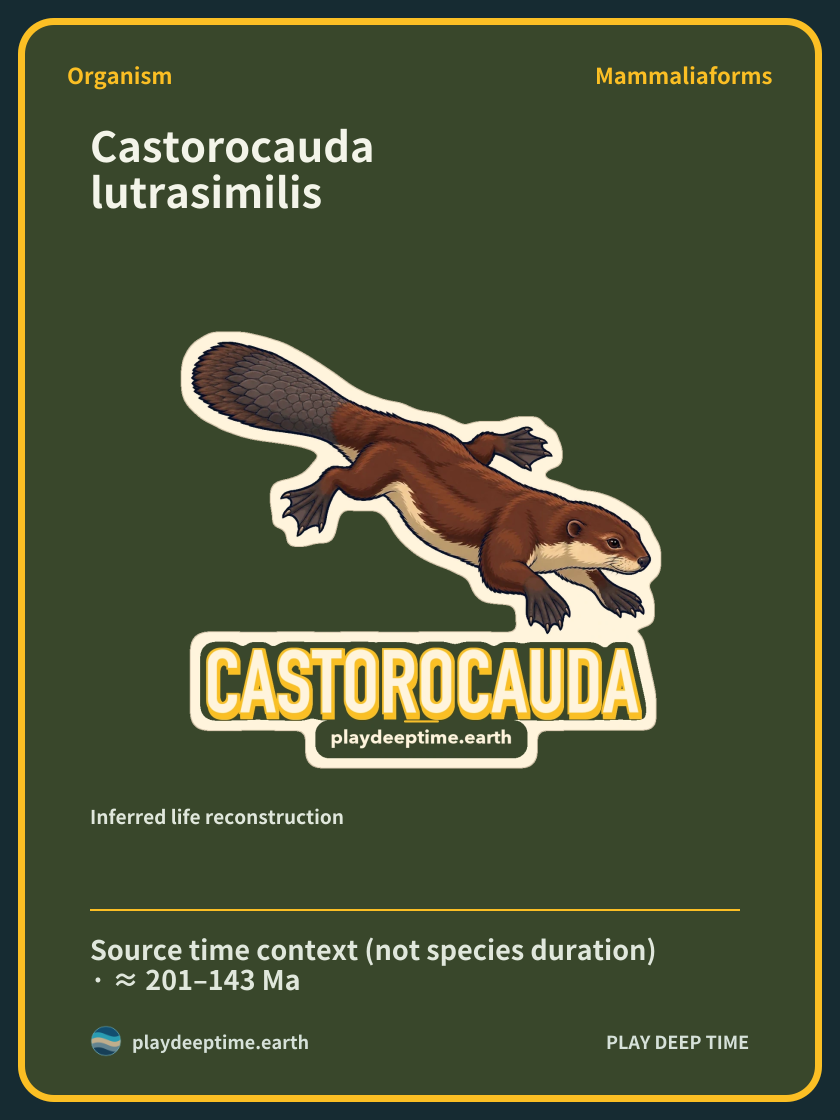
Organism · Mammaliaforms
Castorocauda lutrasimilis
Source time context (not species duration) · ≈ 201–143 Ma
Inferred life reconstruction
Castorocauda lutrasimilis
Overview
Castorocauda lutrasimilis was a mammal relative known for traces of guard hairs and underfur and a broad, flattened tail. Its Middle Jurassic partial skeleton has been studied together with soft-body traces. Bones and body covering provide different kinds of clues.[1]
Loading illustration…
Key facts
Traces of guard hairs and underfur occur on the body, while scales are described on part of the broad tail. Body and tail coverings differed within the same animal.[1]
Time and place
It is known from an original description of Middle Jurassic material. The Jurassic as a whole spans approximately 200–140 million years ago. Important soft-tissue traces contribute to research on the body and way of life of this mammal relative.[1][2]
The time range describes source context, not the complete duration of this species.
Size, form and skeleton
JZMP04-117 preserves a partial skeleton including an incomplete skull, along with traces of fur. The tail is broad and flattened, and the forelimbs and hands are described as robust. Soft-tissue traces around the hind feet have also been studied.[1]
Loading illustration…
Habitat and reproduction
How did Castorocauda live near water? Researchers proposed webbing from soft-tissue traces around the hind feet and interpreted the robust forelimbs and hands as adaptations for digging. They inferred its way of life by considering preserved tissue and bone shape together.[1]
Fossil discovery
Ji and colleagues described this Middle Jurassic mammal relative in 2006. They examined not only the partial skeleton but also guard hairs, underfur, the tail, and traces around the hind feet. The fossil conveyed body information difficult to obtain from bones alone.[1]
References
- A Swimming Mammaliaform from the Middle Jurassic and Ecomorphological Diversification of Early Mammals
- International Commission on Stratigraphy (2024) — Geological time chart
- Meng et al. (2006), A Mesozoic gliding mammal from northeastern China
- Meng et al. (2006) — Volaticotherium, a Mesozoic gliding mammal
- Small Furry Mammal Was Capable Of Gliding Flight Possibly Before Birds
Research questions
What questions do traces of fur, scales, and soft tissues add? Body covering and traces around the feet provide information different from the skeleton. Several kinds of preservation contribute to understanding one animal’s form and way of life.[1]
Observation
Move your gaze from traces of fur on the body to the broad, flattened tail. Examining robust forelimbs alongside traces around the hind feet reveals different clues in different body regions.[1]
Related organisms
 Volaticotherium antiquumMammalsSource time context (not species duration) · ≈ 252–66 Ma
Fur and bodies of Mesozoic mammals and their relatives
Examine the different records of bodies and time preserved in these two organisms. Castorocauda: Castorocauda lutrasimilis was a mammal relative known for guard hairs, underfur, and a broad, flattened tail. A Middle Jurassic partial skeleton and soft-body traces were studied together. It is known from an original description of Middle Jurassic material; the Jurassic as a whole spans approximately 200–140 million years ago. Volaticotherium antiquum: not all mammals of the dinosaur age moved only along the ground. This small mammal is known for long limbs and a fur-covered skin membrane. Its setting was Mesozoic Asia, when dinosaurs lived. The specimen locality is known as Daohugou in Ningcheng, present-day Inner Mongolia, China.