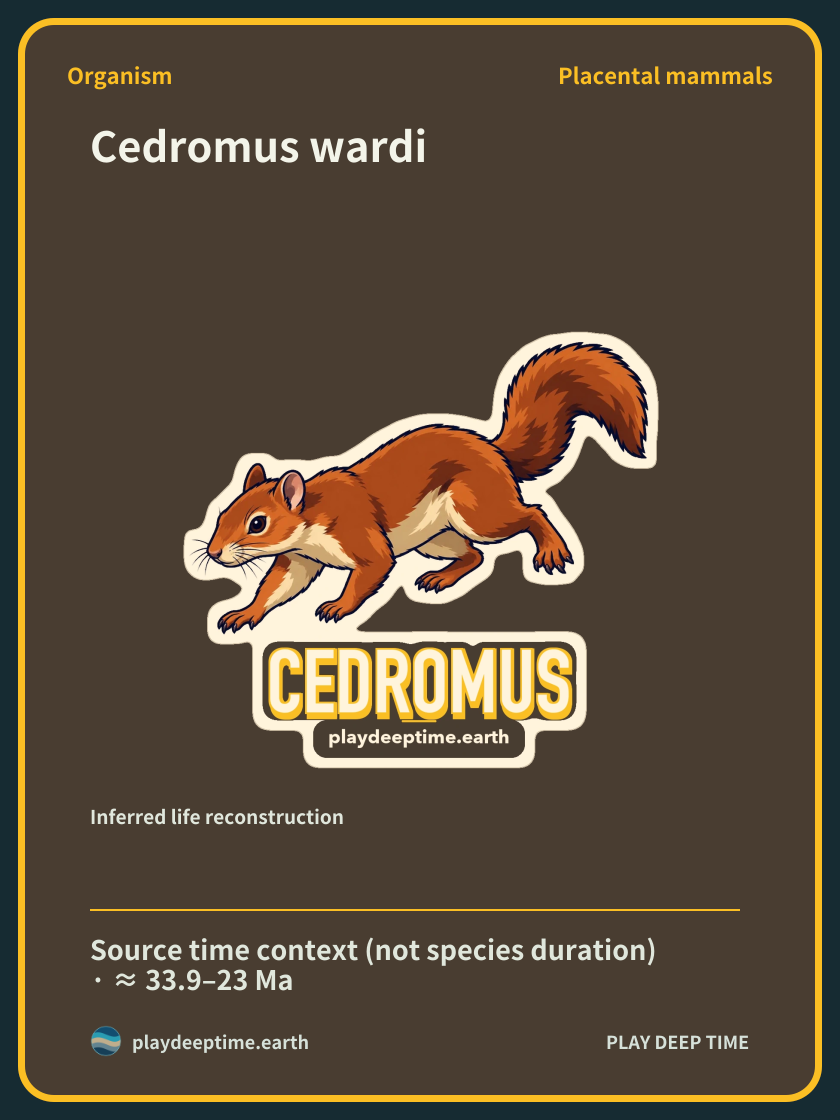
Organism · Placental mammals
Cedromus wardi
Source time context (not species duration) · ≈ 33.9–23 Ma
Inferred life reconstruction
Cedromus wardi
Overview
Cedromus wardi is an early member of the squirrel family from the Oligocene. A lower jaw retaining molars and a provisionally assigned skull have been studied. It introduces an ancient relative of familiar squirrels through jaws and teeth.[1]
Loading illustration…
Key facts
The thickness of a lower jaw can help distinguish squirrel relatives. Cedromines are described as having deep lower jaws that are thick from side to side. The bones supporting small molars, as well as the teeth themselves, are compared.[1]
Time and place
The lower jaw UCM19808 in the original description came from present-day Colorado, USA. The species is studied from Orellan material of the Oligocene. The Oligocene spanned approximately 34–23 million years ago.[1][3]
The time range describes source context, not the complete duration of this species.
Size, form and skeleton
UCM19808 is a lower jaw with molars, while UCM19852 is a skull provisionally assigned to the species. Cedromine lower jaws are described as deep and thick. Jaw shape and tooth positions provide clues to differences among early squirrels.[1]
A small jaw fragment of Cedromus wardi preserves the teeth of an Oligocene squirrel. The upper third molar of a specimen found in North Dakota, USA, measured 2.44 mm long and 2.56 mm wide. Even a tooth small enough to rest on a fingertip contains relief on its chewing surface.[8]
Loading illustration…
Habitat and reproduction
Teeth and the lower jaw supporting them provide a starting point for comparing food-processing structures. Research on early squirrels compares separate body-skeleton material as well as head and dental features. Examining different body regions across relatives explores the diversity of ancient squirrels.[1][2]
Fossil discovery
A 2015 comparative study treated the lower jaw and provisionally assigned skull of Cedromus wardi together. The jaw is distinguished by the number UCM19808 and the skull by UCM19852. Accurate museum specimen records underpin comparisons of small fossils.[1]
References
- Korth (2015) — Comparison of cedromine mandibles and skulls
- 1982 study — Skeletal comparisons of early squirrels
- International Commission on Stratigraphy (2024) — Geological time chart
- Korth (2015) — Comparison of cedromine mandibles and skulls
- International Commission on Stratigraphy (2024) — Geological time chart
- Matthew (1901) — The skull and humerus of Proscalops
- Paleobiology Database — Stratigraphic records of Proscalops fossils
- Korth et al. (2019) — Oligocene rodents from Fitterer Ranch, North Dakota
Research questions
How similar were the heads of early squirrels? Researchers compared molar and lower-jaw shapes across several species. Considering skeletal research on other species alongside them reveals how both head and body are studied in the squirrel family.[1][2]
Observation
Move your gaze from the head to the depth of the lower jaw and the region carrying the molars. Picture a familiar squirrel’s face, then find the specific features revealed by a small fossil jaw.[1]
Related organisms
 Proscalops miocaenusPlacental mammalsSource time context (not species duration) · ≈ 34–25 Ma
Jaw and forelimb clues from Oligocene Colorado
Compare the lower jaw of Cedromus with head and humerus material of Proscalops. Different Oligocene records from present-day Colorado, USA, reveal ancient forms of a squirrel relative and a mole.