Organism · Reptiles including birds
Chanaresuchus bonapartei
Source time context (not species duration) · ≈ 252–201 Ma
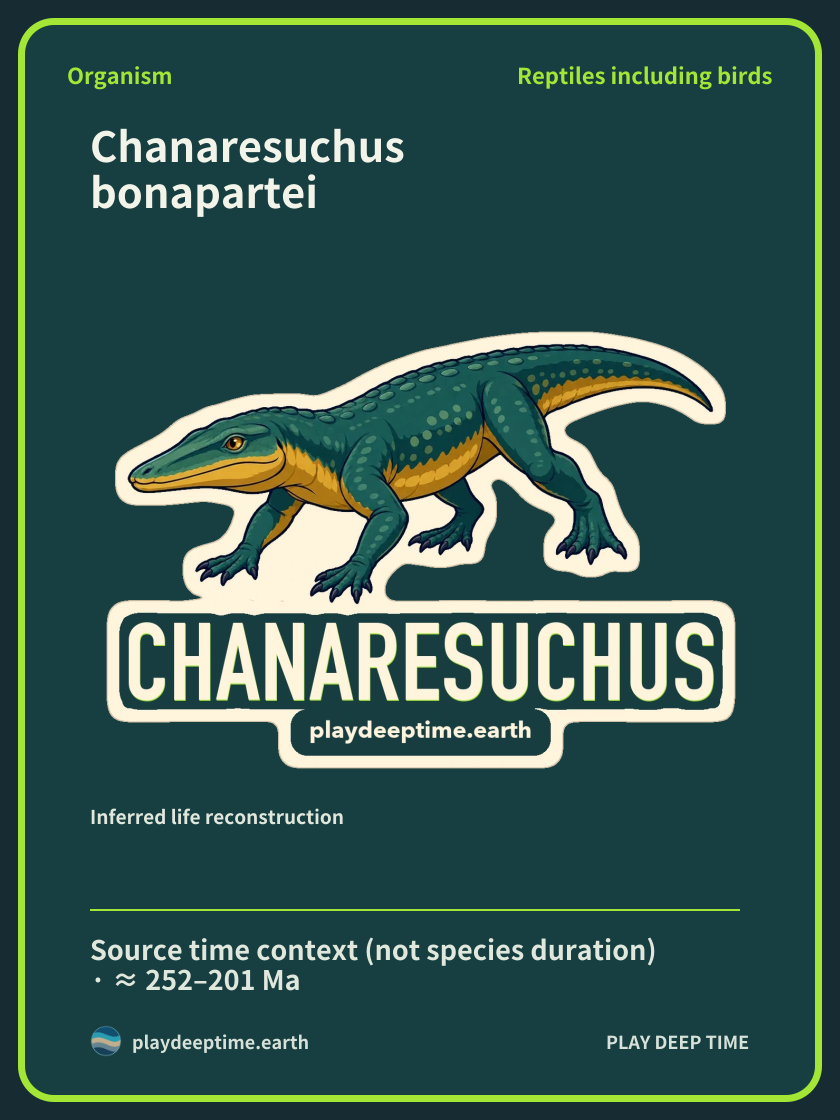
Inferred life reconstruction
Chanaresuchus bonapartei
Overview
Chanaresuchus bonapartei was a Triassic South American reptile. Its low triangular skull, four legs, and broad, low tail attract attention. Within a crocodile-like appearance, different body features can be found.[1][2]
Loading illustration…
Key facts
A flattened head does not necessarily mean upward-facing eyes. Chanaresuchus’s eyes were not concentrated on top of its skull. Even similar-looking reptiles reveal differences when skull outline and eye position are examined together.[1]
Time and place
It is associated with Middle to Late Triassic layers around 240–230 million years ago. Material from the Chañares Formation in present-day Argentina and from Brazil has been studied. Comparing different South American localities reveals its distribution.[2][1]
The time range describes source context, not the complete duration of this species.
Size, form and skeleton
The skull is triangular with a gently flattened upper surface. The body bears small armor plates, and the tail is described comparatively as low and broad. The limbs and feet are not reduced, and differences in toe proportions have also been studied.[1]
One skeletal specimen of Chanaresuchus bonapartei had a femur 12.8 cm long. Its humerus measured 8.5 cm. Comparing the two bones gives a concrete view of the difference in their lengths.[3]
Loading illustration…
Habitat and reproduction
What way of life might unreduced legs and feet and a low, broad tail indicate? Researchers compare these regions together to explore use of water and land. Reptiles whose heads alone look similar can offer clues to different lives when the whole body is examined.[1]
Fossil discovery
Brazilian specimen UFRGS-PV-0877-T includes a skull, vertebral centra, rib fragments, and hind limb bones. A 2013 study reported this material as a new occurrence in Brazil. The story of a reptile known from Argentina extended to another locality.[2]
References
- Arcucci, Previtera & Mancuso2019 — Body form and ecology of Chañares reptiles
- Raugust, Lacerda & Schultz2013 — Discovery of Chanaresuchus in Brazil
- Padian (2008) — Limb proportions in early archosaurs and pterosaurs
- Voeten·Albers·Klein (2019) — Body comparison of nothosauroids
- Klein·Eggmaier·Hagdorn (2022) — Redescription of the type specimen of Nothosaurus mirabilis
Research questions
Did reptiles with similar heads adapt to the same environments? A 2019 study compared skulls, limbs, tails, and other regions of proterochampsians. It illustrates exploring ecology through external form and bone structure together.[1]
Observation
Find the eyes on the triangular head, then move your gaze to the four legs and tail. Look for differences as well as similarities to familiar crocodiles.[1]
Related organisms
 Nothosaurus mirabilisReptiles including birdsSource time context (not species duration) · ≈ 252–201 Ma
Different bodies among reptiles
Compare the bodies and backgrounds of Chanaresuchus bonapartei and Nothosaurus. Chanaresuchus bonapartei: a Triassic South American reptile with a low triangular skull, four legs, and a broad, low tail. Nothosaurus: Nothosaurus mirabilis was a Middle Triassic reptile. Comparative genus-level material describes an elongated, flattened skull, broad forelimbs, and a slender femur.