Organism · Animals
Chancelloria eros
Source time context (not species duration) · ≈ 539–487 Ma
Inferred life reconstruction
Chancelloria eros
Overview
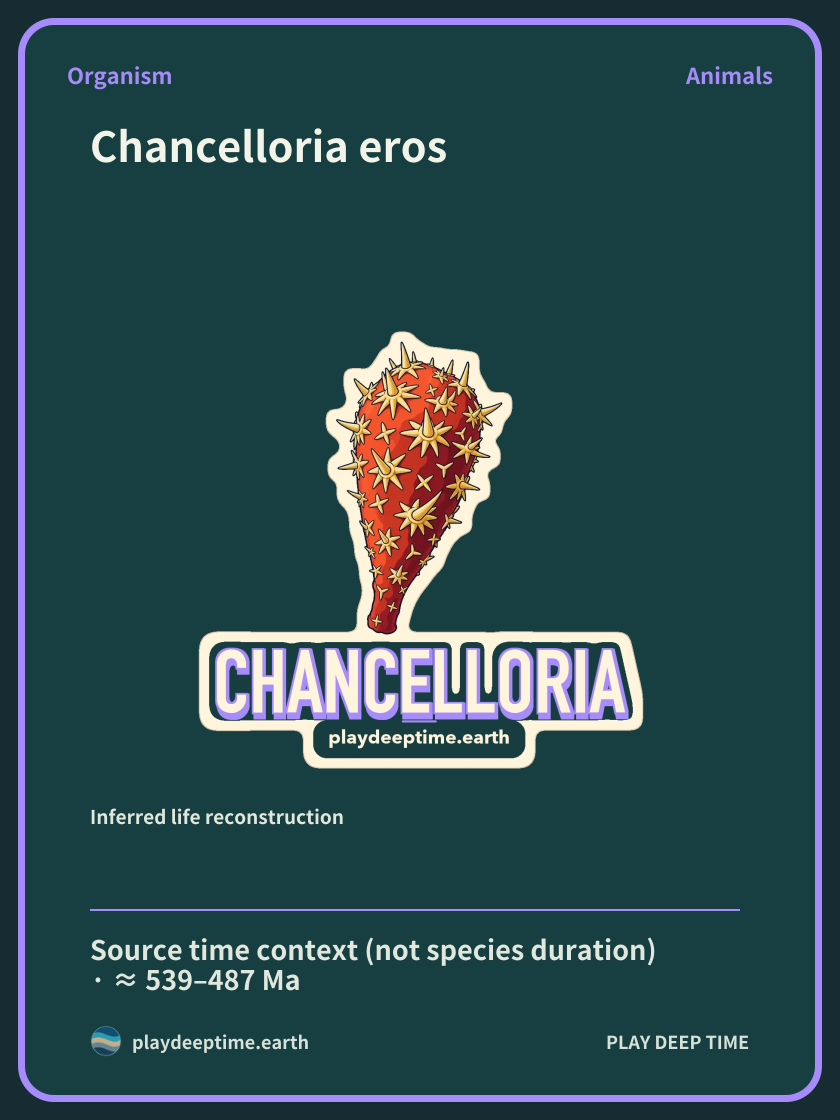
Chancelloria eros was an organism with a club-shaped body widening upward and scattered star-shaped sclerites. It is known from Cambrian Burgess Shale material. Spines pointing in several directions cover its apparently simple body surface.[1]
Loading illustration…
Key facts
The star-shaped sclerites do not all have the same size or number of rays. A central spine projecting outward can be distinguished from spines spreading along the body surface. Even within one tiny star, directions differ.[1]
Time and place
Walcott’s specimen series, which originally included Chancelloria eros, came from localities near Field in present-day British Columbia, Canada. A 2015 study divided this material into three kinds and reexamined the existing lectotype USNM 66524. The Cambrian spans approximately 540–490 million years ago.[1][2][3][4][5]
The time range describes source context, not the complete duration of this species.
Size, form and skeleton
The nearly complete reference specimen USNM 66524 is described as showing a body narrow below and widening upward. Sclerites of varying sizes and spine counts lie irregularly across its surface. Tiny stars gather within a larger outline.[1]
Reference specimen USNM 66524 of Chancelloria eros has a preserved body length of 29 mm. Part of the lower end of its club-shaped body is missing, so this measures only the portion surviving in the fossil.[6]
Loading illustration…
Habitat and reproduction
Did all spines point in the same direction? The central spine is described as projecting away from the body, while surrounding spines spread parallel to its surface. This helps turn a flat star-shaped impression into a three-dimensional structure.[1]
Fossil discovery
A 2015 study described reference specimens and surface sclerites of Chancelloria by species. Reading the whole body alongside the arrangement of small spines reveals identifying features in structures of different sizes.[1]
References
- Bengtson·Collins(2015). Chancelloriids of the Cambrian Burgess Shale. Palaeontologia Electronica18.1.6A.
- International Commission on Stratigraphy (2024) — Geological time chart
- Royal Ontario Museum — The Burgess Shale locality today
- Royal Ontario Museum — Waptia fieldensis
- Parks Canada — Mount Stephen trilobite site
- Bengtson·Collins (2015) · Chancelloriids of the Cambrian Burgess Shale
- Bengtson·Collins (2015) · Chancelloriids of the Cambrian Burgess Shale
- Royal Ontario Museum — Dinomischus isolatus
- Paleobiology Database — Age of fossil-bearing strata of Dinomischus
Research questions
How regular was a surface covered in similar star shapes? Described sclerites vary in size, ray count, and position. Finding differences within repeated forms is part of the fascination of examining this organism.[1]
Observation
First examine the body outline widening from bottom to top. Then distinguish the central and surrounding spines of one sclerite to connect the whole body with a small structure.[1]
Related organisms
 Dinomischus isolatusAnimalsSource time context (not species duration) · ≈ 520–510 Ma
Unfamiliar bodies of Cambrian seas
Examine the different records of bodies and time preserved in these two organisms. Chancelloria: Chancelloria eros had a club-shaped body widening upward and scattered star-shaped sclerites, known from Cambrian Burgess Shale material. Walcott’s original specimen series came from localities near Field in present-day British Columbia, Canada. A 2015 study divided the material into three kinds and reexamined lectotype USNM 66524. Dinomischus isolatus: a Cambrian organism with a cup-shaped body atop a long stalk, extending from a swollen base through the stalk to the upper body. Holotype USNM 198735 and separate specimen MCZ 1083 came from the Walcott Quarry on Fossil Ridge in present-day British Columbia, Canada.