Organism · Animals
Charnia masoni
Source time context (not species duration) · ≈ 635–539 Ma
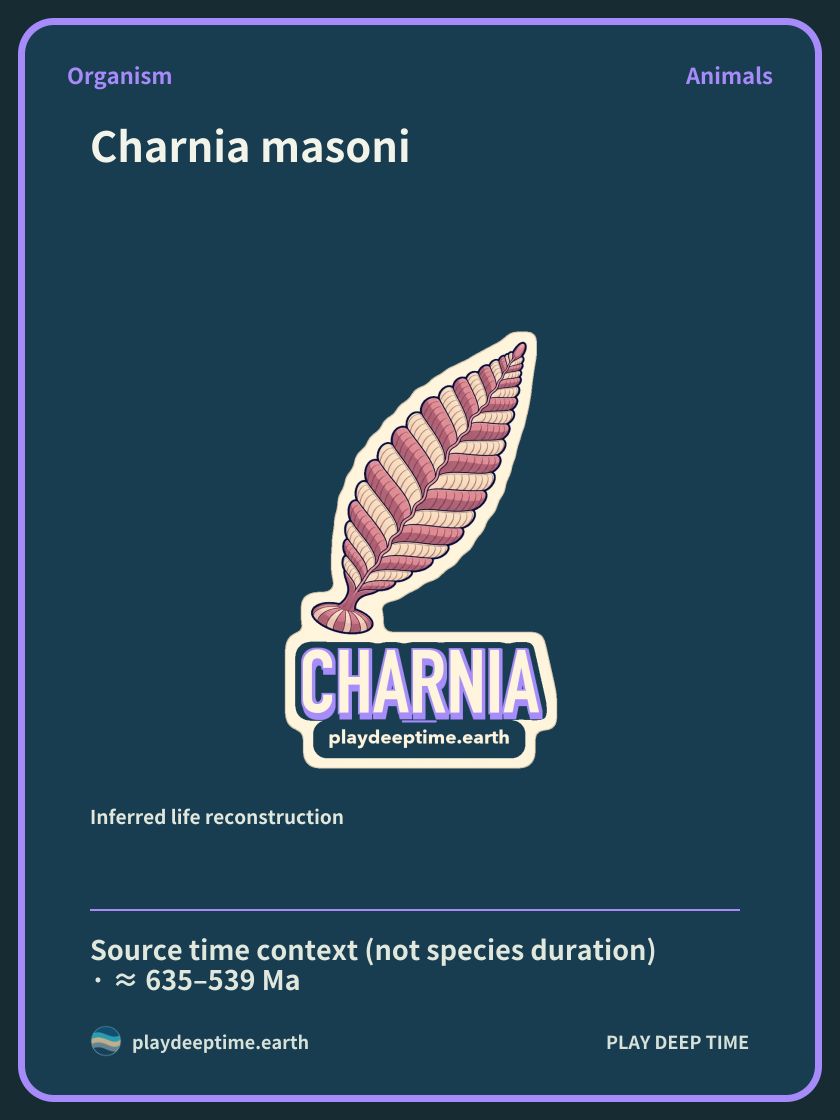
Inferred life reconstruction
Charnia masoni
Overview
Charnia masoni is an organism known for alternating branches, repeated branching and a small holdfast disc. Smaller branches extend within its leaf-like overall outline. Repeated structures can be examined at several scales.[1]
Loading illustration…
Key facts
Specimen GSM105972 in the study is reported to be about 12 cm long overall. It provides evidence for examining both the length and branching arrangement of one fossil.[1]
Time and place
It is treated as Ediacaran material. This period spans roughly 640–540 million years ago. In the study's table, GSM105972 is recorded as material from Bed B in Charnwood Forest.[1][2]
The time range describes source context, not the complete duration of this species.
Size, form and skeleton
Large branches alternate, with repeated branching within them. A small holdfast disc is described at the base. Move from the broad outline toward the finer branches.[1]
Loading illustration…
Habitat and reproduction
How do repeated branches fit into the body as a whole? The alternating large branches can be examined together with their smaller subdivisions. Its body is characterized by branching that does not stop after a single division.[1]
Fossil discovery
A 2019 morphological study tabulated several measurements of Charnia specimens. The total length and basal portion of GSM105972 are recorded separately. This provides a way to understand a repetitive body by dividing it into several regions.[1]
References
- Anatomy of the Ediacaran rangeomorph Charnia masoni
- International Commission on Stratigraphy (2024) — Geological time chart
- Study — Branching and attachment structures of Doushantuophyton
- International Commission on Stratigraphy (2024) — Geological time chart
- Dunn et al. (2019) — A study of the morphology of Charnia
- International Commission on Stratigraphy (2024) — Geological time chart
- Rahman et al. (2015) — Study of suspension feeding in Tribrachidium
- Olaru et al. (2024) — Study of functional morphology in Tribrachidium
- International Commission on Stratigraphy (2024) — Geological time chart
- Dunn et al. (2019) — A study of the morphology of Charnia
- International Commission on Stratigraphy (2024) — Geological time chart
Research questions
Can still smaller repetitions be found by following the fine branches? Descriptions of Charnia explain its alternating branches and repeated branching. Moving between the large shape and small structures allows the same body to be read in different ways.[1]
Observation
Move your gaze from the small holdfast disc upward into the branches. Following the alternating large branches and the subdivisions within them reveals repetition at several scales.[1]
Related organisms
 Doushantuophyton lineareChlorophytaSource time context (not species duration) · ≈ 635–539 Ma
Repeated structures in Ediacaran bodies
Doushantuophyton's slender branches divide in two, whereas Charnia has repeated smaller branches within alternating large branches. Examine branch arrangement in these two Ediacaran organisms side by side. Looking at the attachment structures below and branching above reveals different ways repeated small parts form an entire body.
 Tribrachidium heraldicumAnimalsSource time context (not species duration) · ≈ 635–539 Ma
Three-way ridges and alternating branches
Tribrachidium has curved ridges arranged in three directions on its low body. Charnia has large branches alternating from side to side, with repeated smaller branches within them. Compare the broad outlines and small repetitions of Ediacaran organisms to examine bodies organized in different ways.