Organism · Reptiles including birds
Chisternon undatum
Fossil record age bounds · ≈ 51.1–37.7 Ma
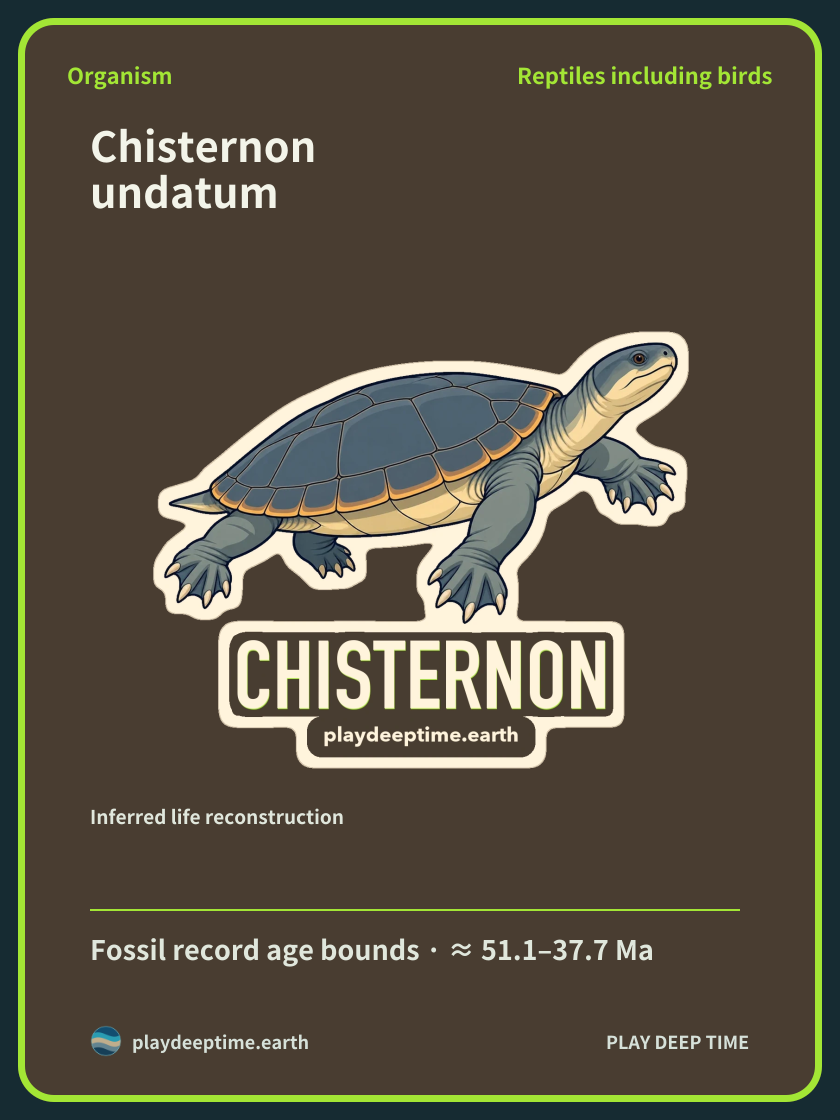
Inferred life reconstruction
Chisternon undatum
Overview
Chisternon undatum is an Eocene turtle from the Bridger strata of Wyoming. The holotype representing the species name is part of a shell. Research on one kind of turtle began with a fragment of its hard covering.[1]
Loading illustration…
Key facts
A species’ type specimen need not be a whole body. In Chisternon undatum, a partial shell serves as the reference. Later research compared shell and skull features to distinguish baenid turtles more finely.[1][2]
Time and place
It is known as an Eocene turtle from the Bridger strata of Wyoming, USA. Research addresses Early to Middle Eocene records; the Eocene as a whole was roughly 56–34 million years ago. The Bridgerian holotype record provides a basis for comparison.[1][4]
The time range describes source context, not the complete duration of this species.
Size, form and skeleton
A partial shell and later comparisons of shells and skulls provide clues to this turtle. The hard structure enclosing the body and head features can be examined separately. Comparisons of several regions help distinguish forms within Baenidae.[1][2]
Chisternon undatum is introduced as a large turtle with a carapace more than 50cm long. A 2015 taxonomic study examined this large carapace together with the arrangement of shell plates to distinguish it from other turtles of the same period.[8]
Loading illustration…
Habitat and reproduction
How can a turtle shell help distinguish kinds of turtles? Comparing shells and skulls together raises different questions from examining one region alone. Chisternon is a case of finding taxonomic clues in a hard body covering.[2]
Fossil discovery
This turtle, named in 1871, was also addressed in later reviews of fossil baenids. Shapes of several specimens are compared alongside the holotype’s partial shell. Old reference material connects with new research.[1][3]
References
- Joyce·Lyson (2015) — Review of the fossil record of Baenidae
- Study of morphological variation and classification in baenid turtles
- Smithsonian — Chisternon undatum specimen
- International Commission on Stratigraphy (2024) — Geological time chart
- Smithsonian — Type-specimen record of Saniwa
- Smithsonian — Saniwa skeleton from the Green River Formation
- Joyce·Lyson (2015) — Review of the fossil record of Baenidae
- Joyce·Lyson (2015) — Reassessment of the fossil record of baenid turtles
Research questions
Do shell and skull differences appear in the same way? Research on baenid morphological variation and classification examines several regions together. Attention can broaden from one turtle’s shell to differences among related forms.[2]
Observation
Move your gaze from the outline of the shell enclosing the body toward the head. Imagining different regions together helps explain why several criteria are used to compare turtles.[1][2]
Related organisms
 Saniwa ensidensLizards and snakesFossil record age bounds · ≈ 56–37.7 Ma
Lizards and turtles of the Bridger Formation
Saniwa and Chisternon are Eocene reptiles known from the Bridger Formation in present-day Wyoming, USA. Connect different evidence, such as lizard bones and turtle shells, to broaden the ancient biological story of this region.