Organism · Flowering plants
Cobbania corrugata
Source time context (not species duration) · ≈ 84–72 Ma
Inferred life reconstruction
Cobbania corrugata
Overview
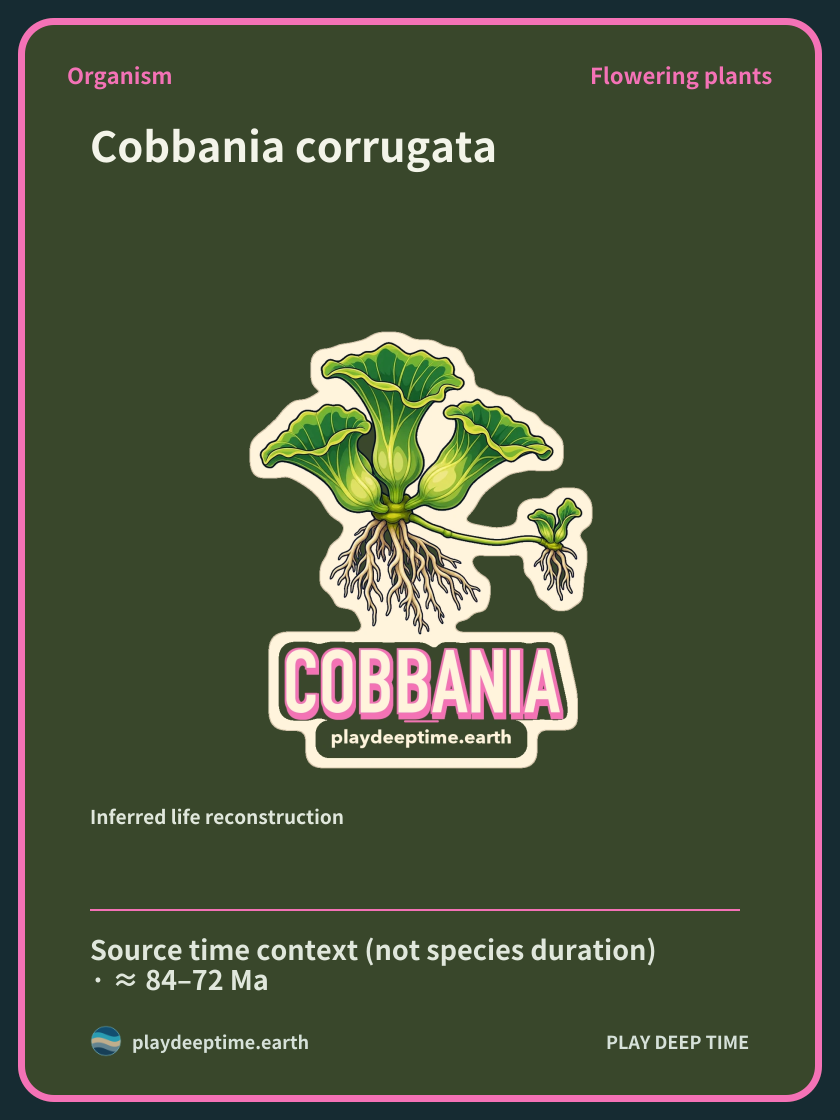
Cobbania corrugata is an aquatic plant that spread its leaves over water during the age of dinosaurs. Trumpet-like leaves and roots emerged from a short stem. Fossils of several plants connected by lateral stems vividly reveal the life of an ancient water plant.[1]
Loading illustration…
Key facts
Up to six plants remained connected on one rock slab. The researchers in 2007 examined 71 plants in total. Rather than detached leaves, preserved leaves, roots, and connecting stems allow exploration of how one plant spread into a group.[1]
Time and place
It is a plant from the Campanian Age of the Late Cretaceous, roughly 80–70 million years ago. Fossils came from the Dinosaur Park Formation in present-day Alberta, Canada. Deposits of a lake left behind by a meandering river preserved the plants.[1]
The time range describes source context, not the complete duration of this species.
Size, form and skeleton
The leaves are trumpet-shaped, with broadly swollen lower portions. Several strong veins continue through leaves and petioles, and roots branch beneath the leaf clusters. Leaf bases with well-developed air spaces were also studied.[1]
The leaves of floating Cobbania corrugata were reported as about 1.9–7cm long. Leaves clustered on short, thick stems, and connected plants spread widely across the water surface.[9]
Loading illustration…
Habitat and reproduction
Leaf clusters connected by stolons are interpreted as having spread over quiet water. A stolon is a stem extending sideways to a new plant. Researchers also associated swollen leaf bases and surface hairs with a floating lifestyle.[1]
Fossil discovery
A 2007 study established the new genus Cobbania from well-preserved, connected plants. It also revised the name of the plant previously called Pistia corrugata. Organs preserved attached to one another were the key to a new classification.[1]
References
- Stockey, Rothwell & Johnson2007 — Connected aquatic plant fossils of Cobbania
- Stockey, Rothwell & Johnson2007 — Connected aquatic plant fossils of Cobbania
- Farke et al.2013 — Growth and cranial crest of Parasaurolophus
- Natural History Museum — Parasaurolophus
- Parks1922 — Original description of Parasaurolophus walkeri
- 2021 study — Bone lesions in the type skeleton of Parasaurolophus
- Stockey, Hoffman & Rothwell (1997), The fossil monocot Limnobiophyllum scutatum: resolving the phylogeny of Lemnaceae
- Stockey, Rothwell & Johnson2007 — Connected aquatic plant fossils of Cobbania
- Stockey et al. (2007) — Cobbania, a floating Cretaceous plant
Research questions
If only leaves had survived, could we have understood how this plant spread across water? Several connected plants and their roots provide special evidence for comparing ways of life. They also prompt exploration of whether structures resembling those of living aquatic plants functioned in the same way.[1]
Observation
Find the roots beneath the trumpet-shaped leaves and follow the slender stem connecting to the next plant. You can imagine one plant together with a group spread over the water.[1]
Related organisms
 Parasaurolophus walkeriDinosaursSource time context (not species duration) · ≈ 143–66 Ma
Aquatic plants and dinosaurs of the Dinosaur Park Formation
Cobbania and Parasaurolophus walkeri are Late Cretaceous organisms known from the Dinosaur Park Formation in present-day Alberta, Canada. Examine trumpet-shaped leaves spread over water alongside a tubular crest extending behind a head to encounter the varied forms of plants and animals preserved in the same formation.
 Limnobiophyllum scutatumFlowering plantsSource time context (not species duration) · ≈ 66–56 Ma
Aquatic plants of Alberta from different times
Limnobiophyllum and Cobbania are aquatic plants of different ages from present-day Alberta, Canada. Compare rounded leaf clusters from Paleocene Joffre Bridge with trumpet-shaped leaves from the Late Cretaceous Dinosaur Park Formation to explore different constructions of ancient plants that spread their leaves over water.