Organism · Jawed vertebrates
Coccosteus cuspidatus
Source time context (not species duration) · ≈ 420–359 Ma
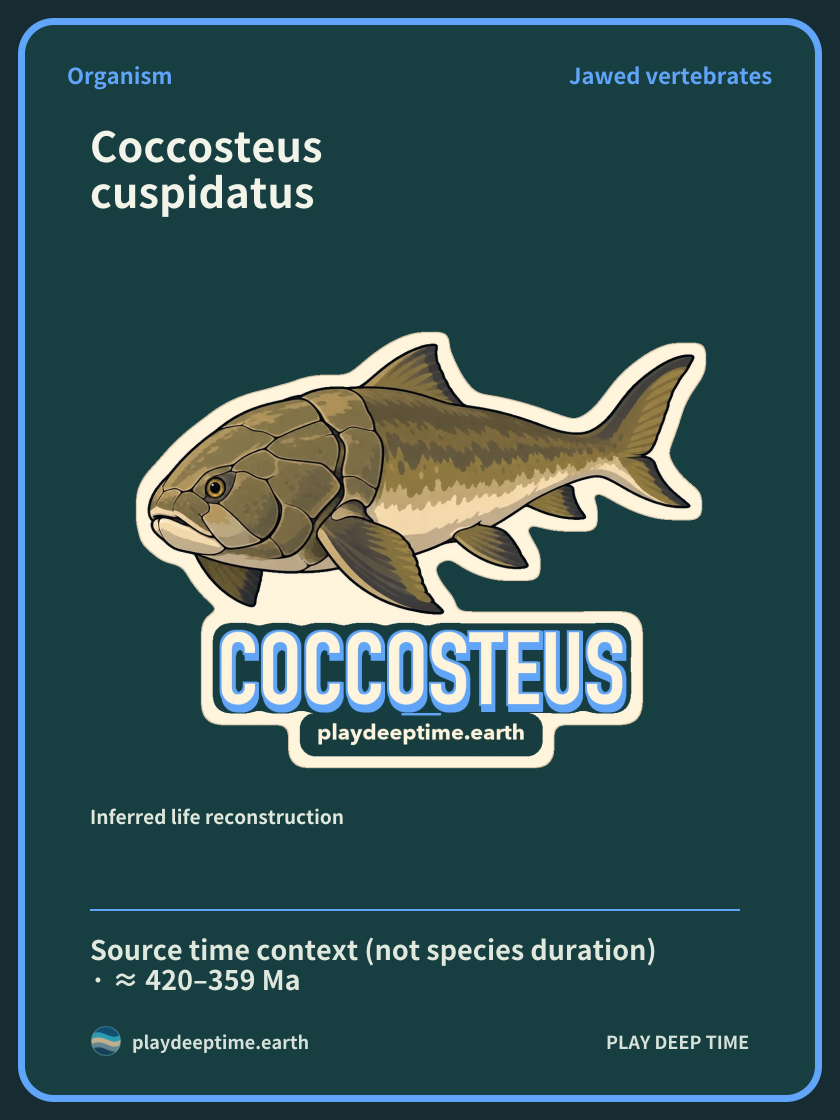
Inferred life reconstruction
Coccosteus cuspidatus
Overview
Coccosteus cuspidatus is a Devonian fish known for armor covering its head and front trunk and for its jaw plates. A joint connects the hard head and trunk. We can examine the arrangement extending from armor to fins and tail.[2][1]
Loading illustration…
Key facts
A single dorsal fin with a long base and a tail with unequal upper and lower portions are described on the rear part of the body. The front armor can be read separately from the different rear outline.[1]
Time and place
It is known from Middle Devonian material at Edderton and in the Old Red Sandstone of present-day Scotland. The Devonian as a whole spanned approximately 420–360 million years ago. Museum records and geological conservation accounts convey its locality and age.[2][3][4]
The time range describes source context, not the complete duration of this species.
Size, form and skeleton
Hard armor covers the head and front trunk, with a joint between them. Tooth plates are described in the jaws. The rear body is studied as an arrangement continuing into a long-based dorsal fin and an asymmetrical tail.[2][1]
The species account in a geological conservation description gives a length of approximately 40 cm.[2]
Loading illustration…
Habitat and reproduction
Where are the connections in the body of an armored fish? A joint between the head and front trunk is described in Coccosteus. Examining connections between hard plates helps reveal the broad body arrangement.[2]
Fossil discovery
Accounts of Scottish Devonian fossil fishes describe the armor and jaw structures. A 2024 comparative reconstruction study also discussed the fins and tail of Coccosteus. Questions extend from the hard front body to the rear outline.[2][1]
References
- Engelman (2024) — Comparing body reconstructions of Coccosteus
- GCR16 Chapter6: Mid Devonian fossil fishes sites of Scotland
- Natural History Museum, London — Coccosteus specimen record
- International Commission on Stratigraphy (2024) — Geological time chart
- Trewin (2003) — The story of an armoured fish that looked winged
- Photograph caption in a collected volume — Middle Devonian Pterichthyodes
- Dineley (1999) — Fossil fishes from the Middle Devonian of Scotland
- Natural History Museum, London — Coccosteus specimen record
- International Commission on Stratigraphy (2024) — Geological time chart
- Engelman (2024) — Comparing body reconstructions of Coccosteus
- Achanarras Quarry SSSI — Site Management Statement
Research questions
What evidence should be compared when reconstructing a fish’s tail? The study cautioned against interpretations that extend the rear body and tail of Coccosteus too far. It asks how known connections can inform the proportions of the whole animal.[1]
Observation
First examine the joint between the armor of the head and front trunk. Then move your gaze to the dorsal fin and asymmetrical tail of the rear body to see how its arrangement differs from the hard front region.[2][1]
Related organisms
 Pterichthyodes milleriJawed vertebratesFossil record age bounds · ≈ 393–388 Ma
Two armored fishes from Achanarras
Pterichthyodes milleri and Coccosteus cuspidatus both appear in the list of Middle Devonian fossil fishes from Achanarras. This quarry in present-day Scotland, UK, preserves a record of an ancient lake. After examining the armored front bodies of both fishes, move your gaze to the paddle-like pectoral appendages of Pterichthyodes.