Organism · Cnidarians
Coelosmilia texana
Source time context (not species duration) · ≈ 143–66 Ma
Inferred life reconstruction
Coelosmilia texana
Overview
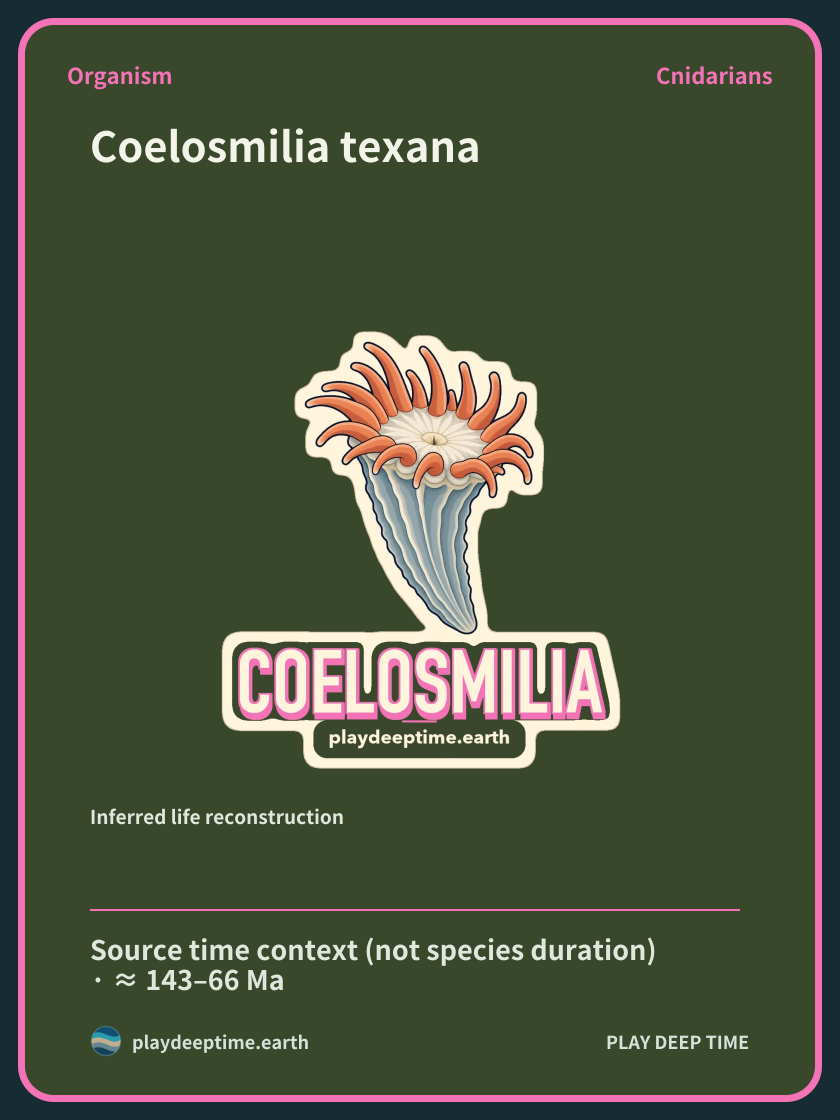
Coelosmilia texana is a solitary coral with a narrow, slightly curved conical skeleton. Thin septa lie inside the upper coral cup. It offers a view of one individual's skeleton, unlike a broad coral colony.[1]
Loading illustration…
Key facts
The number of skeletal septa is not the same information as the number of tentacles. A specimen in the literature is described as having 48 septa, but this cannot simply be converted into 48 tentacles. The stone-like skeleton and the soft living body provide different clues.[1][3]
Time and place
The literature treats this species as Albian material from the Early Cretaceous. The Cretaceous spans roughly 140–66 million years ago, and the Albian lies near the end of its early part. The small conical corallum provides evidence for comparing the bodies of ancient corals.[1][4]
The time range describes source context, not the complete duration of this species.
Size, form and skeleton
A coral cup opens at the top of the narrow, slightly curved corallum. The septa inside the cup and ridges on the outer wall are features used in morphological comparisons. Examining the inside and outside of the hard skeleton separately reveals the structure of one individual.[1]
Coelosmilia texana was a coral of Early Cretaceous seas. The largest specimen collected from the Tucumcari Formation of present-day New Mexico in the United States was 2.1 cm high. Thin partitions radiated within its small, slightly bent cone-shaped skeleton.[5]
Loading illustration…
Habitat and reproduction
This species is described as a solitary coral that grew alone. In living stony corals, tissue covers the skeleton and tentacles surround the mouth.[1][3][2]
Fossil discovery
A 2001 study of the fauna of the Tucumcari Formation presented material of this coral. Reading species-level skeletal descriptions alongside research on basic coral anatomy connects different kinds of evidence. It is a process of relating a body preserved in stone to a living body.[1][3]
References
- Kues·Lucas (2001) — Coelosmilia of the Tucumcari Formation
- Paleobiology Database — Coelosmilia texana
- Brahmi et al. (2010) — Skeletons and living tissues of stony corals
- International Commission on Stratigraphy (2024) — Geological time chart
- Kues·Lucas (2001) — Cretaceous coastal fauna of the Tucumcari Formation
- Corals of the World — Colonies of Cladocora caespitosa
Research questions
What are the thin plates inside the coral cup? They are skeletal septa, distinct from the tentacles extending outward from the body. Identifying the names and positions of visible repeated structures helps us understand even a small coral in greater detail.[1][3]
Observation
Move your gaze from the outline of the slightly curved cone to the coral cup at the top. Distinguishing the internal septa from the external ridges separates the inside and outside of the skeleton.[1]
Related organisms
 Cladocora caespitosaCnidariansPresent
Different body forms among corals
Explore the bodies of Coelosmilia texana and Cladocora caespitosa together. Coelosmilia texana: Coelosmilia texana is a solitary coral with a narrow, slightly curved conical skeleton. Cladocora caespitosa: Cladocora caespitosa is a living coral composed of densely clustered, small, tube-shaped coral individuals.