Organism · Dinosaurs
Coloradisaurus brevis
Source time context (not species duration) · ≈ 252–201 Ma
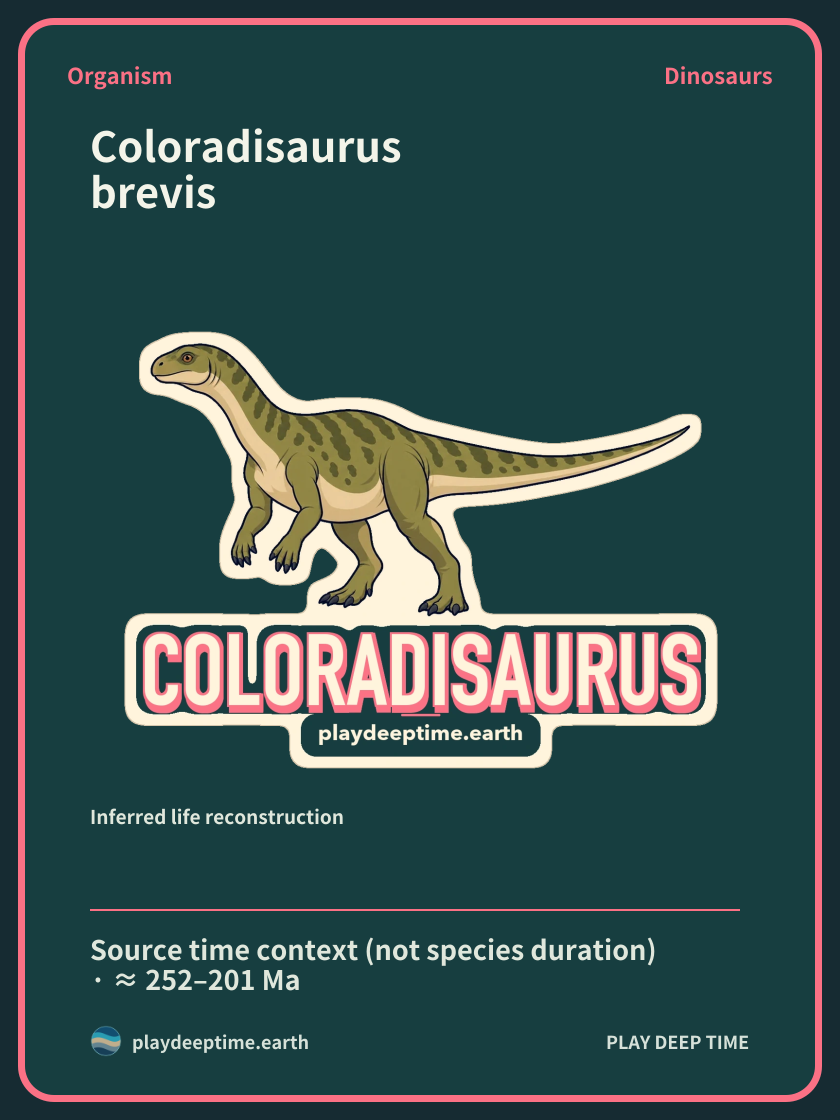
Inferred life reconstruction
Coloradisaurus brevis
Overview
Coloradisaurus brevis was a Late Triassic dinosaur known from material of the head, neck, trunk, and limbs. Two different specimens provide complementary clues to its body. Questions can expand from the articulated head and neck to the trunk and feet.[1]
Loading illustration…
Key facts
The type specimen preserves the skull and lower jaw connected to the first three neck vertebrae. Another specimen includes articulated back vertebrae, the pelvis and legs, and a complete left foot. Each specimen reveals different regions particularly well.[1]
Time and place
It is studied from Late Triassic dinosaur material of the Los Colorados Formation. The Triassic as a whole spans approximately 250–200 million years ago. It is also used in comparisons of postcranial bones with early dinosaurs from the same formation.[1][2]
The time range describes source context, not the complete duration of this species.
Size, form and skeleton
PVL3967 preserves the connection between the head and front of the neck. PVL5904 includes articulated back vertebrae, shoulder and pelvis, limbs, and the left foot. Several regions from head to foot can be compared across different specimens.[1]
The Natural History Museum in London gives a body length of about 4 m for the genus Coloradisaurus.[5]
Loading illustration…
Habitat and reproduction
What information do the trunk and foot each provide? Articulated back vertebrae reveal the central body axis, while the pelvis, legs, and feet show the organization of the rear body. This research explores early dinosaur bodies by considering their front and rear regions separately.[1]
Fossil discovery
Researchers described the type specimen together with another specimen referred to the species. Information about the trunk and feet supplemented material showing the head and neck. Another fossil added regions difficult to understand from a single specimen.[1]
References
- Study — Postcranial skeleton of Coloradisaurus
- International Commission on Stratigraphy (2024) — Geological time chart
- 2013 study — Postcranial comparisons of early dinosaurs
- Bonaparte (1979) — Earlier research records on dinosaurs of the Los Colorados Formation
- Natural History Museum, London — Coloradisaurus
Research questions
Does examining several specimens mean that the complete body is fully known? Distinguishing the articulated regions in each specimen reveals which connections are directly preserved. Reading the separate roles of different fragments is an important part of dinosaur research.[1]
Observation
Move your gaze from the head and front of the neck to the back and pelvis, then the hind limbs and feet. Examining each region in order connects body information supplied by different fossils.[1]
Related organisms
 Riojasaurus incertusDinosaursSource time context (not species duration) · ≈ 252–201 Ma
Dinosaurs of the Los Colorados Formation
Riojasaurus and Coloradisaurus are known from the Late Triassic Los Colorados Formation. Their different neck and shoulder structures can be compared within the same broad time interval and formation.