Organism · Dinosaurs
Deinocheirus mirificus
Source time context (not species duration) · ≈ 143–66 Ma
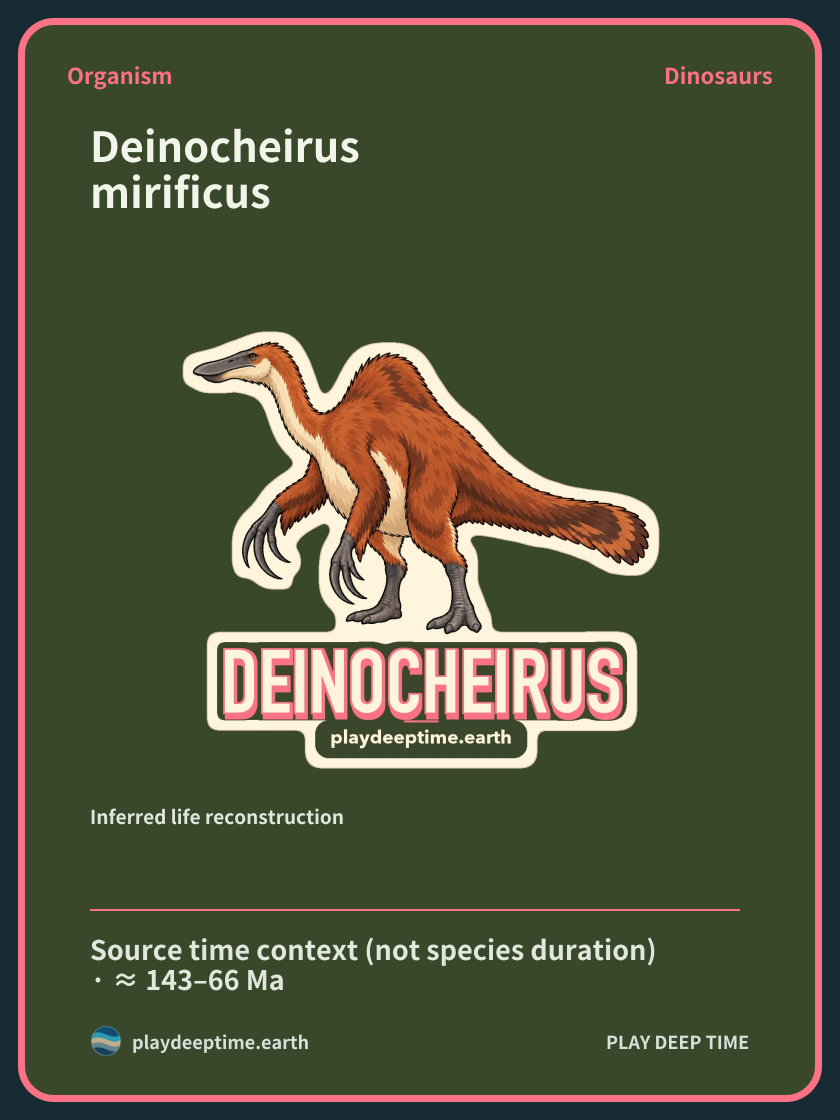
Inferred life reconstruction
Deinocheirus mirificus
Overview
Deinocheirus mirificus is a dinosaur first known from enormous arms. The rest of its body remained a mystery for a long time. The later discovery of a long, shovel-shaped snout and high back greatly changed expectations.[1][2]
Loading illustration…
Key facts
The first discovered arms were approximately 2.4 m long. But large arms alone could not reveal the entire animal. New skeletons connected a massive body, large feet, and a long, toothless snout into one story.[1][2]
Time and place
It lived in the region of present-day Mongolia during the Late Cretaceous, around 70 million years ago. Fossils were discovered in the Nemegt Formation of the Gobi. Several localities helped establish what this large-armed dinosaur was like.[1]
The time range describes source context, not the complete duration of this species.
Size, form and skeleton
The long snout broadens into a shovel shape and lacks teeth. Vertebral processes on the back and sacrum are tall, the pelvis is broad, and the feet are large. Large claws cap long, robust forelimbs.[1]
Loading illustration…
Habitat and reproduction
Fish remains and many gastroliths were discovered in the abdomen. Researchers interpreted them as evidence of a giant omnivorous dinosaur using several food sources. The possibility of gathering waterside plants with its long arms has also been discussed.[1]
Fossil discovery
A Mongolian–Polish expedition discovered the large arms in 1965. After the animal was named in 1970, Korean–Mongolian expeditions found more postcranial bones in 2006 and 2009. Separately dispersed head and foot material returned to Mongolia in 2014. One foot bone matched an impression on another fragment, helping connect material from the same individual.[1][2]
References
- Deinocheirus mirificus, no longer an enigma
- Osmólska & Roniewicz1970 — Deinocheiridae
- Wilson2005 — Reexamination of the skull of Nemegtosaurus
- Currie et al.2018 — Rediscovery of Nemegt sauropod localities
- Osmólska & Roniewicz1970 — Deinocheiridae
- Tsuihiji et al.2011 — Head and growth of a juvenile Tarbosaurus
- Osmólska & Roniewicz1970 — Deinocheiridae
- Kobayashi & Barsbold (2006) — Ornithomimosaurs of Mongolia’s Nemegt Formation
- Osmólska & Roniewicz1970 — Deinocheiridae
Research questions
Large arms alone easily suggest a giant hunter. But comparisons of the snout, stomach contents, and feet revealed a different life story. It shows how much a dinosaur’s appearance can change when new body regions are discovered.[1]
Observation
Move your gaze from the shovel-shaped snout to the high back, long arms, and large feet. Imagine the animal when only its arms were known, then look at the whole body to share the surprise of discovery.[1][2]
Related organisms
 Nemegtosaurus mongoliensisDinosaursSource time context (not species duration) · ≈ 143–66 Ma
Neighbors in the Nemegt region near the end of the Cretaceous
Nemegtosaurus and Deinocheirus are known from the Nemegt Formation in present-day Mongolia. Consider a long-necked sauropod alongside a theropod with large forelimbs to compare different dinosaur bodies from the same region.
 Tarbosaurus bataarDinosaursSource time context (not species duration) · ≈ 143–66 Ma
Neighbors in the Late Cretaceous Nemegt Formation
Tarbosaurus and Deinocheirus are both known from the Nemegt Formation in present-day Mongolia. Explore the diverse dinosaur world revealed by the same formation.
 Gallimimus bullatusDinosaursSource time context (not species duration) · ≈ 143–66 Ma
Late Cretaceous dinosaurs of the Nemegt Formation
Gallimimus and Deinocheirus are known from Late Cretaceous material in the Nemegt Formation of present-day Mongolia. Compare different dinosaur bodies from the same formation and time side by side.