Organism · Dinosaurs
Diamantinasaurus matildae
Source time context (not species duration) · ≈ 143–66 Ma
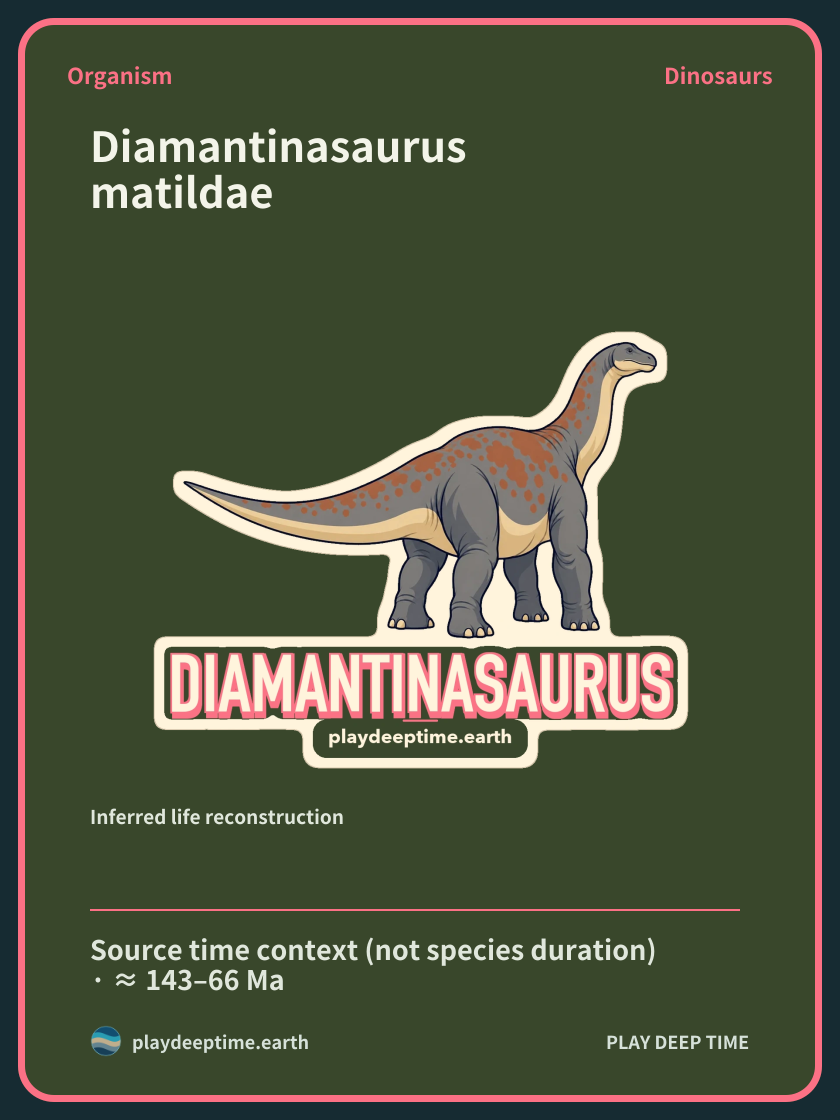
Inferred life reconstruction
Diamantinasaurus matildae
Overview
Diamantinasaurus matildae is an Australian sauropod that supported its body on four robust legs. The reference specimen preserves shoulders, a pelvis, limbs, and hand bones. It is a useful dinosaur for examining the structures supporting a giant body.[1]
Loading illustration…
Key facts
The hands of a large dinosaur can be examined like small columns supporting the body. The forefoot of Diamantinasaurus is reconstructed with several hand bones packed closely together. Attention is drawn not only to the enormous legs but also to the arrangement of the hands meeting the ground.[1]
Time and place
It is studied from Cretaceous material at Winton in present-day Queensland, Australia. It was described as a new dinosaur in a 2009 study. The Cretaceous spans roughly 140–66 million years ago.[1][2]
The time range describes source context, not the complete duration of this species.
Size, form and skeleton
AODF603 is described as preserving the shoulder skeleton, robust forelimbs and hind limbs, hands and pelvis, and some ribs and sacral material. This material allows several body-supporting regions to be compared together. The structures formed by the shoulders and hands, and by the pelvis and legs, are particularly striking.[1]
Diamantinasaurus is presented as having been about 15–16 m long from head to tail tip. This value appears in the Australian Museum's reconstruction account, with the long neck and tail making up a large part of the body length.[3]
Loading illustration…
Habitat and reproduction
The bones connecting shoulders to forelimbs and hands, and pelvis to hind limbs, invite exploration of how a large body was supported. The reference specimen of this dinosaur preserved material for studying these regions. A starting point for understanding the life of a large animal can also lie beneath its feet.[1]
Fossil discovery
Hocknull and colleagues described this species in 2009 while studying dinosaurs from Winton. The shoulders, limbs, hands, and pelvis of AODF603 provided the basis for the description of its form. Recording several regions together helped distinguish a new dinosaur.[1]
References
Research questions
How different were the hands and legs of large sauropods? Comparing the arrangement of hand bones, forelimbs and hind limbs, shoulders, and pelvis can reveal differences. Alongside impressions of the head and neck, body-supporting bones are important material for distinguishing dinosaurs.[1]
Observation
Move your gaze from the shoulders to the thick forelimbs and closely packed forefeet. Then examine the pelvis and hind limbs together to reveal more clearly the structures supporting this dinosaur's large body.[1]
Related organisms
 Nigersaurus taquetiDinosaursSource time context (not species duration) · ≈ 143–66 Ma
Different bodies among sauropods
Explore the bodies and living contexts of Diamantinasaurus matildae and Nigersaurus together. Diamantinasaurus matildae: Diamantinasaurus matildae is an Australian sauropod that supported its body on four robust legs. The reference specimen preserves shoulders, a pelvis, limbs, and hand bones. Nigersaurus: Nigersaurus taqueti is a sauropod dinosaur with teeth concentrated at the end of a broad snout. Its neck is relatively short compared with the long-necked dinosaurs of the same group.