Organism · Placental mammals
Dichobune leporina
Source time context (not species duration) · ≈ 38–27 Ma
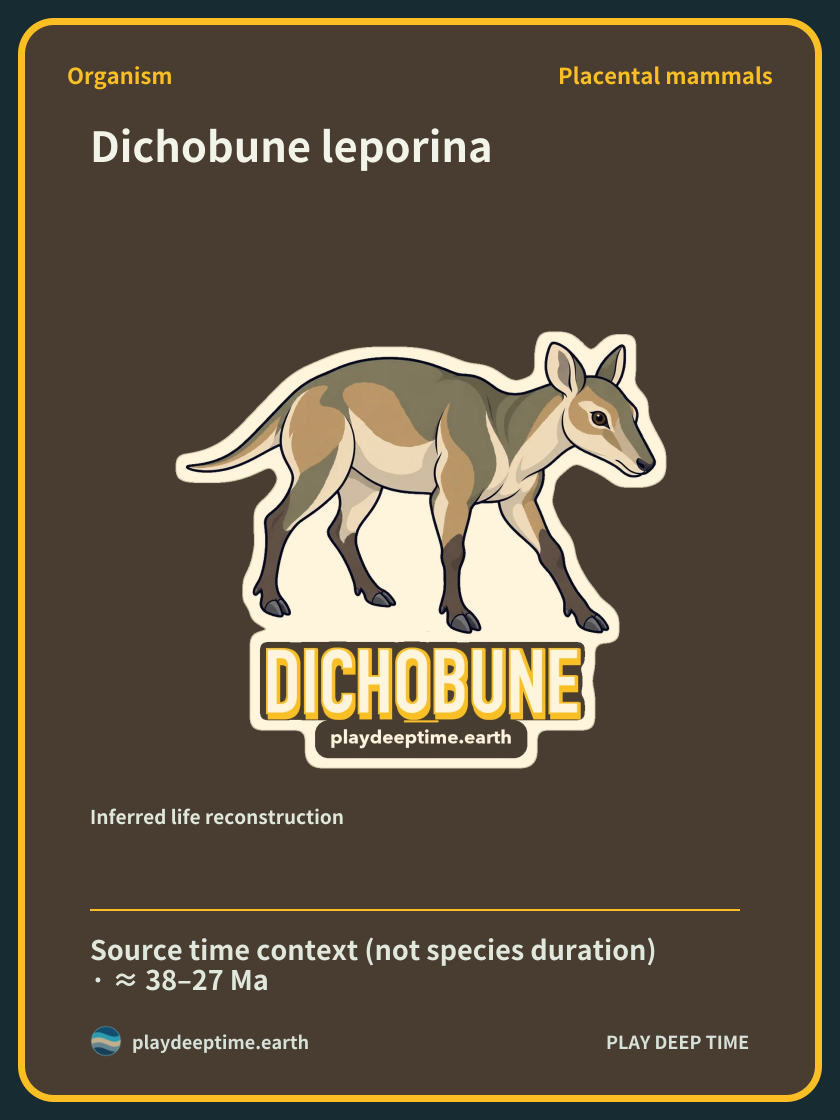
Inferred life reconstruction
Dichobune leporina
Overview
Dichobune leporina is an extinct mammal studied by comparing lower jaws, teeth, and cranial fossils. A few molars and old skeletal records provide clues to its appearance. Small fossils connect a long research history.[1][2]
Loading illustration…
Key facts
A lower jaw preserving just two molars can be used in comparative research. The left lower jaw NHMUK M1499 retains its second and third molars. Researchers recorded tooth positions and shapes together for comparison with other fossils.[1]
Time and place
Material from phosphate deposits at Caylux in present-day France has been studied. Registered fossil-bearing strata are summarized as a broad Eocene–Oligocene time window of approximately 38–27 million years ago. Fossils from different regions and strata are compared to assess which material belongs under the same name.[1][2][3]
The time range describes source context, not the complete duration of this species.
Size, form and skeleton
Lower jaws and cranial material assigned to the species or tentatively compared with it are known. Dichobune heads are described as having elongated skulls and rounded braincases. Different features conveyed by cranial outlines and molars can be explored side by side.[1][2]
The small molars of Dichobune leporina also provide size clues. The third lower molar of specimen ACQ1 from Quercy, France, measures 8.1 mm long and 5.1 mm wide. Its chewing surface fits within a length of less than 1 cm.[9]
Loading illustration…
Habitat and reproduction
Comparisons of feet and limbs form another branch of research alongside skulls and teeth. Literature describing Dichobune also compares foot bones and limb structures of other early mammals. Questions about the body change when legs are considered alongside the head.[2]
Fossil discovery
An old articulated drawing by Cuvier survives for the forefoot of Dichobune. Although the original specimen is described as lost, the drawing and later records remain in research history. Study continues by examining surviving jaw fossils alongside old records.[2]
References
- 2012 study — Eocene mammals and comparisons of the mandible of Dichobune
- Dichobune — Comparison of skulls and historical skeletal material
- Paleobiology Database — Fossil-bearing strata of Dichobune
- Fournier et al.2020 — Classification and ankle bones of Cynodictis
- 2025 study — The skull of Cynodictis
- 2012 study — Eocene mammals and comparisons of the mandible of Dichobune
- Dichobune — Comparison of skulls and historical skeletal material
- Paleobiology Database — Fossil-bearing strata of Dichobune
- Harrison et al. (2012) — New additions to the late middle Eocene mammal fauna of Creechbarrow, Dorset, southern England
Research questions
What does a small lower jaw reveal compared with an old drawing of a foot? Comparing tooth shapes and examining limb arrangement answer different questions. Reading several kinds of records separately reveals the long history of Dichobune research.[1][2]
Observation
Move your gaze from the elongated head outline to the molars at the back of the lower jaw. Then imagine the legs and feet to understand how cranial features and limb arrangement are studied separately.[1][2]
Related organisms
 Cynodictis lacustrisPlacental mammalsSource time context (not species duration) · ≈ 33.9–23 Ma
Mammals of Eocene and Oligocene France
Connect Cynodictis and Dichobune fossils to explore different records from Eocene–Oligocene France. Studies of skulls and teeth from separate localities and independently discovered Cynodictis ankle bones broaden the story of ancient mammals.