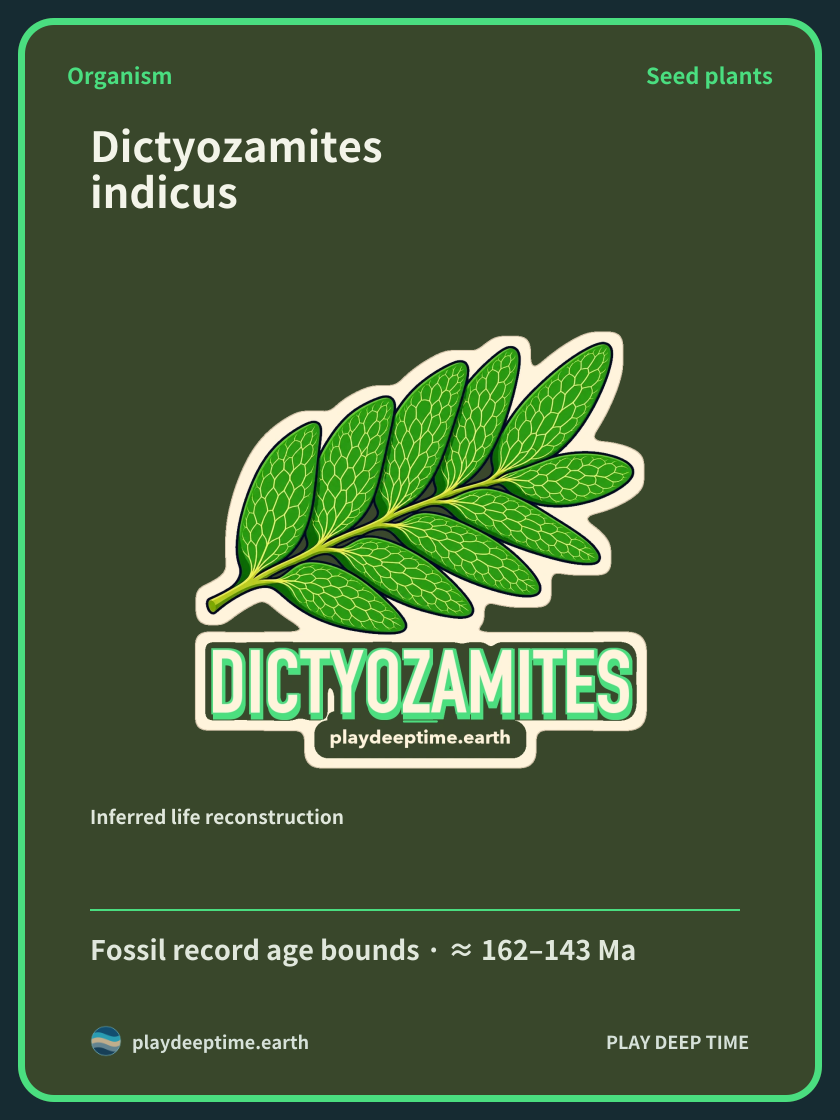
Organism · Seed plants
Dictyozamites indicus
Fossil record age bounds · ≈ 162–143 Ma
Inferred life reconstruction
Dictyozamites indicus
Overview
Dictyozamites indicus is a fossil plant encountered through pinnate foliage and net-like venation. A 2014 study described a single leaf impression, BSIP 40160.[1]
Loading illustration…
Key facts
The veins within each pinna connect like a small net. Following veins from the base as they branch and rejoin is part of the interest in observing this specimen.[1]
Time and place
This specimen came from Ommevaram, formerly Vemavaram, in present-day Andhra Pradesh, India. Described as Early Cretaceous material of the Vemavaram Formation, it reveals the plant world of the earlier Cretaceous.[1]
The time range describes source context, not the complete duration of this species.
Size, form and skeleton
Slender, elongated pinnae are closely spaced and overlap slightly. Their bases are described as asymmetrical, their tips rounded, and their margins smooth.[1]
In Dictyozamites indicus, small leaf divisions attach to either side of a central axis, forming a feather-like appearance. Leaf fossil BSIP 40160 studied from India’s Vemavaram Formation was reported as approximately 5 cm long and 2 cm wide.[4]
Loading illustration…
Habitat and reproduction
Research into the ancient environment does not end with large leaf fossils. The paper compared regional floras and also treated pollen, spores, phytoplankton, and foraminiferal evidence.[1]
Fossil discovery
The studied leaf impression survives in hard yellow and purple shale. Following specimen number BSIP 40160 connects the described leaf with its internal vein pattern as one piece of evidence.[1]
References
- Chinnappa·Rajanikanth·Rao (2014) — Plant diversity and environment of the Vemavaram Formation
- Study of the Gangapur Formation — Leaves of Ptilophyllum cutchense
- Chinnappa·Rajanikanth·Rao (2014) — Plant diversity and environment of the Vemavaram Formation
- Study of plant diversity and palaeoenvironment of the Vemavaram Formation (2013)
Research questions
How can leaves bearing the same name be compared? The researchers discussed classification by comparing this specimen’s overall form with leaf material previously reported from Rajmahal and Vemavaram. They also described it as common in the Rajmahal Formation but rare in India’s east-coast basins.[1]
Observation
Follow the pinnae extending to either side of the central axis. Moving outward from the base of a pinna, find where veins fork and connect into a network.[1]
Related organisms
 Ptilophyllum cutchenseSeed plantsFossil record age bounds · ≈ 201–110 Ma
Different leaves from Early Cretaceous India
Compare Early Cretaceous plant records from India through their venation. The parallel veins of Ptilophyllum and the net-like veins of Dictyozamites provide different clues to recognizing leaves. The two records come from separate localities in present-day Telangana and Andhra Pradesh, India.