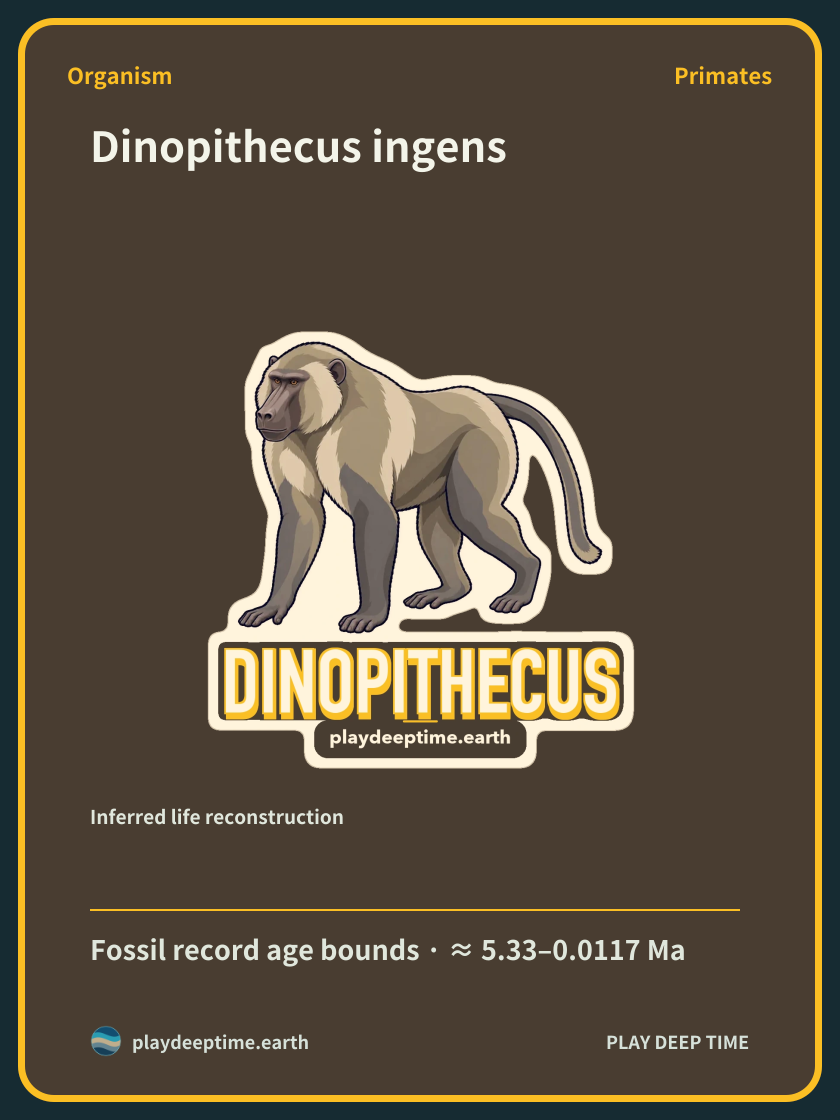
Organism · Primates
Dinopithecus ingens
Fossil record age bounds · ≈ 5.33–0.0117 Ma
Inferred life reconstruction
Dinopithecus ingens
Overview
Dinopithecus ingens is a baboon-like Old World monkey studied from fossils at Schurweberg, South Africa. A lower jaw and partial skull are known. Comparing head bones helps investigate the classification of this ancient monkey.[1]
Loading illustration…
Key facts
A 2026 reassessment examines the type lower jaw and a compressed partial skull from Schurweberg. Even a fossil named long ago can become the starting point for a new comparison.[1]
Time and place
The fossil locality is Schurweberg, South Africa. Research gives differing ages, placing it in either the Late Pliocene or Middle Pleistocene. The Pliocene and Pleistocene together span approximately 5.3 million to 12,000 years ago, while the specimen’s narrower age remains a research question.[1][2]
The time range describes source context, not the complete duration of this species.
Size, form and skeleton
The type material includes a lower jaw and partial skull. The author describes it as a baboon-like Old World monkey. Examining the jaw and skull separately reveals which parts provide the basis for that comparison.[1]
One ecological study treated Dinopithecus ingens as having an average adult body mass of approximately 37.5 kg. The researchers used estimates of about 46 kg for males and 29 kg for females, also considering the size difference between the sexes.[3]
Loading illustration…
Habitat and reproduction
How can an ancient monkey’s jaw help distinguish closely related forms? The research includes comparing type material from Schurweberg alongside material from other localities. It explores the limits of a species by reading small differences in the head.[1]
Fossil discovery
Dinopithecus is a genus established by Broom in 1937. Later reassessments reexamined the Schurweberg type material. The reference material for an old name continues to play a central role in new comparative studies.[1]
References
- Study reassessing the type specimen and classification of Dinopithecus
- International Commission on Stratigraphy (2024) — Geological time chart
- Bettridge·Dunbar (2012) — Models of the ecology and distribution of fossil baboons
- Beard et al.2009 — Ganlea, a primate from Myanmar
- 2020 study — Cranial and postcranial bones of amphipithecids
Research questions
How can a skull compressed underground be distinguished from its original form? Considering the preserved parts together with their deformation makes questions of shape comparison more specific. Fossil preservation is also part of taxonomic research.[1]
Observation
Narrow your gaze from the overall impression of the head to the lower jaw. Considering both the surviving and compressed parts of the type specimen helps follow the perspective of researchers comparing fossils.[1]
Related organisms
 Ganlea megacaninaPrimatesSource time context (not species duration) · ≈ 56–33.9 Ma
Different bodies among primates
Explore the bodies of Dinopithecus ingens and Ganlea megacanina together. Dinopithecus ingens: Dinopithecus ingens is a baboon-like Old World monkey studied from fossils at Schurweberg, South Africa. Ganlea megacanina: Ganlea megacanina is an Eocene primate with strikingly large lower canine teeth.