Organism · Placental mammals
Diplobune secundaria
Source time context (not species duration) · ≈ 56–33.9 Ma
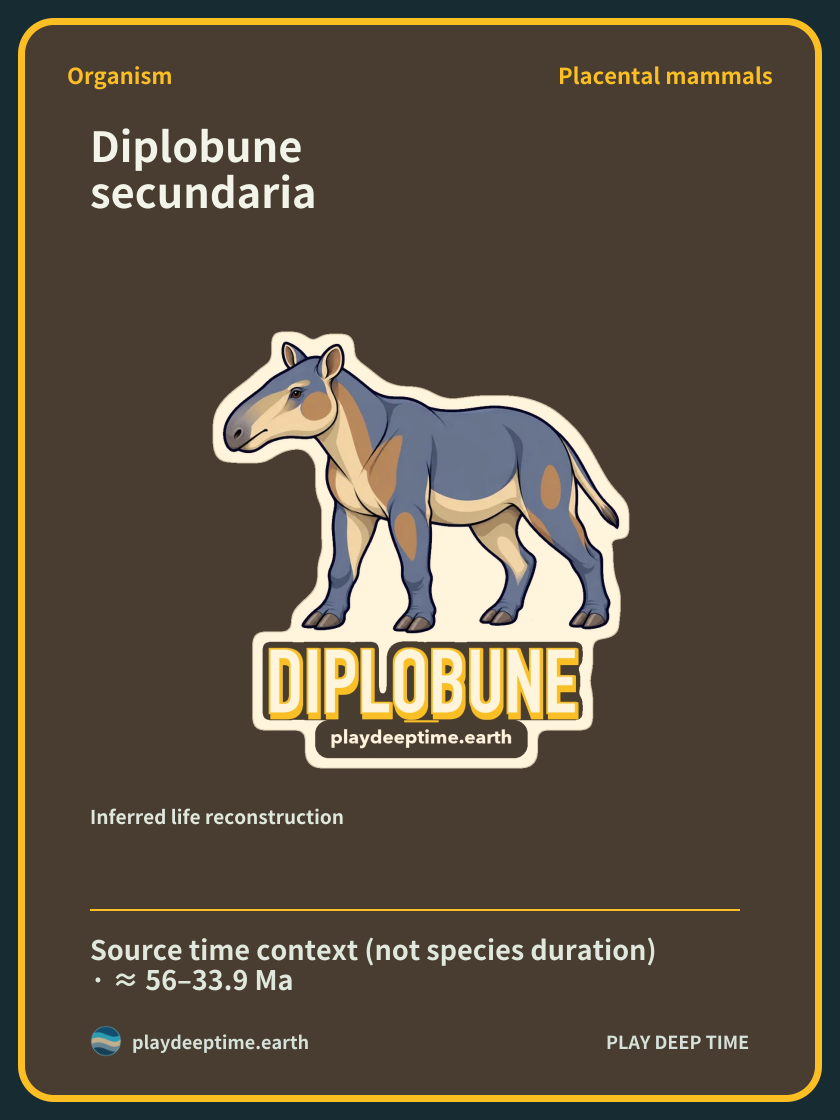
Inferred life reconstruction
Diplobune secundaria
Overview
Diplobune secundaria is a latest Eocene mammal with a long, heavy head. An adult skull discovered in present-day France became important evidence for understanding its face. Its teeth and snout invite investigation of plant feeding.[1]
Loading illustration…
Key facts
What tongue lay inside the long snout? Researchers inferred a long, slender tongue from the shape of its snout bones. This intriguing hypothesis compared it with a giraffe’s tongue stripping leaves from thorny branches.[1]
Time and place
This animal lived near the end of the Eocene, approximately 34 million years ago. Its important skull came from Saint-Capraise-d’Eymet in Dordogne, present-day France. This is an MP20 fossil locality associated with a lake-limestone quarry.[1]
The time range describes source context, not the complete duration of this species.
Size, form and skeleton
A long, heavy skull and rounded front snout are characteristic. Low, robust molars were studied as structures for processing tough plants. The researchers’ body reconstruction estimates were approximately 2 m long and 1.2 m at shoulder height.[1]
Loading illustration…
Habitat and reproduction
The authors interpreted it as a herbivore that cropped and chewed tough vegetation such as leaves and twigs. Low, robust molars and an elongated snout were linked to this lifestyle. Possible use of a long tongue was also proposed from skull shape.[1]
Fossil discovery
In 2000, Leroux discovered a well-preserved adult skull at Saint-Capraise-d’Eymet. Researchers described a head reconstruction that restored missing teeth and the lower jaw, then successively added muscles, cartilage, eyes, and skin. This documents inference from bones to a living face.[1]
References
Research questions
What foods did the long snout process? Tooth form, snout bones, and muscle attachment sites are compared together. This reveals the reasoning used to infer soft parts such as tongue and lips from hard bones.[1]
Observation
Move your gaze from the outline of the elongated head to the front snout and rear molars. Considering head shape alongside plant-chewing teeth brings its lifestyle closer.[1]
Related organisms
 Uintatherium ancepsMammalsSource time context (not species duration) · ≈ 56–33.9 Ma
Different bodies among mammals
Explore the bodies and backgrounds of Diplobune secundaria and Uintatherium together. Diplobune secundaria is a latest Eocene mammal with a long, heavy head. An adult skull discovered in present-day France became important evidence for understanding its face. Uintatherium anceps is a mammal familiar for cranial projections and long canines. A Middle Eocene specimen from Colorado is presented.