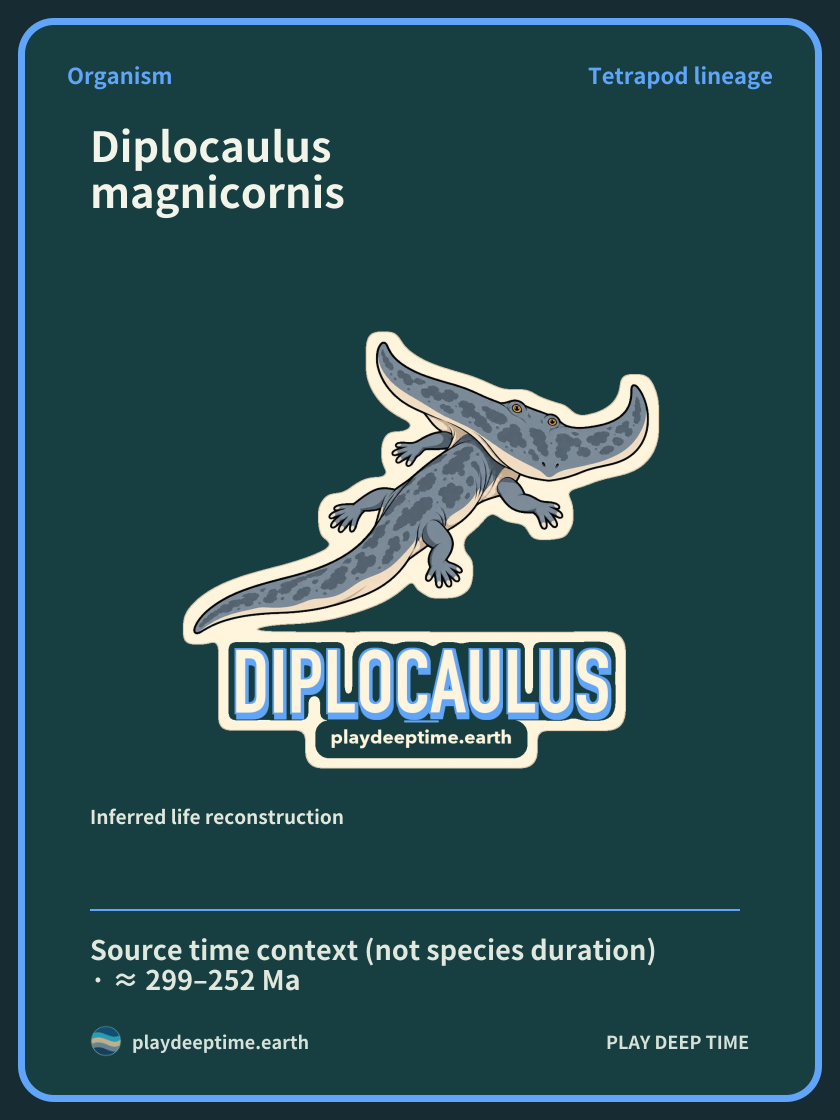
Organism · Tetrapod lineage
Diplocaulus magnicornis
Source time context (not species duration) · ≈ 299–252 Ma
Inferred life reconstruction
Diplocaulus magnicornis
Overview
Diplocaulus magnicornis was a Permian animal whose head extended far to either side, resembling a boomerang. Its broad, flattened skull attracts attention. Researchers have studied the role this unusual shape played in flowing water.[1][2][5]
Loading illustration…
Key facts
Even the head of a long-extinct animal can be tested in a wind tunnel. Researchers directed flow over models of the head and body of the genus Diplocaulus to examine the forces they experienced. It is an intriguing example of fossil form leading to physical experiments.[5]
Time and place
A museum presents it as a Permian animal from around 275 million years ago. It is known from fossils in present-day North America. It reveals a world in which amphibian relatives had varied heads and bodies.[1]
The time range describes source context, not the complete duration of this species.
Size, form and skeleton
The skull is broad and flattened, with long projections extending to both sides. Research on the genus’s forefeet reported four fingers. Examining the head, trunk, and limbs together reveals the body of this unfamiliar animal.[1][2][3]
Loading illustration…
Habitat and reproduction
This animal is studied for the role its unusual head played underwater. Model experiments compared forces generated as flow met the head and body. They invite consideration of body form alongside the movement of surrounding water.[5]
Fossil discovery
Museum skull material shows the long projections on either side of the head. New comparisons continued after skeletal research and a 1917 forefoot study. A 2016 fluid-dynamics study explored the shape in another way by turning it into a model.[1][2][3][5]
References
- American Museum of Natural History — The boomerang-shaped head of Diplocaulus
- Smithsonian — Study of the Diplocaulus skeleton
- Douthitt1917 — The forefoot of Diplocaulus
- ICS geologic time chart2024/12
- Skews2016 — Fluid dynamics of extinct amphibians
- Schoch·Witzmann (2009) — The skeleton of Sclerocephalus
- 2019 study — The rediscovered type specimen of Sclerocephalus
- Witzmann (2009) — Comparative study of dermal bones in early tetrapods
- Approximate size comparison — Genus guide and reconstruction of Diplocaulus
Research questions
What forces might a boomerang-shaped head exert on the body in a flow? Varying head angle and body models allows possible functions to be compared. Research begins with bone form and asks about physical function.[5]
Observation
Follow the broad head from its center to the long tips on either side. Then move your gaze to the trunk and tail to see the proportions of this unusual head within the whole body.[1][2]
Related organisms
 Sclerocephalus haeuseriTetrapod lineageFossil record age bounds · ≈ 299–283 Ma
Heads and bodies of Paleozoic waterside animals
Examine the different records of bodies and time preserved in these two organisms. Diplocaulus: Diplocaulus magnicornis was a Permian animal with a broad, flattened head extending sideways like a boomerang. A museum presents it as dating to around 275 million years ago, and it is known from fossils in present-day North America. Sclerocephalus haeuseri: a Paleozoic temnospondyl known from robust postcranial bones. Studies of adult Sclerocephalus describe a long trunk and a laterally flattened tail. It is known from Lower Rotliegend material in the Saar–Nahe Basin of present-day southwestern Germany. Research on the genus concerns the world around 300 million years ago, from the latest Carboniferous to the earliest Permian.