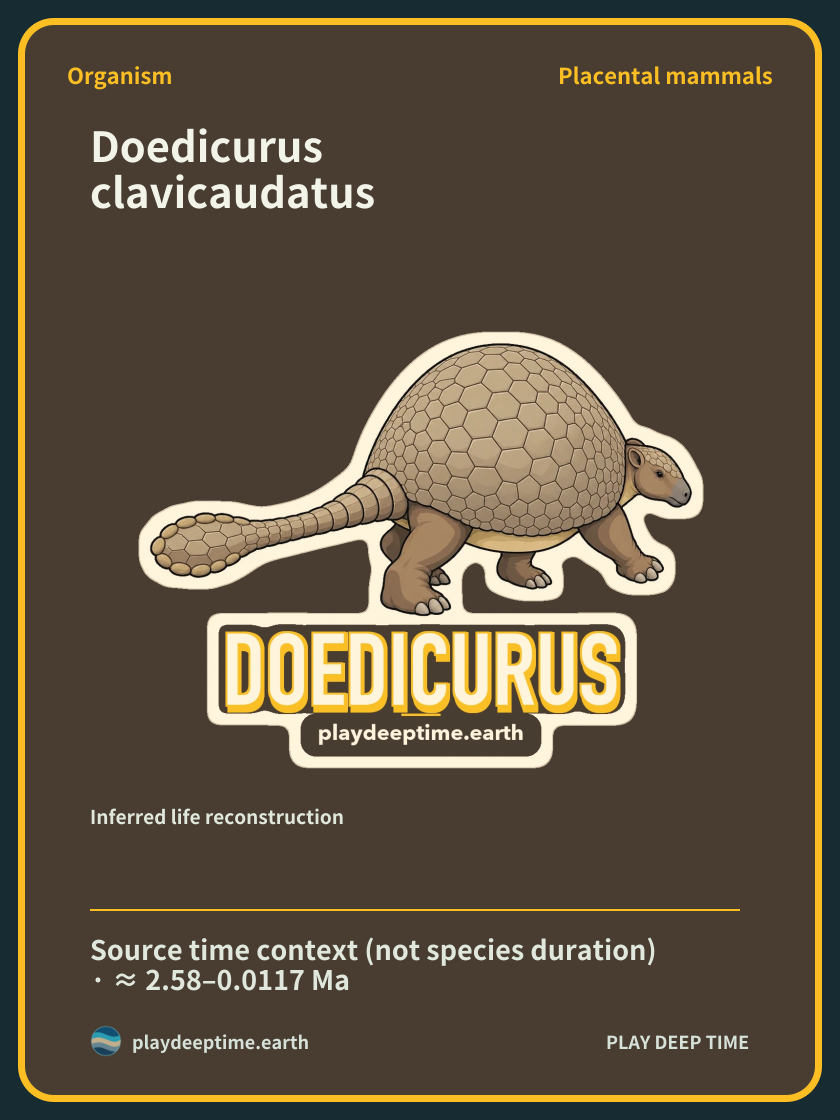
Organism · Placental mammals
Doedicurus clavicaudatus
Source time context (not species duration) · ≈ 2.58–0.0117 Ma
Inferred life reconstruction
Doedicurus clavicaudatus
Overview
Doedicurus clavicaudatus is a glyptodont with a large armored body and an expanded tail tip. Its short forelimbs and sturdy hind limbs have been studied together. It invites questions about how its rigid body and tail moved.[1][2]
Loading illustration…
Key facts
Not every line in the tail armor was a joint that moved in the same way. Movable rings lay close to the body, while the end formed a rigid tube. Flexible and rigid regions thus occurred within the same tail.[1]
Time and place
This animal is known from Pleistocene South America. The Pleistocene spanned approximately 2.6 million–12,000 years ago. It offers a chance to explore the body of a giant armored mammal with extensive armor and a rigid tail.[2]
The time range describes source context, not the complete duration of this species.
Size, form and skeleton
The tail tip is flattened and broadly expanded. A rigid tail tube follows movable rings near the body. Short functional forelimbs and robust hind limbs have been compared as structures supporting the large body.[1][2]
The estimated body mass based on specimen MLP16-24 is approximately 1.47 tonnes.[14]
Loading illustration…
Habitat and reproduction
This animal provides a way to study the body of a giant plant-eating armored mammal. Its weight-bearing limbs and heavy tail are compared together. They invite exploration of how a large animal with a rigid body moved.[2][1]
Fossil discovery
Tail armor MNHN2205 in a museum collection is described as having movable rings and a rigid terminal region. A 2009 study treated such tails as biological hammers and investigated their center of percussion. A study comparing limb proportions and function followed in 2011.[1][2]
References
- Blanco et al.2009 — The center of percussion of biological hammers
- Vizcaíno et al.2011 — Limb proportions and function in glyptodonts
- 2018 study — Comparison and history of descriptions of Glyptodon and Glyptotherium
- International Commission on Stratigraphy (2024) — Geological time chart
- American Museum of Natural History — Bony armor of glyptodonts
- Vizcaíno et al.2011 — Limb proportions and function in glyptodonts
- Blanco et al.2009 — The center of percussion of biological hammers
- Natural History Museum — The story of Toxodon
- International Commission on Stratigraphy (2024) — Geological time chart
- Owen (1837) — First description of Toxodon platensis
- Liendo Lazarte (1941) — Comparative anatomy of Toxodon
- Vizcaíno et al.2011 — Limb proportions and function in glyptodonts
- Blanco et al.2009 — The center of percussion of biological hammers
- Ameghiniana 48(3):305–319 — Body-mass comparisons of glyptodonts
Research questions
How might a rigid tail have worked like a hammer? Researchers calculate possible functions from the distribution of mass and the shape of the tail. They also investigate the possibility of keratinous spikes or pads on rough areas of the expanded tip.[1]
Observation
Move your gaze from the tail rings near the body to the rigid tube and expanded tip. Considering differences between the forelimbs and hind limbs helps reveal the structure of the large armored body.[1][2]
Related organisms
 Glyptodon clavipesPlacental mammalsSource time context (not species duration) · ≈ 2.58–0 Ma
Armor in Pleistocene South America
Glyptodon and Doedicurus are two subjects through which to explore the armored mammals of Pleistocene South America. Expand your observations from the story of Glyptodon’s name and reference fossils to the armored body and expanded tail tip of Doedicurus.
 Toxodon platensisPlacental mammalsSource time context (not species duration) · ≈ 2.58–0.0117 Ma
Heads and armor in Pleistocene South America
Explore the long, low head of Toxodon alongside the armored body of Doedicurus. Compare different mammalian bodies within the broad time and region of Pleistocene South America.