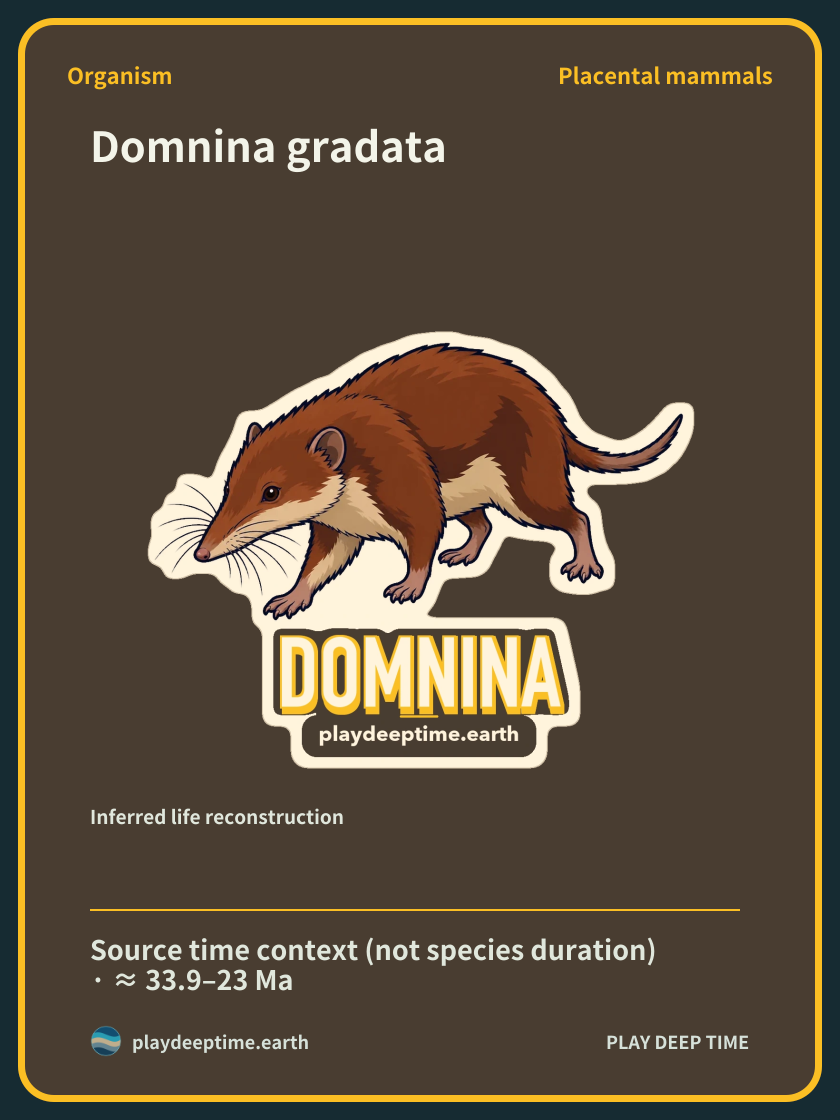
Organism · Placental mammals
Domnina gradata
Source time context (not species duration) · ≈ 33.9–23 Ma
Inferred life reconstruction
Domnina gradata
Overview
Domnina gradata is a small Early Oligocene mammal. Its skull, lower jaw, and an articulated forelimb are known together. It is an intriguing fossil connecting the head and body of a small animal.[1]
Loading illustration…
Key facts
How did the lower jaw articulate with the skull? A double jaw joint is described in Domnina. Even a small joint not obvious from the outside is an important feature for studying mammalian relationships and bodies.[1]
Time and place
It is an Early Oligocene mammal from around 33 million years ago. An important specimen came from the Brule Formation near Douglas in Converse County, present-day Wyoming, USA. It reveals a small body from a time when many mammals flourished.[1]
The time range describes source context, not the complete duration of this species.
Size, form and skeleton
Specimen UW57130 preserves a skull, lower jaw, and left forelimb in association. The end of the right humerus also survives. The incomplete zygomatic arch, jaw joint, and arm bones can be compared together.[1]
The estimated body mass is approximately 37 g. The fossil-based estimate evokes the build of a small mammal weighing only a few tens of grams.[5]
Loading illustration…
Habitat and reproduction
The forelimb associated with the head provides evidence for studying this small mammal’s life. The number and size of lower-jaw premolars were compared with other Domnina species. Examining jaw and arm together explores food-handling structures and movement.[1]
Fossil discovery
The researchers described the skull, jaw, and associated forelimb of specimen UW57130 together. Comparisons of teeth with other Domnina species helped identify the animal. When head and body remain connected, more questions can be explored than with isolated bones alone.[1]
References
- Origins of shrews and the head and forelimbs of Domnina
- Leidy — Description of the skull and teeth of Agriochoerus
- Coombs1983 — Comparing large herbivores with claws
- Origins of shrews and the head and forelimbs of Domnina
- Smits (2017), Remodeling the Fossil Record: Analysis of Emergent Evolutionary and Ecological Patterns
Research questions
Which features of a small skull reveal close relatives? The jaw joint, zygomatic arch, and teeth are compared together. A specimen associated with a forelimb also allows changes in the head and body structure to be studied side by side.[1]
Observation
Move your gaze from the small head to the lower jaw, shoulder, and forelimb. Consider how connected bones help us understand the body of one animal.[1]
Related organisms
 Agriochoerus antiquusPlacental mammalsSource time context (not species duration) · ≈ 40–32 Ma
Early Oligocene mammals of the Brule Formation
Agriochoerus and Domnina are known from Early Oligocene material in the Brule Formation. Through different specimens from present-day South Dakota and Wyoming, USA, examine head and dental structures alongside the forelimb structure of a small mammal.