Organism · Placental mammals
Ectoconus ditrigonus
Source time context (not species duration) · ≈ 66–56 Ma
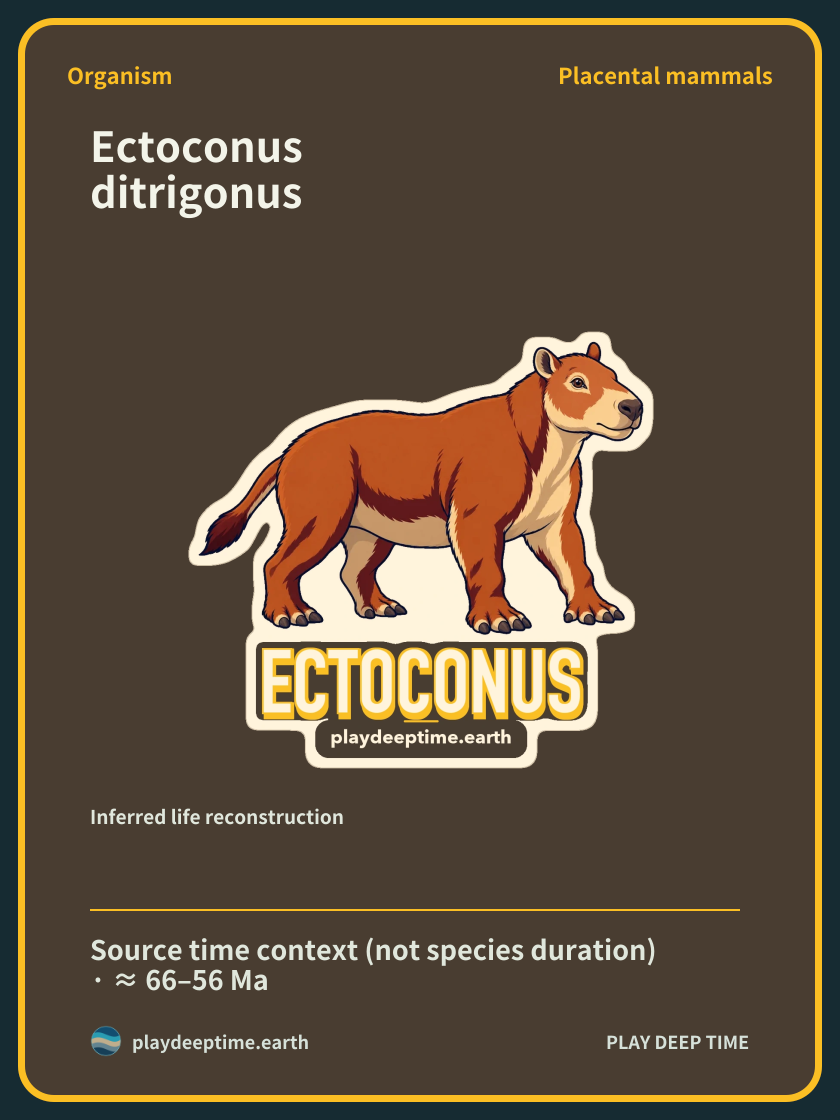
Inferred life reconstruction
Ectoconus ditrigonus
Overview
Ectoconus ditrigonus is an ancient mammal from the groups that diversified in North America after the dinosaur extinction. It evokes a sturdy, sheep-sized animal. Such unfamiliar groups lived on land before today’s familiar hoofed animals appeared.[3][2]
Loading illustration…
Key facts
The name-bearing specimen is a tooth-bearing fragment of lower jaw, not a large skeleton. Later comparisons with more extensive skeletal material clarified the relationships among several names. A name that began with a tooth became linked to the story of an entire body.[1]
Time and place
Picture early Paleocene North America in the few million years after the mass extinction around 66 million years ago. Sites in the western USA, especially the San Juan Basin in present-day New Mexico, provide important material. It belonged to the mammalian world that emerged after a major change.[1][2]
The time range describes source context, not the complete duration of this species.
Size, form and skeleton
Research and educational sources describe a sheep-sized terrestrial animal. Comparative specimens preserve skulls and nearly complete skeletons as well as jaws and molars. This early Paleocene mammal offers substantial material for connecting limbs with the trunk.[1][3]
Ectoconus ditrigonus was a large mammal that appeared in the early Paleocene after the end-Cretaceous mass extinction. A study of the fauna of the San Juan Basin in present-day New Mexico, USA, reported body-mass estimates reaching 100 kg. It illustrates how rapidly mammals grew larger after the age of dinosaurs ended.[10]
Loading illustration…
Habitat and reproduction
It is described as a mainly plant-eating terrestrial animal. Molar form offers clues to how it cut or crushed food. Its story also connects with research into the foods mammals used as plant communities changed after the dinosaur extinction.[3][2]
Fossil discovery
A 2004 taxonomic reassessment compared the species’ reference lower jaw with skeletons previously given other names. Specimens such as AMNH16500, preserving both head and body material, were used in this process. Reexamining old museum collections can reveal new relationships.[1]
References
- Lucas & Kondrashov (2004) · Taxonomic Revision of the Genus Ectoconus (Mammalia, Periptychidae) from the Paleocene of the Western United States · New Mexico Museum of Natural History and Science Bulletin 26
- AMNH — Paleocene environments and Ectoconus
- Science in the Classroom — Exceptional record of biotic recovery after the K–Pg mass extinction
- Clemens2011 — Teeth and Paleocene distribution of Eoconodon
- Toosey et al.2024 — Skeletal comparisons of Triisodon and early mammals
- Denver Museum of Nature & Science — The story of mammalian recovery
- Williamson et al. (2015) — Study of early Paleocene ecosystems in the San Juan Basin
Research questions
Explore how tooth shapes can reveal diet. Considering the overall dental structure alongside wear on chewing surfaces brings food-processing methods into sharper focus. Ectoconus provides material for comparing changes in diet and body size among early mammals.[1][3]
Observation
After examining the head and jaws, broaden your gaze to the impression of a short, sturdy body.[1][3]
Related organisms
 Eoconodon coryphaeusPlacental mammalsSource time context (not species duration) · ≈ 66–63 Ma
Mammals of early Paleocene North America
Ectoconus and Eoconodon introduce the mammals of early Paleocene North America. Follow different material from places such as the San Juan Basin in present-day New Mexico, USA, to explore the mammalian world after the dinosaur mass extinction.